Pevita Pearce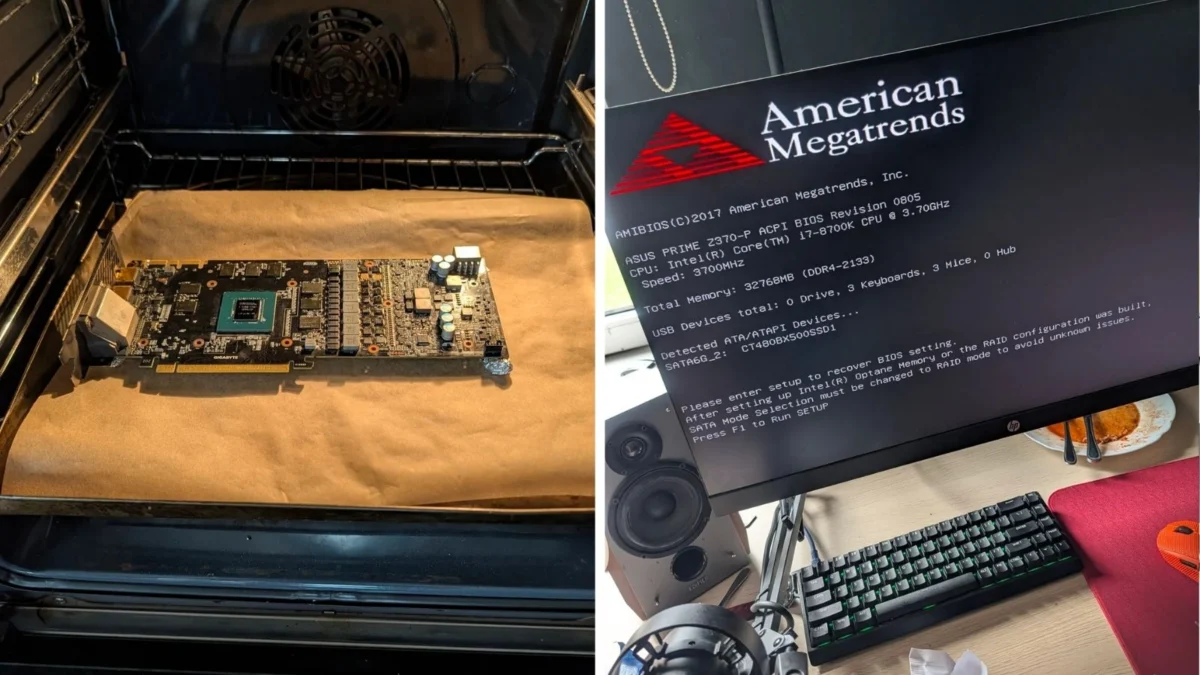
The pursuit of hardware longevity often leads PC enthusiasts to explore unconventional, and sometimes hazardous, repair methods when standard troubleshooting fails. In a recent case that has captured the attention of the global gaming community, a Reddit user operating under the handle u/WilczeQSS documented a successful, albeit controversial, attempt to resurrect a dying Gigabyte GTX 1080 graphics card by placing the component inside a conventional kitchen oven. This "oven-baking" method, while rooted in years of community folklore, highlights the lengths to which users will go to maintain aging hardware in an era of high component costs and planned obsolescence.
The graphics card in question, a Gigabyte variant of NVIDIA’s Pascal-based GTX 1080, had reached a critical failure state after eight years of service. The user reported that the device began exhibiting classic symptoms of hardware degradation, including severe visual artifacts—distorted lines and colors appearing on the screen—and frequent system crashes resulting in "black screens of death." Before resorting to extreme measures, the owner attempted a series of standard maintenance procedures. These included cleaning the PCB (Printed Circuit Board), reapplying high-quality thermal paste to the GPU die, replacing worn thermal pads on the VRAM and VRM components, and performing clean installations of the latest NVIDIA drivers. When these conventional efforts failed to yield results, the card was deemed functionally "dead," prompting the user to attempt the high-risk baking technique as a last resort.
The Technical Execution and Chronology of the Repair
The process of baking a graphics card is not a task to be undertaken lightly, as it involves the precise application of heat to sensitive electronic components. The Reddit user documented a systematic approach to the procedure. First, the card was entirely stripped of its cooling shroud, fans, and any plastic or rubber components that could melt or catch fire at high temperatures. The bare PCB was then propped up on small balls of aluminum foil to ensure it was level and that air could circulate underneath the board, preventing direct contact with the baking tray which could cause uneven heating or localized scorching.
Initially, the user set the kitchen oven to 190°C (approximately 374°F) and baked the card for a duration of 10 minutes. After allowing the hardware to cool slowly to room temperature—a critical step to prevent thermal shock—the card was reassembled and tested. In a subsequent update to the original post, the user noted that while 190°C provided a successful result in this specific instance, technical consensus often suggests that temperatures closer to 210°C or 220°C are required to affect the solder. Against the expectations of many skeptics, the GTX 1080 booted successfully, displayed a clean image without artifacts, and passed initial stress tests.
The Scientific Reality: Reflow vs. Thermal Expansion
The "oven trick" is often discussed in hardware forums as a way to "reflow" solder. To understand why this is a technical misnomer, one must look at the metallurgy of modern electronics. Since the mid-2000s, the electronics industry has moved away from lead-based solder due to environmental regulations like the RoHS (Restriction of Hazardous Substances) directive. Modern components utilize lead-free solder alloys, such as SAC305 (Tin-Silver-Copper), which typically have a melting point of approximately 217°C (422°F).
For a true "reflow" to occur—where the solder transitions back to a liquid state to bridge cracks in a joint—the temperature must be sustained slightly above this melting point for a specific duration, following a precise thermal ramp-up and cool-down profile. Household kitchen ovens are notoriously inaccurate, often fluctuating by 10 to 20 degrees, and lack the targeted infrared or convection precision found in professional SMT (Surface Mount Technology) reflow ovens.
Tech experts and engineers suggest that most "oven successes" are not actually the result of solder reflowing. Instead, the phenomenon is attributed to thermal expansion. Over years of gaming, a GPU undergoes thousands of thermal cycles (heating up during play and cooling down afterward). This causes microscopic mechanical stress on the internal connections within the GPU silicon package itself, known as "bumps" or "wire bonds." When the card is baked, the materials expand and warp slightly, which can physically push a broken connection back into contact. While this restores functionality, it is rarely a permanent fix. Once the card returns to its regular cycle of heating and cooling, the materials will eventually shift again, causing the connection to fail once more.
Historical Context and the Legacy of the GTX 1080
The GTX 1080 holds a significant place in PC gaming history. Launched in May 2016, it represented one of the largest generational leaps in performance in NVIDIA’s history. Built on the 16nm FinFET process, the Pascal architecture offered unprecedented power efficiency and performance. Even eight years later, the GTX 1080 remains a capable card for 1080p and 1440p gaming, which explains why owners are so desperate to keep them running.
This is not the first time the "oven fix" has gained mainstream attention. The technique first rose to prominence during the late 2000s, specifically addressing the high failure rates of the NVIDIA GeForce 8800 series and the early "Red Ring of Death" issues associated with the Xbox 360. In those instances, the failures were often linked to the transition to lead-free solder and the early challenges of BGA (Ball Grid Array) packaging. The fact that users are still utilizing these "MacGyver-style" repairs in 2024 speaks to a broader issue in the consumer electronics market regarding the lack of affordable, professional repair options for out-of-warranty components.
Health, Safety, and Environmental Hazards
While the Reddit community celebrated the revival of the hardware, many users were quick to issue stern warnings regarding the health risks associated with baking electronics in a food-preparation environment. Modern PCBs are composed of various chemicals, including flame retardants (such as brominated flame retardants), epoxies, and residual flux.
When heated to temperatures exceeding 190°C, these materials can "outgas," releasing toxic vapors into the oven’s interior. These chemicals can settle on the oven walls and potentially contaminate food cooked in the appliance later. The user who performed the repair acknowledged these concerns in a post-script, stating that they performed a "deep clean" of the oven following the procedure. However, health experts generally advise against using any oven for food after it has been used to heat electronic components, suggesting instead the use of a dedicated toaster oven in a well-ventilated outdoor area or garage.
Professional Analysis of the "Zombie" Fix
Industry analysts view the oven-baking method as a "zombie fix"—it brings the dead back to life, but the hardware is essentially on borrowed time. Statistics from various hardware repair communities suggest that "baked" cards typically fail again within a few weeks to a few months.
"The fundamental problem with the oven method is that it is a blunt instrument for a surgical problem," says one independent hardware analyst. "If the issue is a fractured solder ball under the GPU, the only real fix is a professional ‘reballing’ procedure, which involves removing the chip entirely, cleaning the pads, and applying new solder spheres using a stencil and a professional rework station. Baking the whole board stresses every component, including capacitors and memory chips, which are not designed to be baked in that manner."
The Broader Impact on Right to Repair
The story of the oven-baked GTX 1080 highlights the ongoing "Right to Repair" debate. As graphics cards have become increasingly expensive—with modern flagship equivalents often exceeding $1,000—the secondary market and the repairability of older cards have become more vital to the average consumer. Most manufacturers offer a standard three-year warranty, leaving users with few options once that period expires.
Professional repair shops that specialize in micro-soldering and GPU repair are rare and often charge fees that approach the used market value of the card itself. This creates a vacuum where consumers feel forced to choose between discarding a high-value item or attempting dangerous DIY repairs.
The successful revival of the eight-year-old Gigabyte card is a testament to the resilience of the Pascal architecture and the ingenuity of the PC gaming community. However, it also serves as a cautionary tale. While u/WilczeQSS managed to squeeze more life out of their hardware, the risks of fire, toxic exposure, and permanent hardware destruction remain high. For now, the "oven trick" remains a legendary, if polarizing, part of PC enthusiast culture—a final, desperate gamble against the inevitable march of hardware failure.




 Jia Lissa
 Yuyun Lusiyani
 Joko Widodo
 Eva Lovia