
 Jia Lissa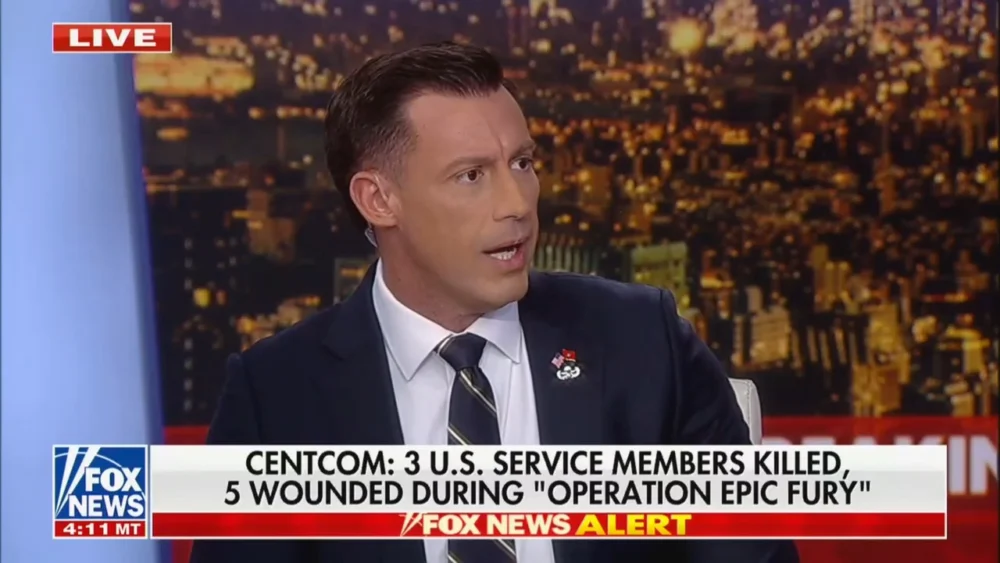
The landscape of American foreign policy shifted dramatically this week following a joint U.S.-Israeli military operation that resulted in the death of Iranian Supreme Leader Ali Khamenei, an event that triggered immediate Iranian retaliation and the loss of three American service members. In the wake of these events, Fox News host and combat veteran Joey Jones utilized his platform on "The Big Weekend Show" to deliver a poignant message to the American public, specifically addressing the "Make America Great Again" (MAGA) constituency. Jones, a retired Marine who lost both legs in Afghanistan, argued that questioning the necessity and imminence of war is not an act of disloyalty but a fundamental right and responsibility of the citizenry, particularly when American lives are at stake.
The veteran’s remarks came shortly after President Donald Trump released a pre-taped address to the nation, in which he confirmed the deaths of the three service members and vowed to "avenge" their sacrifice. The escalating conflict marks one of the most significant military developments in the Middle East in decades, raising profound questions about the legal authority of the executive branch, the strategic objectives of the current administration, and the potential for a prolonged regional war.
The Perspective of a Combat Veteran
Joey Jones’s commentary carries significant weight within the conservative media landscape due to his personal history of service and sacrifice. Having served as an Explosive Ordnance Disposal (EOD) technician in both Iraq and Afghanistan, Jones suffered life-altering injuries that resulted in the loss of both legs above the knee. His perspective on Sunday was rooted in the reality of combat, emphasizing that while military service involves an inherent understanding of risk, the sudden transition to active warfare requires clear communication from the government to those who bear the burden of battle.
"It’s incumbent upon me to stop for a moment," Jones told his viewers. "I understand that three is a small number. But three lives lost, three Americans killed in action, is hundreds if not thousands of lives affected—really millions—for every American out there that understands what that is like."
Jones highlighted a critical distinction between the ongoing operations of the last two decades and the current situation. He noted that for many service members deployed in the region, the shift to a high-intensity conflict with a state actor like Iran happened without the traditional period of mental and familial preparation. "They didn’t know they were going to an active war," Jones said, acknowledging that while service members swear an oath to defend the nation, the American people deserve to understand the specific "imminent" threats that necessitate the shedding of American blood.
Chronology of the Escalation
The current crisis began with a series of intelligence reports indicating that the Iranian regime was preparing for significant strikes against U.S. assets and allies in the region. The Trump administration, working in close coordination with Israeli intelligence and military forces, authorized a high-stakes mission to eliminate the head of the Iranian state.
Saturday, Early Morning: The joint U.S.-Israeli operation was executed, successfully targeting Iranian Supreme Leader Ali Khamenei. President Trump addressed the nation via a pre-taped video, framing the strike as a defensive measure intended to prevent nuclear proliferation and eliminate immediate threats.
Saturday, Midday: Iran’s Islamic Revolutionary Guard Corps (IRGC) launched a retaliatory missile strike against U.S. positions. It was during this exchange that three U.S. service members were killed and several others were wounded.
Sunday Afternoon: President Trump released a second video message. In this address, he adopted a more aggressive tone, vowing that there would be "likely more American deaths" as the U.S. continues its operations, but promising that the fallen would be avenged through continued military pressure on the Iranian regime.
Sunday Evening: Joey Jones appeared on "The Big Weekend Show," calling for a national conversation regarding the strategic goals of the war and the transparency of the administration’s decision-making process.
Political and Legal Controversy
The administration’s decision to initiate a strike of this magnitude has sparked a firestorm on Capitol Hill. While Secretary of State Marco Rubio confirmed that the "Gang of Eight"—a bipartisan group of congressional leaders including the chairs and ranking members of the intelligence committees—was notified shortly before the strikes, many lawmakers argue that the notification was insufficient.
Critics from both sides of the aisle have raised concerns regarding the War Powers Resolution of 1973, which requires the President to consult with Congress before introducing U.S. Armed Forces into hostilities. The Trump administration has maintained that the strike was a lawful exercise of the President’s authority as Commander-in-Chief to protect U.S. personnel from an "imminent threat." However, the lack of a formal briefing for the full Congress has led to accusations of executive overreach.
The debate centers on the definition of "imminence." In his address, President Trump stated that the action was necessary to stop the Iranian regime from acquiring a nuclear weapon and to thwart planned attacks. Lawmakers are now demanding to see the underlying intelligence that prompted the decision, echoing Joey Jones’s sentiment that the public deserves to know "exactly what happened."
Supporting Data: The Stakes of Iranian Conflict
The human and economic costs of a full-scale conflict with Iran are substantial. According to Department of Defense data, the U.S. currently maintains approximately 30,000 to 40,000 troops across various bases in the Middle East, including significant presences in Iraq, Kuwait, and the United Arab Emirates. These personnel are now at an increased state of alert as Iran possesses one of the largest and most diverse missile arsenals in the region.
Historically, the U.S. has seen varying levels of casualty rates in Middle Eastern conflicts. During the height of the Iraq War, monthly casualties often reached triple digits. A direct conflict with a sovereign nation like Iran, which possesses a sophisticated military infrastructure compared to non-state insurgent groups, presents a different set of risks for U.S. forces.
Furthermore, the geopolitical implications are immense. Iran’s proximity to the Strait of Hormuz, a critical chokepoint through which approximately 20% of the world’s petroleum passes, means that any sustained naval conflict could lead to a global energy crisis. Analysts estimate that a total closure of the strait could cause oil prices to spike well above $150 per barrel, impacting economies worldwide.
Domestic Reactions and Public Sentiment
The reaction within the United States has been deeply polarized. Supporters of the administration’s "America First" policy argue that the death of Khamenei is a necessary blow to a regime that has funded terrorism and threatened U.S. interests for decades. They view the President’s decisive action as a restoration of American deterrence.
Conversely, anti-war advocates and some constitutional scholars express concern that the U.S. is being drawn into another "forever war" without a clear exit strategy. Joey Jones’s comments are particularly notable because they provide a "middle ground" for conservative voters who support the President but remain wary of military interventionism. By stating that it is "okay" for MAGA supporters to ask questions, Jones is attempting to decouple patriotism from blind adherence to executive military decisions.
"The American people should ask questions and demand answers when our blood is shed," Jones asserted. "It does not question President Trump’s wisdom in this. But, I think that should be a part of the conversation."
Strategic Implications and Future Outlook
The death of Ali Khamenei creates a power vacuum within the Iranian domestic hierarchy. While the IRGC remains a potent force, the loss of the Supreme Leader could lead to internal power struggles or, conversely, a radicalization of the remaining leadership. The U.S. intelligence community is currently monitoring for signs of civil unrest within Iran, as well as movements by Iranian proxies such as Hezbollah in Lebanon and the Houthi rebels in Yemen.
The Trump administration’s next steps will be critical. The vow to "avenge" the three service members suggests that further military strikes may be imminent. However, the administration must balance its military objectives with the need for domestic support and international legitimacy. The involvement of Israel in the initial strike further complicates the regional dynamic, as it ties U.S. military actions directly to the broader Arab-Israeli conflict.
As the nation mourns the loss of the three service members, the call for transparency remains at the forefront of the political discourse. Whether the administration will provide the "imminent threat" evidence demanded by Congress remains to be seen. In the meantime, the words of Joey Jones serve as a reminder that in a democracy, the cost of war is paid not just in treasury, but in the lives of citizens, and therefore, the justification for war must be clear, compelling, and subject to public scrutiny.
The coming weeks will likely see intensified debates over the scope of the Authorization for Use of Military Force (AUMF) and the role of Congress in declaring war. As the U.S. prepares for potential further escalations, the balance between national security and constitutional oversight will be tested to its limits. For the families of the fallen, and for the veterans like Jones who understand the true price of these decisions, the demand for answers is not just a political preference—it is a moral imperative.


 Yuyun Lusiyani
 Joko Widodo
 Eva Lovia
 Pevita Pearce