
 Ana Megawati
A harrowing incident in Hillsboro, Oregon, has brought a 19-year-old to the forefront of a tragic criminal case, facing multiple felony charges including manslaughter, assault, and driving under the influence. Oscar Regis, now 20, is accused of causing a high-speed crash on February 9 that claimed the life of his passenger, Jackson Greenfell, and severely injured another teen, while allegedly driving recklessly and under the influence of alcohol. The incident, which unfolded on Tualatin Valley Highway, has ignited community discussions about road safety, impaired driving, and the profound consequences of irresponsible choices behind the wheel.
The Catastrophic Events of February 9
The tragic chain of events began on a Monday evening when Oscar Regis, then 19, reportedly met Jackson Greenfell and a female passenger for the first time. According to court documents and police testimony, Regis consumed multiple cans of Four Loko, a potent alcoholic beverage, and Modelo beer while driving. The probable cause affidavit obtained by Law&Crime details a disturbing pattern of behavior that evening, including Regis driving at speeds up to 99 mph, threatening another motorist with a gun at a red light, and engaging in dangerous maneuvers such as splitting lanes and aggressively passing other vehicles in a Chevrolet Malibu.
Approximately five minutes before the fatal collision, a concerned motorist contacted 911 to report a Chevrolet Malibu driving "recklessly westbound" on Tualatin Valley Highway near 185th Avenue in Washington County, specifically noting the vehicle splitting lanes and passing other cars at high speeds. This call served as an ominous precursor to the disaster that was about to strike.
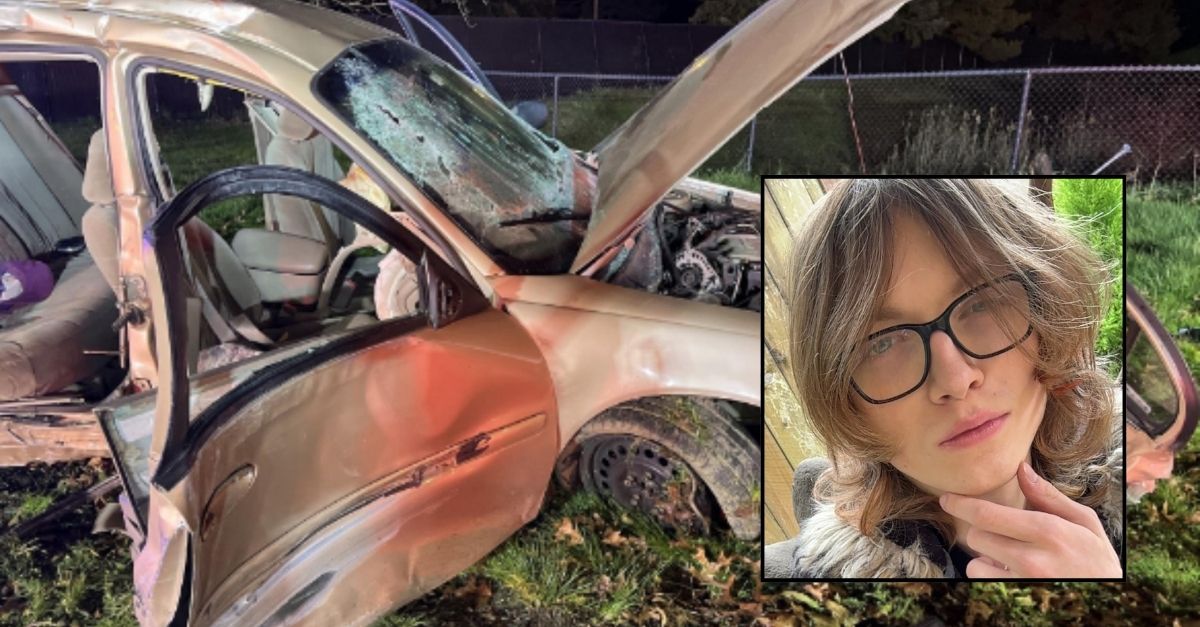
At around 8:42 p.m., police were dispatched to the scene of a catastrophic crash. Regis, allegedly driving 76 mph in a 35 mph zone, lost control of the Malibu and slammed into a "large light pole." The impact was devastating. Jackson Greenfell, who was seated in the back seat, sustained fatal injuries. According to the affidavit, Greenfell was intubated, had a breathing tube, and likely suffered a brain bleed before succumbing to his injuries at a local hospital. The other female passenger in the back seat endured horrific injuries, including a fractured cheekbone requiring surgery, other facial fractures, a broken spine, and a concussion. Her mother later testified in court that metal plates had to be inserted into her daughter’s face, emphasizing that "These injuries are going to be lifelong. The trauma she has suffered is extraordinary."
In the immediate aftermath, Regis, who remarkably suffered no injuries, allegedly fled the scene on foot. He was later apprehended by law enforcement, found wearing a "black and white letterman jacket" that had "blood on the right elbow," as detailed in the affidavit. Upon questioning, Regis exhibited clear signs of impairment, including "glossy eyes, odor of alcoholic beverage, and thick speech," and admitted to officers that he had consumed alcohol.
Legal Proceedings and Courtroom Testimony
The gravity of Regis’s alleged actions led to a detention hearing on Friday, where Washington County Circuit Judge Oscar Garcia presided over the proceedings. Prosecutors meticulously laid out the case against Regis, highlighting the extreme recklessness and the devastating human cost of his choices. A detective who testified during the hearing recounted Regis’s distraught statement following his arrest: "What have I done?" The detective further revealed that Regis had confided that his father had recently warned him that "something like this was going to happen if he continued his behavior," suggesting a pattern of risky conduct that predated the fatal crash.
The testimony of Jackson Greenfell’s mother, Tanya LaBarr-Green, underscored the profound and irreversible loss suffered by her family. Addressing the court, she stated, "The loss of our child has left a permanent void in our lives that can never be filled. His life was stolen because of a series of deliberate and conscious choices." Similarly, the mother of the injured female passenger painted a grim picture of her daughter’s ongoing struggle and the lifelong impact of her injuries.
Regis’s defense attorney, Ryan Anfuso, argued for his client’s release with strict security conditions, acknowledging the severity of the charges but seeking an alternative to pre-trial detention. However, Judge Garcia was unswayed by the defense’s arguments. Citing the extraordinary recklessness of the incident and concerns for public safety, Judge Garcia firmly rejected the request, stating, "This is an extremely, beyond reckless incident. I have no confidence that any of these conditions would somehow keep the community safe." Consequently, Regis was ordered to remain in jail without bond pending his criminal trial. His next court appearance is scheduled for a status hearing on March 6.
A Pattern of Reckless Behavior and Prior Incidents
The probable cause affidavit and courtroom revelations painted a troubling picture of Oscar Regis’s history of dangerous driving and disregard for the law. Prosecutors noted in court that just weeks before the fatal crash, Regis was involved in another incident where he allegedly sideswiped a car while driving his stepmother’s Mini Cooper. In that instance, he was also accused of fleeing the scene, though he was not criminally charged for it. This prior event, while not leading to formal charges, served as an alarming precursor to the February 9 tragedy, indicating a consistent pattern of fleeing responsibility after collisions.
Further compounding this concerning history, Regis reportedly admitted to police that he used to associate with a group of individuals who would steal and crash Kia vehicles. He also explicitly stated that it was "normal for him to run from crashes," according to The Oregonian. These admissions suggest a deeply ingrained habit of reckless behavior and an apparent lack of accountability, which ultimately culminated in the devastating events that cost Jackson Greenfell his life and left another young woman with permanent injuries. This established pattern of conduct undoubtedly played a significant role in Judge Garcia’s decision to deny bail, underscoring the perceived risk Regis posed to the community.
The Perils of Impaired and Reckless Driving: A National Concern
The tragic case involving Oscar Regis is a stark reminder of the devastating consequences of impaired and reckless driving, a public health and safety crisis that continues to plague communities across the United States. According to the National Highway Traffic Safety Administration (NHTSA), impaired driving remains a leading cause of traffic fatalities. In 2021 alone, drunk-driving fatalities accounted for 13,384 deaths, representing 31% of all traffic fatalities in the U.S. While the legal drinking age is 21, data consistently shows that young drivers, particularly those between 18 and 24, are disproportionately involved in alcohol-related crashes. This demographic often exhibits a higher propensity for risk-taking behavior, coupled with inexperience behind the wheel and a lesser understanding of alcohol’s full effects.
Oregon, like many states, grapples with its share of impaired driving incidents. The Oregon Department of Transportation (ODOT) and Oregon State Police consistently report hundreds of DUI arrests and dozens of fatalities annually linked to impaired driving. The state has stringent laws regarding driving under the influence (DUII), with penalties ranging from significant fines and license suspension to mandatory jail time and participation in diversion programs. However, for cases involving fatalities or serious injuries, charges escalate significantly to felonies such as manslaughter and assault.
The specific alcohol alleged in this case, Four Loko, has a controversial history. Known for its high alcohol content (often around 12-14% ABV in a large can, equivalent to several standard drinks) and once infamous for combining alcohol with caffeine, it has been linked to numerous incidents of alcohol poisoning and dangerous behavior, particularly among young adults. Although reformulated to remove caffeine in 2010 due to regulatory pressure, its high alcohol volume continues to pose significant risks, especially when consumed rapidly or in conjunction with driving. Its appeal to younger demographics, often due to marketing and lower cost per unit of alcohol, makes it a frequent factor in incidents involving underage drinking and driving.
Furthermore, the element of excessive speed, 76 mph in a 35 mph zone, significantly amplified the danger. The kinetic energy involved in a crash increases exponentially with speed, meaning that even a small increase in velocity can dramatically multiply the force of impact and the severity of injuries. At 76 mph, the forces exerted upon collision are immense, often leading to catastrophic structural damage to vehicles and severe, often fatal, trauma to occupants, as tragically demonstrated by Jackson Greenfell’s injuries and the female passenger’s lifelong medical challenges.
The Broader Implications for Public Safety and Accountability
The Oscar Regis case extends beyond the immediate tragedy, raising crucial questions about public safety, the efficacy of preventative measures, and the justice system’s role in deterring such egregious acts. The fact that Regis allegedly exhibited a pattern of reckless driving and fleeing accident scenes highlights a systemic challenge: how to intervene effectively before such behaviors culminate in fatal consequences. His admission about "running from crashes" being "normal" points to a profound disconnect from accountability and a disregard for the law and the safety of others.
From a legal standpoint, the charges of manslaughter, assault, and DUI carry severe penalties in Oregon, reflecting the gravity of taking a life and inflicting serious harm due to criminal negligence. Manslaughter in the first degree, for instance, is a Measure 11 crime, meaning it carries mandatory minimum prison sentences upon conviction. The outcome of Regis’s trial will not only determine his fate but also send a powerful message about the legal and societal consequences for those who choose to drive under the influence and with extreme recklessness.
The case also underscores the critical role of community vigilance, as demonstrated by the 911 call reporting Regis’s reckless driving just minutes before the crash. Such calls are vital for law enforcement to intercept dangerous drivers before tragedy strikes. However, they also reveal the limitations of reactive policing in preventing all incidents.
Ultimately, this case serves as a poignant and urgent reminder of the collective responsibility to foster a culture of road safety. It emphasizes the need for continued education on the dangers of impaired driving, stricter enforcement of traffic laws, and robust support systems to address underlying behavioral issues that contribute to such devastating incidents. For the families of Jackson Greenfell and the injured passenger, the legal process, while offering a measure of justice, can never fully heal the wounds inflicted by a single night of reckless and irresponsible choices. The shadow of this tragedy will undoubtedly linger over Hillsboro, serving as a somber lesson on the fragility of life and the immense power of personal accountability behind the wheel.

 Yuyun Lusiyani
 Joko Widodo
 Jia Lissa
 Pevita Pearce
 admin
admin
