
 Jia Lissa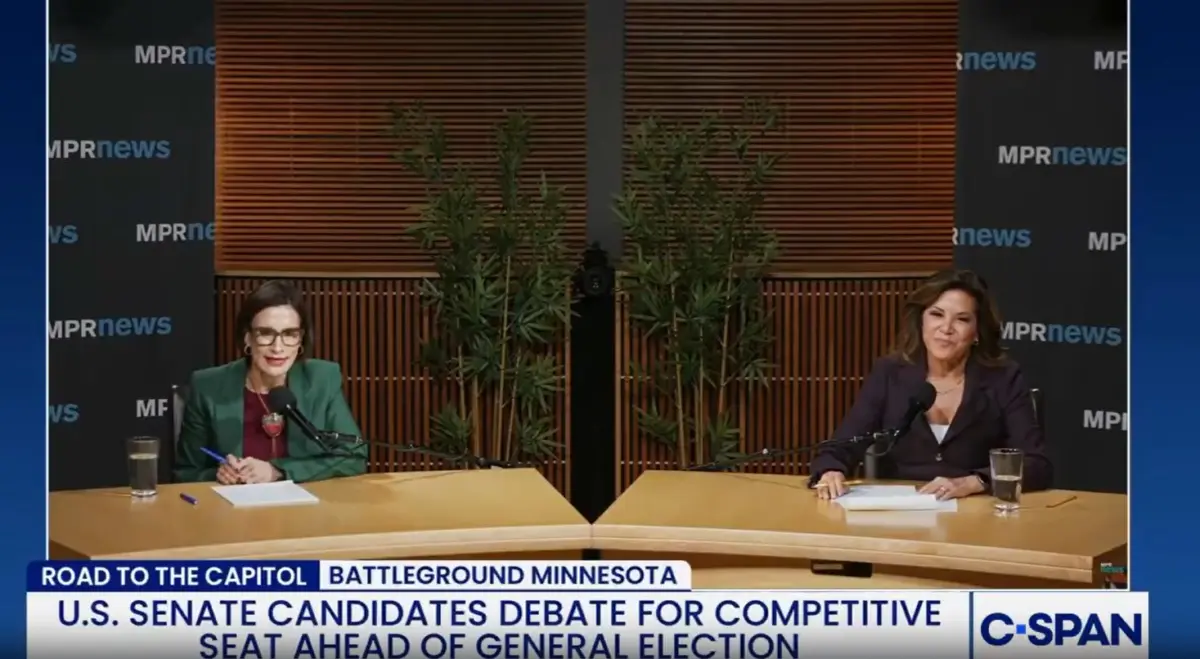
The political atmosphere in Minnesota reached a fever pitch on Friday as former sports broadcaster Michele Tafoya, representing the Republican ticket, faced off against Lieutenant Governor Peggy Flanagan in a televised U.S. Senate debate. The encounter, characterized by sharp ideological divides and personal accusations, centered on the future of federal immigration enforcement and the fallout from a controversial law enforcement operation that resulted in the deaths of two Minnesotans. As the race enters its final weeks, the debate highlighted the core tensions of a campaign that has seen Tafoya, a political newcomer, maintain a surprisingly narrow margin against an entrenched incumbent in a traditionally Democratic stronghold.
The confrontation began with a direct challenge regarding the U.S. Immigration and Customs Enforcement (ICE) agency. The moderator revisited comments made by Flanagan earlier this summer, in which she advocated for the total dismantling of the agency. When pressed on what should replace the current federal structure, Flanagan remained firm in her stance, advocating for a complete overhaul of the American immigration apparatus.
Flanagan argued that ICE should be "ripped apart" and replaced with a system predicated on secure borders, public safety, dignity, due process, and humanity. She emphasized the necessity of a pathway to citizenship for law-abiding individuals who have resided in the United States for extended periods. However, the Lieutenant Governor quickly pivoted from policy theory to a specific, localized tragedy that has become a flashpoint in the Minnesota Senate race: the fatal shootings of Renee Good and Alex Pretti during a federal operation.
The Controversy Surrounding Operation Metro Surge
The debate took a somber and accusatory turn as Flanagan addressed the deaths of Good and Pretti, which occurred during a controversial ICE initiative known as Operation Metro Surge. Flanagan accused the Republican candidate of capitalizing on the tragedy for political gain. According to Flanagan, Tafoya used footage from the chaotic operation in her campaign rollout video just days after the fatalities occurred. Furthermore, Flanagan alleged that Tafoya appeared on a podcast on the day of Renee Good’s death and effectively blamed the victim for the circumstances that led to her killing.
"We know what we saw here, which was agents who descended, the chaos, the terror, the killing of two Minnesotans," Flanagan stated during the debate. She framed the incident as a failure of federal aggression and a lack of empathy, positioning herself as a candidate who would prioritize human rights over what she described as "systemic terror."
The moderator then turned the focus to Tafoya’s shifting rhetoric regarding the operation. While Tafoya had initially defended the broader mission of the agents in early January, citing a commitment to "law and order," she more recently characterized the surge as "very poorly handled." When asked to clarify which stance she truly held, Tafoya leaned into her personal narrative to bridge the gap between her support for enforcement and her criticism of the specific execution of the surge.
Tafoya’s Defense: A Nation of Immigration and Law
Responding to the criticism, Tafoya positioned herself as a bridge between two seemingly opposing American values: the welcoming of immigrants and the strict adherence to the rule of law. Drawing on her background as the granddaughter of immigrants and the adoptive mother of a child born in Colombia, Tafoya argued that these identities are not in conflict with a desire for secure borders.
"America should be a nation of immigration and also a nation of law and order," Tafoya replied. While she acknowledged that the loss of Renee Good and Alex Pretti was "devastating," she shifted the blame away from the concept of federal enforcement and toward the specific leadership involved at the time. Tafoya specifically criticized South Dakota Governor Kristi Noem’s handling of the rollout—noting that Noem was "appropriately fired" from her oversight role in the operation—but saved her harshest critiques for the current Minnesota administration.
Tafoya alleged a "massive failure in leadership" from Governor Tim Walz and Lieutenant Governor Flanagan. She claimed that the state executive branch prevented local law enforcement from intervening to protect protesters, immigrants, and the general public. According to Tafoya, the administration issued "stand down" orders to local officers, which she argues exacerbated the chaos of Operation Metro Surge.
Law Enforcement Endorsements and Political Realignment
One of the most significant moments of the debate occurred when Tafoya discussed her relationship with Minnesota’s law enforcement community. Despite being a civilian with no prior political or policing experience, Tafoya has secured the endorsements of the Minnesota Police and Peace Officers Association (MPPOA) and the Minneapolis Federation of Police.
Tafoya used these endorsements to highlight a perceived disconnect between the sitting Lieutenant Governor and the state’s front-line officers. She cited a recent statement from the MPPOA claiming that their leadership had spent more time consulting with Tafoya over the last six months than they had with Flanagan over her eight-year tenure in the state’s executive office.
This development is particularly notable given Minnesota’s recent history of civil unrest and the ongoing national debate over police reform. Tafoya’s strategy appears to be a direct appeal to "law and order" voters who feel that the Walz-Flanagan administration has been insufficiently supportive of police departments. She argued that once the initial "poorly handled" phase of the surge ended and Tom Homan took a more prominent role, the situation stabilized, demonstrating that effective enforcement is possible without the chaos seen in the Good and Pretti incident.
Chronology of the Campaign and Key Events
To understand the weight of Friday’s debate, it is essential to look at the timeline of events that have shaped this Senate race:
- January 2026: Michele Tafoya enters the race, framing her platform around constitutional conservatism and public safety. She initially defends the "law and order" mission of federal agents amid rising border tensions.
- Spring 2026: Operation Metro Surge is launched. The operation is designed to target high-priority criminal targets but results in the high-profile deaths of Renee Good and Alex Pretti, sparking statewide protests and federal inquiries.
- Summer 2026: Peggy Flanagan makes her "rip ICE apart" comments during a preliminary debate, signaling a progressive shift in the Democratic platform focused on systemic reform.
- August 2026: Polling begins to show a tightening race. Despite Minnesota’s "Deep Blue" reputation, Tafoya’s focus on crime and the economy begins to resonate in suburban and rural districts.
- September 2026: The MPPOA officially endorses Tafoya, a rare move for a major police association to back a non-incumbent challenger against a sitting executive.
- October 2026: The final debate takes place, with both candidates attempting to solidify their base while reaching out to the remaining undecided voters.
Supporting Data and State Sentiment
The closeness of the race is supported by several key data points. Recent polling from the Minnesota Star-Tribune and Mason-Dixon indicates that while Flanagan holds a slim 3-point lead, she is underperforming in key areas outside of the Twin Cities. Public safety remains a top-three issue for Minnesota voters, alongside inflation and healthcare.
Furthermore, internal campaign data suggests that Tafoya’s background as a well-known media personality has given her a level of name recognition that typical Republican challengers in Minnesota lack. Her ability to articulate a personal connection to immigration through her daughter has also blunted some of the traditional Democratic attacks regarding the Republican party’s stance on border security.
On the other side, Flanagan’s supporters point to her historic role as the first Native American woman in statewide executive office and her work on child care and education. However, her comments regarding the dismantling of ICE have become a central pillar of the Republican attack strategy, aimed at painting her as "out of touch" with the security concerns of the average Minnesotan.
Official Responses and Stakeholder Reactions
Following the debate, several key figures and organizations issued statements. The Minnesota Democratic-Farmer-Labor (DFL) Party released a statement doubling down on Flanagan’s criticism of Tafoya’s rollout video, calling it "ghoulish" to use the imagery of a fatal operation for a political advertisement.
Conversely, the Republican Party of Minnesota praised Tafoya’s performance, stating that she "exposed the radical agenda of the Walz-Flanagan administration." A spokesperson for the MPPOA also confirmed Tafoya’s claims during the debate, stating, "Our members feel heard by Michele Tafoya. We are looking for a partner in government who values the difficult work our officers do every day, and right now, that person is Michele."
The family of Renee Good has also been vocal throughout the campaign. While they have expressed frustration with the federal government’s handling of the operation, they have also called for an end to the "politicization" of their loved one’s death, a sentiment that neither campaign has fully satisfied as the tragedy remains central to the political discourse.
Broader Impact and Implications
The outcome of the Minnesota Senate race has national implications. If Tafoya were to pull off an upset, it would signal a massive shift in the political alignment of the Upper Midwest and could provide the Republican party with the seat necessary to gain a majority in the U.S. Senate.
The debate over ICE and the "stand down" orders also reflects a broader national conversation about the limits of state versus federal authority. Tafoya’s argument—that the state failed to protect its citizens by refusing to cooperate with federal or local law enforcement—is a narrative that Republicans are testing in several key swing states.
For Flanagan, the challenge remains balancing the progressive wing of her party, which demands radical changes to the immigration and policing systems, with the broader electorate that remains wary of "ripping apart" established security institutions. Her performance on Friday was a calculated attempt to frame herself as the candidate of "humanity" while painting her opponent as a "law and order" hardliner who lacks the temperament for the Senate.
As the campaign enters its final three-week sprint, the focus will likely remain on these two competing visions for Minnesota’s future. Whether voters prioritize the "dignity and due process" advocated by Flanagan or the "safe streets and neighborhoods" promised by Tafoya will ultimately decide one of the most closely watched races in the country. The debate on Friday ensured that, regardless of the winner, the issues of immigration enforcement and public safety will remain at the forefront of the Minnesotan consciousness for the foreseeable future.

 Yuyun Lusiyani
 Joko Widodo
 Eva Lovia
 Pevita Pearce
 admin
admin