
 Jia Lissa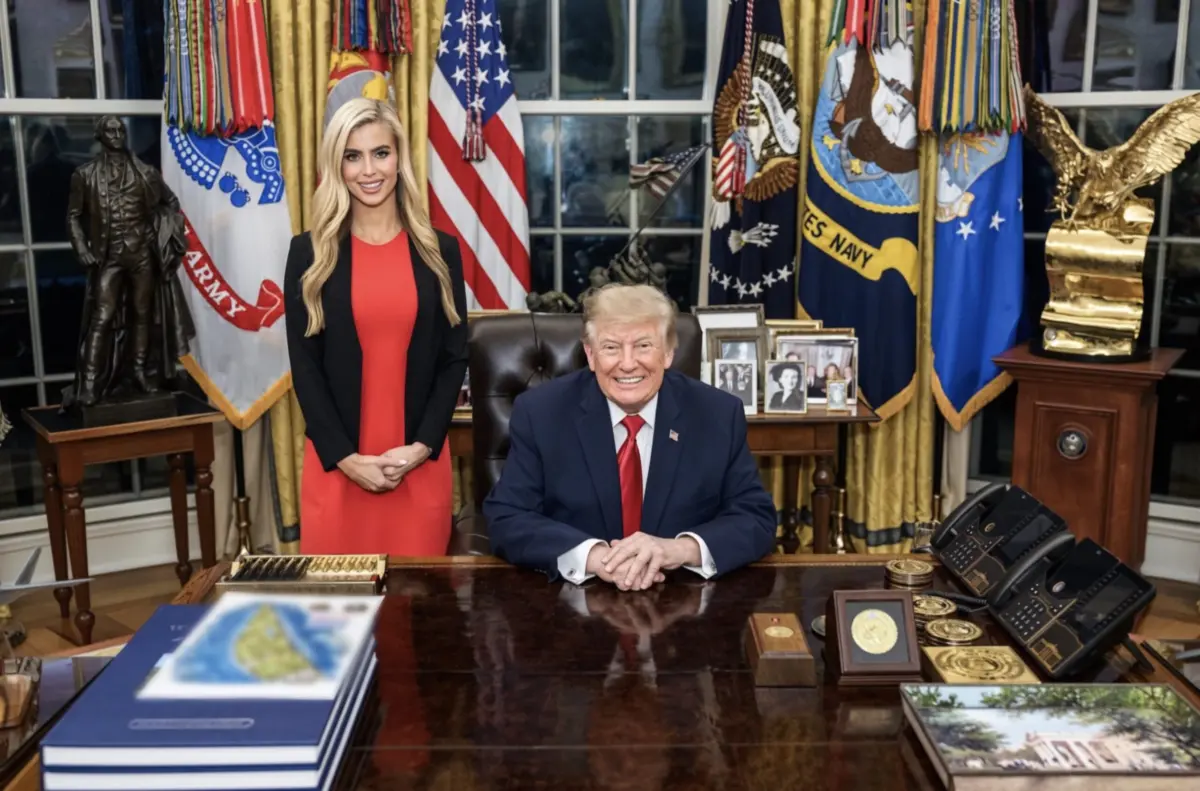
Former White House Press Secretary Katie Zacharia, whose tenure lasted a historic seven days, issued her first public statement Friday night following her abrupt dismissal from the West Wing. Zacharia, 41, utilized the social media platform X to express continued loyalty to President Donald Trump, despite a week characterized by intense media scrutiny, internal administrative friction, and a series of high-profile interview failures that ultimately led to her removal from the podium. Her departure marks the shortest tenure for a White House Press Secretary or Communications Director in United States history, surpassing the previous record held by Anthony Scaramucci.
In a post published at approximately 9:00 p.m. ET on Friday, October 17, 2026, Zacharia shared a photograph of herself standing behind President Trump in the Oval Office. The image, which featured the President seated at the Resolute Desk, was accompanied by a caption praising the commander-in-chief’s character and work ethic. "President Trump is a kind, wonderful, gracious, thoughtful, enthusiastic, and hardworking man," Zacharia wrote. "I wish more Americans appreciated him. No one will ever make America great the way he has and continues to. It was an honor to work for him." The statement, notable for its lack of bitterness regarding her termination, suggests an effort to maintain a positive relationship with the administration, which has indicated she will remain in a different capacity.
The Timeline of a Record-Breaking Exit
Zacharia’s swift ascent and even swifter fall began just one week prior, when she was tapped to succeed Karoline Leavitt in the high-profile role of Press Secretary. Her appointment was initially viewed as a strategic move to bring a fresh, perhaps more controlled, voice to the White House briefing room. However, the momentum of her appointment stalled almost immediately upon her public debut.
The timeline of Zacharia’s tenure illustrates a rapid deterioration of confidence from both the press corps and the executive office:
- Tuesday, October 14: Zacharia held her debut press briefing. The session lasted only 14 minutes, significantly shorter than the standard White House briefing. During this time, she took questions from only three news outlets and was observed reading extensively from a prepared script, leading to accusations from the press corps that she was unprepared or overly restricted.
- Wednesday, October 15: Following a day of negative coverage regarding her "nervous" debut, reports began to surface regarding the accuracy of her professional credentials.
- Thursday, October 16: Zacharia appeared on Hannity for what was intended to be a friendly interview with Fox News host Sean Hannity. Instead, the interview became a rigorous interrogation of her qualifications and her performance at the podium.
- Friday Morning, October 17: A follow-up appearance on Fox & Friends failed to rehabilitate her image, as she faced further questions regarding her legal background.
- Friday Afternoon, October 17: Zacharia was reportedly informed of her termination while she was in the middle of a meeting with reporters from The Wall Street Journal.
The Briefing Room Debut and Initial Criticism
The catalyst for Zacharia’s downfall was her performance during the October 14 briefing. White House Press Secretaries are traditionally expected to manage a room of adversarial reporters with a mix of policy knowledge and rhetorical agility. Zacharia’s approach was notably different. By limiting the session to 14 minutes and strictly adhering to a script, she was perceived as being unable to handle the spontaneous nature of the "Q&A" format.
Reporters in the room noted a visible sense of unease. By only selecting three outlets—none of which were known for particularly aggressive questioning—Zacharia signaled a defensive posture that reportedly frustrated the President. Sources close to the administration suggest that Trump, who values strength and "combative" performance in his spokespeople, was disappointed by the lack of "fire" shown during the debut.
The Interview That Changed Everything: Sean Hannity and the Bar Exam
The most significant blow to Zacharia’s credibility occurred during her Thursday night interview with Sean Hannity. While Fox News is often a supportive environment for Trump administration officials, Hannity took a surprisingly confrontational tone, reflecting the growing concerns within Republican circles about Zacharia’s viability.
The focal point of the interview was Zacharia’s claim to be a lawyer. Hannity pointedly asked whether she had passed the bar exam, a standard requirement for any individual practicing law or claiming the professional title of attorney in most jurisdictions. Zacharia admitted on national television that she had not passed the bar, despite having characterized herself as a lawyer in previous professional contexts.
This admission sparked an immediate controversy regarding "stolen valor" in a professional sense. Legal experts noted that while an individual can hold a Juris Doctor (JD) degree, referring to oneself as a "lawyer" without being admitted to a state bar can be seen as misleading at best and a violation of professional ethics at worst. The revelation that she had not disclosed this specific detail to the President before her appointment reportedly caused a significant rift within the West Wing.

Credential Scrutiny and the Definition of a Lawyer
The fallout from the Hannity interview was compounded by a subsequent appearance on Fox & Friends, where Lawrence Jones confronted Zacharia about the lack of transparency regarding her credentials. The central question was whether she had explicitly informed President Trump about her failure to pass the bar exam. Her responses were characterized as evasive, further fueling the narrative that she had gained the position under false pretenses.
Data regarding White House appointments shows that vetting processes are designed to catch such discrepancies. The failure to identify this issue beforehand has led to questions regarding the internal vetting team, reportedly led by Chief of Staff Susie Wiles. Some reports suggest that Wiles herself arranged the Hannity interview as a "stress test" or a "sanctioned hit" after becoming concerned with Zacharia’s initial performance.
Historical Context: Eclipsing the Scaramucci Record
Zacharia’s seven-day tenure now stands as a historical anomaly. For nearly a decade, the benchmark for short-lived White House service was Anthony Scaramucci, who served as Communications Director for 10 days (often cited as 11 depending on the start-date calculation) in 2017 before being removed by then-Chief of Staff John Kelly.
Scaramucci himself weighed in on the news via X, stating, "Records are made to be broken. But I take no pleasure in other people’s pain." The comparison highlights the volatility that has occasionally characterized the Trump administration’s communications department. Unlike Scaramucci, who was fired following a profanity-laced interview with The New Yorker, Zacharia’s exit appears to be the result of a perceived lack of competence and a "credentialing" scandal rather than a singular behavioral outburst.
Administrative Fallout and Internal Management
The rapid exit of a Press Secretary creates a vacuum in the administration’s messaging strategy. President Trump has stated that Zacharia will remain within the administration, though he has not specified her new role. This "soft landing" is a common tactic used to prevent disgruntled former employees from speaking out against the administration, though it remains to be seen how much influence she will retain.
The incident has also placed a spotlight on Susie Wiles. As the individual reportedly responsible for arranging the media appearances that led to Zacharia’s downfall, Wiles is facing scrutiny over the administration’s internal management. Political analysts suggest that the Zacharia episode may lead to a more rigorous, perhaps even "traditional," vetting process for the next Press Secretary.
Broader Implications for White House Communication Strategy
The Zacharia saga underscores the high-stakes nature of the White House Press Secretary role in the modern era. In an environment of 24-hour news cycles and instant social media feedback, a single "rocky" outing can be fatal to a career.
For the Trump administration, the challenge remains finding a spokesperson who can balance the President’s desire for a loyalist who "fights" with the media’s demand for factual accuracy and professional transparency. The failure of the Zacharia appointment suggests that "loyalty" alone is insufficient if not backed by the technical skills required to navigate the briefing room.
As the search for a replacement begins, names of veteran communicators and former cable news personalities are already circulating. The administration’s next choice will be under immense pressure to restore stability to the press office and prove that the lessons of the "Zacharia Week" have been learned.
For now, Zacharia returns to a private or lower-level public life, having secured a permanent, if unenviable, spot in the annals of American political history. Her parting words of praise for the President suggest she hopes to remain in the "MAGA" fold, even if she is no longer the face of it.



 Yuyun Lusiyani
 Joko Widodo
 Eva Lovia
 Pevita Pearce
 admin
admin