
 Jia Lissa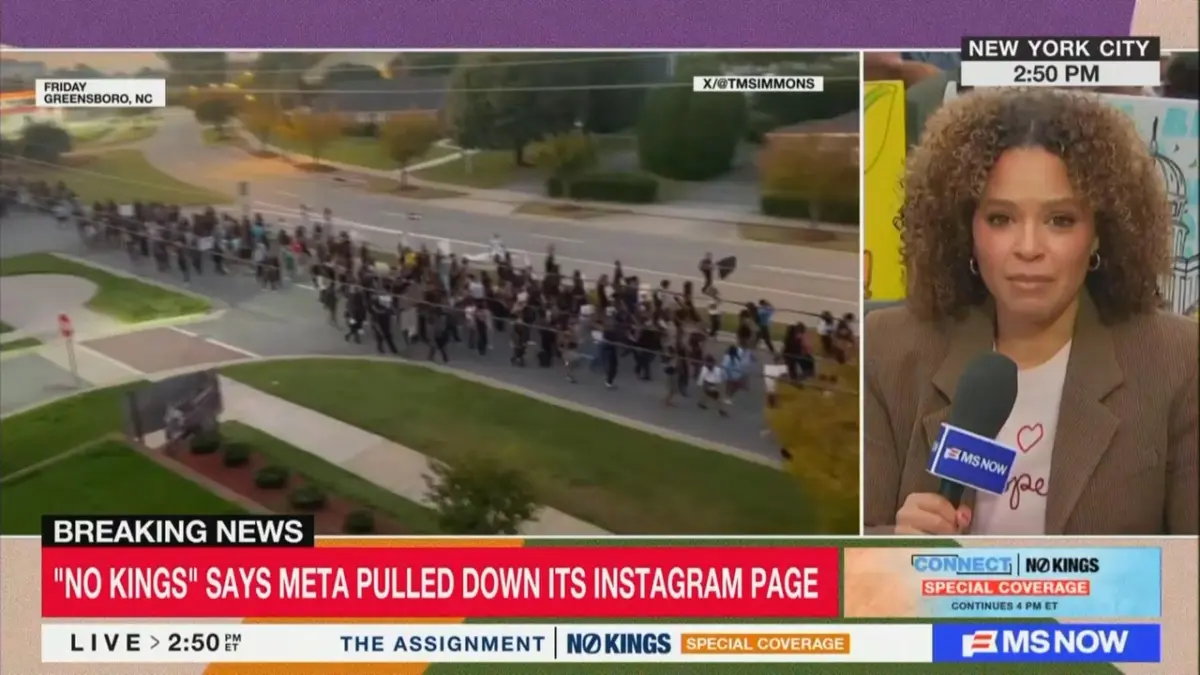
The social media giant Meta, the parent company of Instagram and Facebook, faced intense scrutiny on Saturday following the abrupt suspension of the primary accounts belonging to the No Kings Coalition. The suspension occurred at the height of a coordinated national day of action, leaving organizers unable to communicate with millions of followers as protests unfolded across several major U.S. cities. While Meta later characterized the incident as an automated technical error, the timing of the blackout has reignited a fierce debate over the role of private tech corporations in moderating political speech during periods of civil unrest.
The No Kings Coalition, a prominent advocacy group that emerged in early 2025 following the return of Donald Trump to the presidency, had organized Saturday’s events as part of its fourth major round of nationwide demonstrations. The protests were aimed at addressing concerns over executive overreach and the perceived erosion of institutional checks and balances. According to internal reports from the coalition, their Instagram presence—a critical tool for real-time logistics, safety updates, and mobilization—was disabled without warning in the early afternoon, precisely when turnout was peaking in hubs like Washington D.C., New York, and Chicago.
Chronology of the Suspension
The disruption began at approximately 1:30 p.m. Eastern Time on Saturday. Organizers reported that administrators suddenly lost all backend access to the coalition’s main Instagram account. While the page remained visible to the public for a brief window, it was essentially "frozen," preventing the movement from posting new content or responding to inquiries. Shortly thereafter, the page was pulled down entirely, returning a "Page Not Found" error to users attempting to access the coalition’s digital headquarters.
Antonia Hylton of MS NOW was among the first to break the news, reporting that the coalition’s leadership was in a state of confusion as they attempted to navigate the blackout. "A spokesperson for No Kings says the main accounts for the coalition on Instagram were frozen and pulled down, and the administrators lost access to the account at the peak of their national day of action," Hylton stated during a live broadcast.
By 3:00 p.m. ET, the account was partially restored to public view, but organizers remained locked out of the administrative interface. Ezra Levin, a co-founder of the coalition and a central figure in the organizing efforts, spoke with MeidasTouch to express his frustration. Levin described the atmosphere on the ground as "joyful" and "mobilized," only to be dampened by the sudden digital severance. "In the middle of that joyful experience at the protest locally, I got word from my team that Mark Zuckerberg’s Meta had suspended the Instagram account," Levin said. "We didn’t have access to it. We couldn’t post to it. Nobody could go to the page. That was for about an hour-and-a-half, during the height of the mobilization."
Meta’s Technical Defense and Official Response
As the outcry grew on other social platforms like X (formerly Twitter), Meta issued a formal explanation through its communications department. Andy Stone, Meta’s long-standing communications officer, addressed the incident by attributing the suspension to the platform’s automated safety protocols rather than a deliberate policy decision or political bias.
"When accounts post, share, or comment at very high frequencies, it can trigger automated systems," Stone wrote in a statement posted to social media. "That’s what happened with the No Kings IG account in the lead-up to today’s day of action. Unfortunately, that automated action was clearly taken in error. Everything is now working as it should and we sincerely apologize."
The "automated systems" Stone referred to are part of Meta’s broader anti-spam and integrity infrastructure. These algorithms are designed to detect bot-like behavior, such as rapid-fire posting or sudden spikes in engagement, which are often hallmarks of coordinated inauthentic behavior or disinformation campaigns. However, critics argue that these same systems frequently fail to distinguish between malicious bot activity and legitimate, high-velocity organic engagement generated by grassroots movements during breaking news events.
Comparative Context: The Brazil Precedent
The suspension of the No Kings Coalition account drew immediate comparisons to recent international controversies involving Meta’s moderation policies. During his interview, Ezra Levin pointed to a recent legal conflict in Brazil where the judiciary scrutinized Meta’s handling of political content. In that instance, a court ruled that Meta’s algorithms had unfairly penalized certain political factions while failing to curb the spread of authoritarian-leaning rhetoric.
"This is strikingly reminiscent of what we saw in Brazil just this week," Levin remarked. "A court ruled against Meta for favoring the authoritarians in that country. And we might be seeing something similar from Meta in our country right now."
The reference highlights a growing global concern regarding "algorithmic bias." In the Brazilian context, investigators found that automated moderation tools were more likely to flag content from civil rights groups and activists as "spam" or "sensitive" while allowing government-aligned messaging to propagate unchecked. The No Kings Coalition suggests that a similar dynamic may be at play in the United States, where the high frequency of protest-related updates is interpreted by AI as a violation of platform rules, effectively silencing dissent at critical moments.
The Role of Social Media in 2026 Political Mobilization
To understand the impact of Saturday’s suspension, it is necessary to examine the scale of the No Kings Coalition’s digital footprint. Since its inception in 2025, the group has relied heavily on Instagram’s visual-first platform to share infographics, live-stream police interactions, and coordinate "pop-up" protests. With an estimated following in the millions, the coalition’s Instagram account serves as a primary news source for a demographic that increasingly eschews traditional media.
Data from digital advocacy firms suggests that for movements like No Kings, a 90-minute blackout during a peak mobilization window can result in a significant drop in "day-of" participation. Without the ability to share location changes or safety alerts, decentralized protest groups often struggle to maintain momentum. In the case of Saturday’s protests, organizers in several cities reported that "flash" events were smaller than anticipated because the central hub for coordination was offline during the final push for attendance.
Furthermore, the incident underscores the vulnerability of modern political movements that are dependent on third-party infrastructure. While platforms like Instagram provide unprecedented reach, they also function as "walled gardens" where the terms of service and automated enforcement can be changed or triggered without due process.
Broader Implications for Digital Governance and Free Speech
The "error" acknowledged by Meta raises fundamental questions about the accountability of tech giants in the 2026 political landscape. As the United States navigates a period of intense polarization and frequent civil demonstrations, the reliability of communication channels becomes a matter of public interest.
Legal experts specializing in digital rights have noted that "automated errors" are becoming a convenient catch-all for platforms seeking to avoid the appearance of censorship. By blaming an algorithm, a company can deflect charges of intentional bias while still achieving the result of suppressing a specific message during a sensitive timeframe. This phenomenon, often referred to as "soft censorship," is difficult to challenge in court because it lacks the clear "intent" required for many legal remedies.
The No Kings Coalition has indicated that it does not accept Meta’s apology as a sufficient resolution. In a follow-up statement, the group called for greater transparency regarding the specific triggers that led to the account’s suspension. They are also advocating for a "protected status" for verified advocacy groups during sanctioned days of action, ensuring that high-frequency posting does not lead to automatic lockouts.
"We’re not going to stop organizing against this regime," Levin concluded, signaling that the coalition intends to move forward with its fifth round of protests despite the digital hurdles. "But we need to be clear-eyed about the fact that the platforms we use to talk to each other are not neutral ground."
As the dust settles on Saturday’s protests, the incident remains a potent reminder of the intersection between technology, corporate power, and democratic participation. While the No Kings Coalition’s account has been fully restored, the precedent set by the 90-minute blackout continues to reverberate through the activist community, prompting a reevaluation of how movements can maintain resilience in an era where an algorithm can silence a national conversation with a single "automated error."

 Yuyun Lusiyani
 Joko Widodo
 Eva Lovia
 Pevita Pearce
 admin
admin