
 Pevita Pearce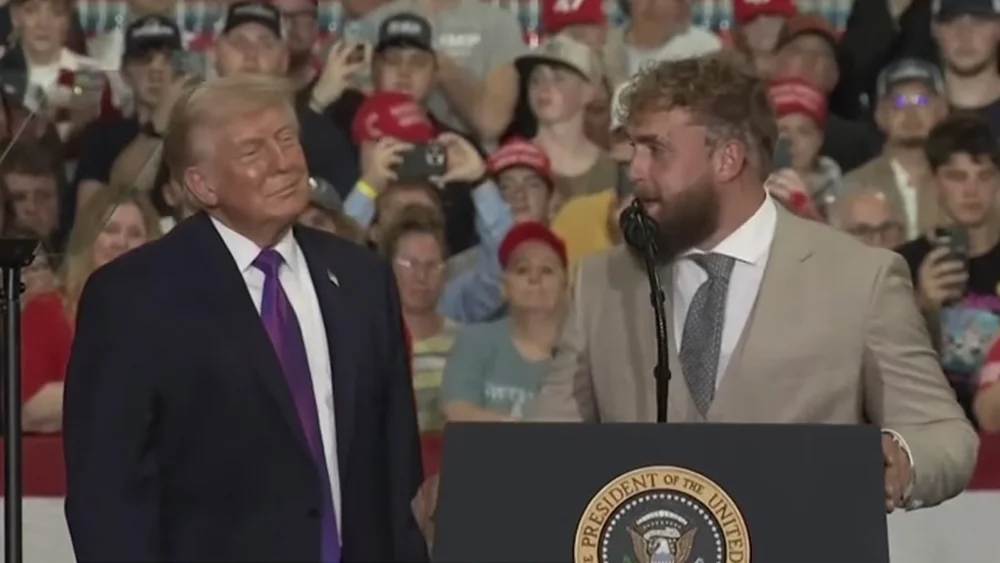
In a move that underscores the evolving landscape of American political endorsements and the increasing fusion of digital entertainment with public service, President Donald Trump formally signaled his support for social media personality and professional boxer Jake Paul to pursue a career in politics. The endorsement took place on March 11, 2026, during a presidential visit to the Verst Logistics packaging facility in Hebron, Kentucky. Addressing a crowd of workers, local officials, and media representatives, the President paused his remarks on domestic manufacturing and supply chain resilience to acknowledge Paul, who was seated in the audience. The interaction culminated in Paul being invited onto the stage, where the President issued a predictive endorsement that has since sparked widespread discussion regarding the role of high-profile influencers in the future of the American legislative and executive branches.
The event in Hebron was part of a broader regional tour focused on the economic revitalization of the Ohio River Valley and the logistical advantages of Northern Kentucky. Hebron, situated near the Cincinnati/Northern Kentucky International Airport (CVG), has become a critical hub for national distribution, making it a strategic backdrop for the President’s policy addresses. However, the focus of the afternoon shifted significantly when President Trump identified Paul in the crowd. Describing the 29-year-old influencer as a "hell of a fighter," the President invited him to the podium. Paul, who has transitioned from a controversial YouTube creator to a prominent figure in professional boxing and sports media, shared a brief exchange with the President before the crowd.
President Trump’s praise for Paul was not limited to his athletic achievements. He specifically highlighted Paul’s temperament and public image as indicators of political potential. "I’m going to make a prediction that you will be in the not-too-distant future running for political office," the President stated. "You have my complete and total endorsement. Okay? That’s what we want. He’s an incredible guy. Lotta courage and smarts." This public backing represents one of the most explicit instances of a sitting president encouraging a member of the "creator economy" to transition into formal governance.
The Chronology of the Hebron Address and Interaction
The events of March 11 followed a structured schedule typical of a presidential site visit, though the inclusion of a high-profile digital celebrity added an unconventional element to the proceedings. The President arrived at the Verst Logistics facility at approximately 1:30 PM local time, accompanied by a small cohort of economic advisors. Following a brief tour of the packaging lines and a meeting with the facility’s management, the President took the stage at 2:15 PM.
The first twenty minutes of the address focused on the "America First" economic agenda, specifically targeting the expansion of logistics infrastructure in the Midwest. At approximately 2:38 PM, the President shifted his gaze to the front rows of the invited guests. Upon recognizing Jake Paul, the President interrupted his prepared remarks to bring attention to the influencer’s presence. Paul ascended the stage at 2:40 PM, shaking hands with the President in a moment that was immediately captured and circulated across social media platforms.
After Paul’s brief remarks, in which he thanked the President and expressed his appreciation for the Kentucky workforce, the President delivered the endorsement that would dominate the news cycle. By 3:00 PM, the President had concluded his speech and departed for CVG, but the implications of the endorsement had already begun to resonate across political and entertainment media.
Background: Jake Paul’s Evolution from Content Creator to Political Ally
Jake Paul’s presence at a presidential event in Kentucky is the result of a multi-year transformation of his public persona. Originally rising to fame on the now-defunct platform Vine and later becoming a centerpiece of YouTube’s "vlogger" era, Paul was frequently associated with high-energy, often controversial stunts. However, his entry into professional boxing in 2020 marked a shift toward a more disciplined and business-oriented brand.
By 2024 and 2025, Paul had become increasingly vocal about his political leanings, often utilizing his massive digital reach—totaling over 70 million followers across various platforms—to comment on national issues such as inflation, free speech, and the economy. His support for President Trump has been a consistent theme in his recent public appearances. Unlike many of his peers in the entertainment industry who remain politically neutral or lean toward the progressive left, Paul has aligned himself with the populist-conservative movement, often framing his views through the lens of individual liberty and the "American Dream."
Paul’s business ventures, including the sports betting and media company Betr, have also positioned him as a successful entrepreneur within the "Creator Economy," a sector now valued at over $250 billion. This background in media and business aligns with the archetype of the "outsider candidate" that has become a staple of modern Republican politics.
The Paul Family’s Long-Term Political Aspirations
The prospect of a "Paul" on a ballot is not a new concept within the influencer’s inner circle. Jake’s older brother, Logan Paul, a WWE superstar and co-founder of the beverage giant Prime, has frequently discussed a potential run for the presidency. In 2020, Logan Paul stated on his podcast, Impaulsive, that he intended to run for President by 2032, the year he would turn 37.
Logan Paul’s political roadmap has occasionally involved his brother. In a 2023 interview with the Wall Street Journal, Logan suggested that if he were to reach the White House, he would consider appointing Jake as the U.S. Secretary of Defense—a comment that, while largely viewed as hyperbolic at the time, signaled the brothers’ interest in high-level governance. More recently, in 2025, Logan Paul tempered his own ambitions by suggesting that fellow creator Jimmy "MrBeast" Donaldson might be a more effective leader, though he maintained that he would run if he felt he could truly benefit the country.
Jake Paul has approached the idea with a mix of humor and strategic planning. In 2021, he suggested that he and his brother might "flip a coin" to decide who would run for President and who would serve as Vice President. He noted the contrast in their public images, describing Logan as more "likable and PC" while characterizing himself as the "villain"—a persona that often thrives in the combative environment of modern political campaigning.
Implications of the Influencer-Politician Pipeline
The endorsement of Jake Paul by a sitting president highlights a significant shift in how political capital is built and deployed. For decades, the path to political office typically involved a background in law, community organizing, or the military. However, the success of Donald Trump—himself a former reality television star—demonstrated that a pre-existing media platform could serve as a powerful springboard to the highest levels of government.
Political analysts suggest that the "Influencer-to-Politician" pipeline offers several distinct advantages in the current media environment:
- Direct Audience Access: Candidates like Paul do not require traditional media gatekeepers to reach voters. They possess the ability to communicate directly with millions of citizens via smartphones.
- Demographic Reach: Paul’s core audience consists of Gen Z and Millennials, demographics that traditional political campaigns often struggle to engage.
- Fundraising Potential: The ability to monetize a digital following provides a built-in infrastructure for small-dollar grassroots fundraising.
- Brand Resilience: Having built a career on navigating public scrutiny and "cancel culture," influencers are often more resilient to the negative campaigning that defines modern elections.
The endorsement in Hebron suggests that the Republican party may be looking toward these digital-native figures to broaden its appeal. By validating Paul as a potential candidate, President Trump is effectively signaling to a younger generation of voters that the party is open to unconventional leaders who have succeeded outside of the traditional political establishment.
Official Reactions and Public Sentiment
The reaction to the endorsement has been polarized, reflecting the broader divisions in American public life. Supporters of the President and fans of Jake Paul praised the move as a forward-thinking embrace of new leadership. On social media, the clip of the endorsement garnered millions of views within hours, with many commentators noting that Paul’s "combative" style in the boxing ring would translate well to the "combat" of political debate.
Conversely, critics and some traditional political strategists expressed concern over the "celebrity-fication" of government. Skeptics argue that the complexities of policy-making and international diplomacy require a level of experience and temperament that may not be present in individuals whose careers are based on viral entertainment. Local Kentucky officials who attended the event offered a more nuanced view, with some expressing appreciation for the attention the visit brought to Hebron, while others remained cautious about the prospect of a Paul candidacy in the state or elsewhere.
As of the evening of March 11, Jake Paul has not officially filed paperwork for any specific office, nor has he indicated which state he would represent. However, his residence in Puerto Rico and his business ties in Florida and Ohio provide several potential avenues for a future run. Whether Paul decides to pursue a seat in the U.S. House of Representatives, a governorship, or a higher office, the endorsement from Donald Trump has moved the prospect from the realm of internet speculation into the sphere of serious political discourse.
The event at Verst Logistics may eventually be viewed as a pivotal moment in the 2020s political landscape—the day when the distinction between digital influence and political power became officially blurred by the highest office in the land. As the 2026 midterm elections approach and the 2028 presidential cycle begins to take shape, the influence of the "Paul brand" on American politics remains a significant and unpredictable factor.



 Yuyun Lusiyani
 Joko Widodo
 Eva Lovia
 admin
admin
 Lina Irawan