
 Jia Lissa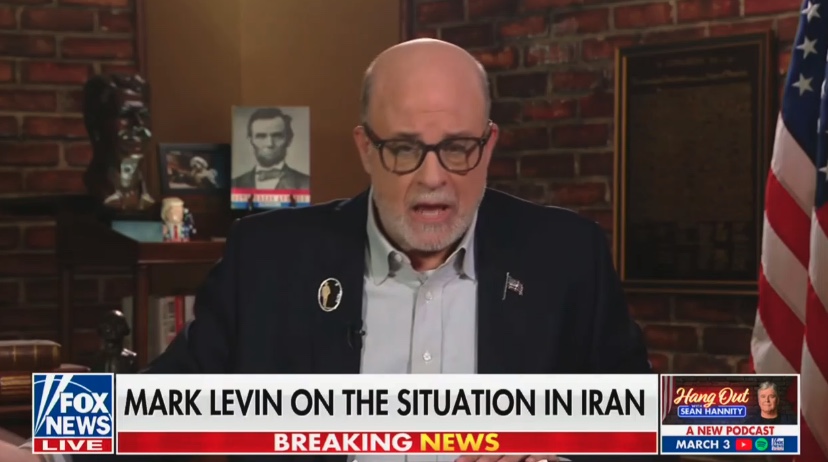
The intersection of American media rhetoric and Middle Eastern diplomacy reached a significant flashpoint this week as prominent Fox News personality Mark Levin issued a public call for President Donald Trump to abandon ongoing diplomatic negotiations and initiate military strikes against the Islamic Republic of Iran. This development comes at a precarious moment for regional stability, as the United States simultaneously manages a substantial military buildup in the Middle East while maintaining a delicate backchannel for peace talks through the Sultanate of Oman. The tension between the "maximum pressure" advocates and proponents of a negotiated nuclear settlement highlights a deep-seated rift in American foreign policy strategy regarding Tehran’s nuclear ambitions and regional influence.
The Call for Military Intervention
Appearing on the Friday edition of "Hannity," Mark Levin, a constitutional lawyer and influential conservative commentator, argued that the window for diplomatic engagement with Iran has effectively closed. Addressing the current administration’s stance, Levin asserted that the time for patience had expired, framing the situation not as a new conflict, but as a necessary response to a decades-long undeclared war.
"There’s a time for negotiation, there is a time for diplomacy, and I think the president has demonstrated he’s bent over backwards that that time does not last forever, that that time is up!" Levin stated during the broadcast. He further argued that the United States is already in a state of conflict with Iran, citing a historical toll of American casualties. "It’s not us going to war with Iran… They’ve been at war with us for half a century! They’ve killed over 1,000 Americans! They have maimed tens of thousands of Americans! We don’t need to put up with that. It’s time to put it to an end."
Levin’s rhetoric was echoed by host Sean Hannity, who drew historical parallels between the current Iranian leadership and the rise of the Third Reich. Hannity, who famously compared former Iraqi leader Saddam Hussein to Adolf Hitler in the lead-up to the 2003 Iraq War, questioned the logic of those favoring continued talks. "If you knew after what Hitler did, you could stop it ahead of time, wouldn’t you wanna do it?" Hannity asked, suggesting that a "radical mindset" in Tehran makes diplomacy a futile endeavor.
Levin responded by criticizing the "isolationist" wing of American politics, suggesting that a failure to act now could lead to a catastrophic nuclear event. "The isolationists brought us Hitler," Levin argued. "Do we really need to be hit again, this time by a nuclear weapon? The enemy is not isolated, the enemy’s not pacifistic, the enemy is not appeasing. The enemy wants to destroy us!"
The Omani Diplomatic Track
While voices on Fox News call for kinetic action, the diplomatic reality on the ground presents a different narrative. Badr Albusaidi, the Foreign Minister of Oman, recently provided an optimistic assessment of the ongoing negotiations between Washington and Tehran. In an extensive interview with Margaret Brennan on CBS News’ "Face the Nation," Albusaidi revealed that a "peace deal is within our reach."
Oman has historically served as a critical intermediary between the West and Iran, often facilitating the "Muscat Channel" that led to the 2015 Joint Comprehensive Plan of Action (JCPOA). According to Albusaidi, recent talks have resulted in "substantial progress," with Iranian officials reportedly reiterating a commitment to never develop or possess nuclear weapons. The Omani Foreign Minister emphasized that while the framework for an agreement is emerging, more time is required to finalize the technical and political details necessary for a sustainable treaty.
The contrast between Albusaidi’s diplomatic optimism and Levin’s call for bombardment illustrates the high stakes of the current standoff. Proponents of the Omani track argue that a negotiated settlement is the only way to ensure long-term monitoring of Iran’s nuclear facilities, while critics argue that Tehran uses such talks merely to buy time while advancing its enrichment capabilities.
A Chronology of Escalation and Diplomacy
To understand the current friction, it is necessary to examine the timeline of events that have brought U.S.-Iran relations to this juncture:
- May 2018: The United States withdraws from the JCPOA, initiating a "maximum pressure" campaign involving heavy economic sanctions.
- January 2020: A U.S. drone strike kills Iranian General Qasem Soleimani in Baghdad, leading to Iranian missile strikes on U.S. bases in Iraq.
- 2021-2023: Various attempts to revive the nuclear deal occur in Vienna, with fluctuating levels of success and frequent stalemates.
- Late 2023 – Present: Amid rising regional tensions involving proxy groups in Yemen, Lebanon, and Iraq, the U.S. increases its naval and aerial presence in the Persian Gulf and Eastern Mediterranean.
- Current Month: Reports emerge of "substantial progress" in Omani-mediated talks, even as the U.S. military maintains a high state of readiness in the region.
Supporting Data: The Nuclear and Military Landscape
The urgency felt by commentators like Levin is often tied to technical data regarding Iran’s nuclear program. According to the latest reports from the International Atomic Energy Agency (IAEA), Iran has significantly increased its stockpiles of uranium enriched to 60% purity. While 90% purity is required for weapons-grade material, the jump from 60% to 90% is technically shorter than the initial enrichment phases.
Data from the Institute for Science and International Security suggests that Iran’s "breakout time"—the time required to produce enough weapons-grade uranium for one nuclear explosive—has been reduced to a matter of weeks, or even days, in some scenarios. This technical reality fuels the argument that diplomacy may be lagging behind the pace of scientific advancement.
On the military side, the United States has deployed significant assets to the region to deter escalation. This includes:
- Carrier Strike Groups: The presence of nuclear-powered aircraft carriers provides a massive platform for air sorties.
- Advanced Missile Defense: Deployment of THAAD (Terminal High Altitude Area Defense) and Patriot missile batteries to protect U.S. personnel and allies.
- Strategic Bombers: Periodic deployments of B-52 Stratofortress bombers to the region as a "show of force."
Internal Political Implications and Official Responses
The debate between Levin and the diplomatic community reflects a broader schism within the Republican Party and the American foreign policy establishment. On one side, the "Jacksonian" school of thought, represented by Levin, favors decisive military action to eliminate threats. On the other side, a more "Realist" or "Restraint" oriented faction—which has gained ground within the "America First" movement—is wary of entering another protracted conflict in the Middle East.
While the White House has not issued a direct response to Levin’s specific comments on "Hannity," the State Department has consistently maintained that diplomacy remains the preferred path, provided it is backed by a "credible threat of force." A spokesperson for the National Security Council recently noted that while the U.S. remains committed to preventing Iran from obtaining a nuclear weapon, the administration continues to explore all avenues, including the Omani mediation, to achieve that goal without a full-scale war.
The "1,000 Americans" figure cited by Levin refers to a 2019 Pentagon report which estimated that Iranian-backed forces were responsible for the deaths of at least 608 U.S. service members in Iraq between 2003 and 2011. Critics of Levin’s stance argue that while these figures are tragic, they do not necessarily justify a preemptive strike on Iranian soil, which could trigger a regional conflagration.
Broader Impact and Global Implications
The potential shift from diplomacy to military action would have immediate and profound effects on the global stage.
1. Energy Markets: A conflict in the Persian Gulf would likely see the closure of the Strait of Hormuz, through which approximately 20% of the world’s petroleum passes. Analysts predict oil prices could surge past $150 per barrel, potentially triggering a global recession.
2. Regional Alliances: U.S. allies, including Israel and Saudi Arabia, are watching the Omani talks closely. While Israel has expressed extreme skepticism regarding any deal that does not completely dismantle Iran’s enrichment infrastructure, Saudi Arabia has recently engaged in its own de-escalation efforts with Tehran, mediated by China. A U.S. military strike would force these regional powers to recalibrate their security postures instantly.
3. Proliferation Risks: Proponents of the Omani deal argue that a military strike would only delay, not destroy, Iran’s nuclear knowledge. They suggest that a strike might actually incentivize Tehran to sprint toward a nuclear deterrent to prevent future attacks. Conversely, Levin and his supporters argue that only the destruction of physical infrastructure can provide a meaningful setback to Iran’s ambitions.
Conclusion: The Path Ahead
The rhetoric displayed on Fox News by Mark Levin and Sean Hannity serves as a bellwether for a significant portion of the American political landscape that views Iran as an existential threat requiring a military solution. However, the quiet, persistent efforts of Omani diplomats suggest that a non-kinetic resolution remains a possibility, albeit a fragile one.
As President Trump weighs these competing pressures—the calls for "putting it to an end" via military force versus the "substantial progress" reported by Omani mediators—the decision will likely define the security architecture of the Middle East for the next generation. For now, the world remains in a state of watchful waiting, as the roar of military engines in the Gulf competes with the hushed negotiations in Muscat.


 Nila Kartika Wati
 Ana Megawati
 Pevita Pearce
 Joko Widodo
 admin
admin