
 Amara Maple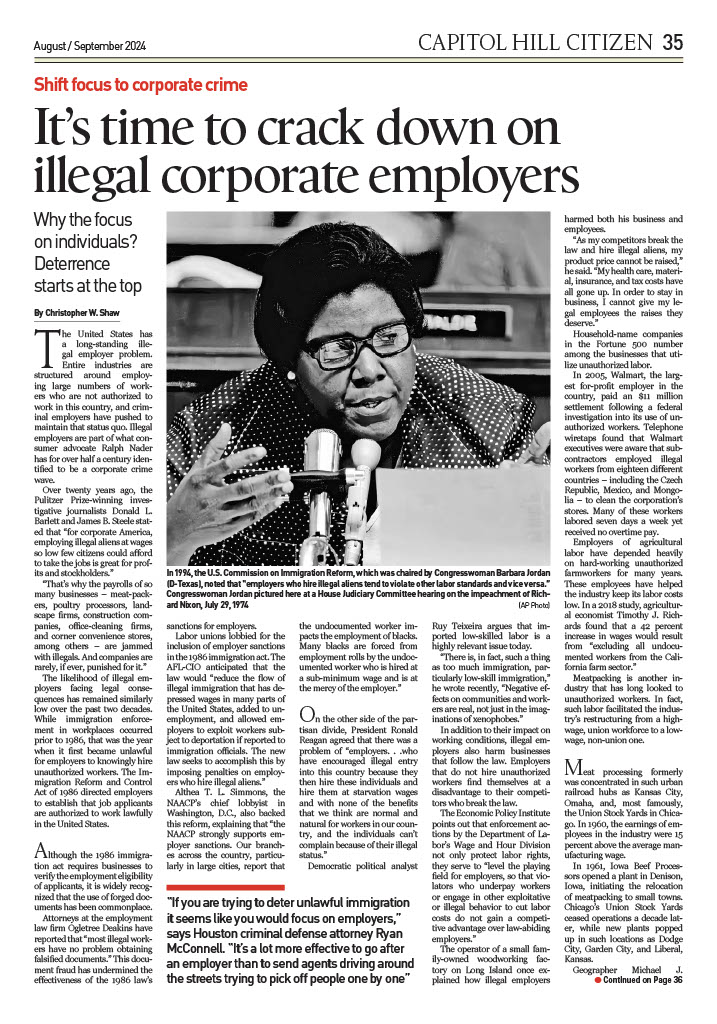
The United States continues to grapple with a pervasive and deeply entrenched issue of illegal employment, a problem that has persisted for decades and underpins significant segments of the national economy. This isn’t merely an isolated phenomenon but a systemic challenge, with entire industries—ranging from agriculture and construction to hospitality and service sectors—structured around the deliberate employment of workers unauthorized to work in the country. This systemic reliance, often driven by the pursuit of reduced labor costs and increased profits, has been identified by consumer advocate Ralph Nader for over half a century as a significant component of what he terms a "corporate crime wave."
This persistent issue is highlighted in a recent report, "Shift focus to corporate crime: It’s time to crack down on illegal corporate employer," penned by Christopher Shaw for the February/March 2026 issue of the Capitol Hill Citizen. The report echoes long-standing concerns about the economic and social ramifications of such practices, pointing to how criminal employers actively work to maintain this profitable status quo, often at the expense of fair labor practices, worker exploitation, and competitive market dynamics.
A Decades-Long Battle: Historical Context and Legislative Efforts
The challenge of illegal employment is not new; its roots delve deep into the nation’s economic and immigration history. More than two decades ago, Pulitzer Prize-winning investigative journalists Donald L. Barlett and James B. Steele meticulously documented how employing unauthorized workers at wages below market rates became a powerful engine for corporate profits and shareholder value. In their incisive reporting, they highlighted the pervasive nature of this practice across various sectors. "For corporate America, employing illegal aliens at wages so low few citizens could afford to take the jobs is great for profits and stockholders," they wrote, underscoring the stark economic incentive. They further elaborated, "That’s why the payrolls of so many businesses — meat-packers, poultry processors, landscape firms, construction companies, office-cleaning firms, and corner convenience stores, among others — are jammed with illegals. And companies are rarely, if ever, punished for it."
Despite the clarity of such observations, the likelihood of illegal employers facing significant legal consequences has remained remarkably low over the past two decades, perpetuating a cycle of exploitation and unfair competition.
The legislative framework designed to combat this problem dates back to the Immigration Reform and Control Act (IRCA) of 1986. While immigration enforcement in workplaces existed in various forms prior to this, IRCA marked a pivotal moment by making it explicitly unlawful for employers to knowingly hire or continue to employ unauthorized workers. The act mandated that employers establish the employment eligibility of job applicants, primarily through verifying identity and work authorization documents. This was a landmark attempt to shift the focus of immigration enforcement from individual migrants to the employers who benefited from their labor.
The Flaws in the System: Document Fraud and Enforcement Gaps
Despite IRCA’s intentions, its effectiveness has been significantly undermined by widespread document fraud. It is a widely recognized reality that the market for falsified identification and work authorization documents thrives, rendering employer verification processes often superficial. Attorneys at prominent employment law firms, such as Ogletree Deakins, have openly reported that "most illegal workers have no problem obtaining falsified documents." This pervasive fraud creates a loophole that allows employers to claim due diligence while often tacitly acknowledging or even facilitating the employment of unauthorized individuals. The reliance on easily forged documents essentially neuters the core enforcement mechanism of the 1986 law, allowing the status quo of illegal employment to persist largely unchecked.
The U.S. Commission on Immigration Reform, chaired by Congresswoman Barbara Jordan (D-Texas) in 1994, explicitly recognized this systemic vulnerability. The commission observed that "employers who hire illegal aliens tend to violate other labor standards and vice versa." This critical insight links illegal employment not just to immigration violations but to a broader pattern of corporate malfeasance, including wage theft, unsafe working conditions, and disregard for workers’ rights. The employment of unauthorized workers often goes hand-in-hand with a host of other labor abuses, creating a deeply exploitative environment.
Advocacy for Employer Accountability: A Unified Front
The call for employer sanctions within the 1986 immigration act was not without significant advocacy from labor unions and civil rights organizations. These groups recognized the detrimental impact of illegal employment on the broader workforce and sought to protect both authorized workers and the integrity of labor standards.
The AFL-CIO, a leading federation of unions, was a vocal proponent of including employer sanctions. They anticipated that the law would "reduce the flow of illegal immigration that has depressed wages in many parts of the United States, added to unemployment, and allowed employers to exploit workers subject to deportation if reported to immigration officials. The new law seeks to accomplish this by imposing penalties on employers who hire illegal aliens." This stance underscored a fundamental belief that by targeting the demand side of the equation—the employers—the economic incentive for unauthorized immigration would diminish, thereby protecting domestic labor markets and vulnerable workers.
Similarly, the NAACP, through its chief lobbyist in Washington, D.C., Althea T. L. Simmons, strongly backed the reform. Simmons explained that "the NAACP strongly supports employer sanctions. Our branches across the country, particularly in large cities, report that…" (The original article cuts off here, but the implication is clear: the NAACP observed firsthand the negative impacts on their communities). This support from a major civil rights organization highlighted the intersection of immigration policy with broader issues of economic justice and racial equality, recognizing that the exploitation of one group of workers could depress wages and opportunities for all.
Legal experts have consistently echoed the sentiment that focusing enforcement on employers is a more strategic and effective approach. Houston criminal defense attorney Ryan McConnell articulates this perspective succinctly: "If you are trying to deter unlawful immigration it seems like you would focus on employers. It’s a lot more effective to go after an employer than to send agents driving around the streets trying to pick off people one by one." This viewpoint suggests a pragmatic shift in enforcement strategy, moving from reactive, individual-level interventions to proactive, systemic corporate accountability.
Economic and Social Ramifications: Undermining Fair Competition and Worker Rights
The presence of a large, exploitable workforce of unauthorized individuals creates significant distortions in the labor market. The Economic Policy Institute (EPI) has consistently highlighted that lax enforcement against illegal employers not only harms workers but also creates an uneven playing field for businesses. When some employers gain a competitive advantage by underpaying workers, avoiding taxes, or flouting labor laws, law-abiding businesses are put at a distinct disadvantage. The EPI points out that robust enforcement actions by the Department of Labor’s Wage and Hour Division serve a dual purpose: they "not only protect labor rights, they serve to level the playing field for employers, so that violators who underpay workers or engage in other exploitative or illegal behavior to cut labor costs do not gain a competitive advantage over law-abiding employers."
This competitive imbalance has far-reaching consequences. Businesses that comply with labor laws and pay fair wages struggle to compete with those that drastically cut costs by employing unauthorized workers under exploitative conditions. This can lead to downward pressure on wages across entire industries, affecting authorized workers and contributing to income inequality. Moreover, it fosters a shadow economy where workers are vulnerable to abuse, fear of deportation silences complaints, and basic human rights are often violated.
The Scale of the Problem: Data and Scope
Estimates from various research institutions, including the Pew Research Center, indicate that millions of unauthorized immigrants reside in the United States, with a significant portion participating in the workforce. While precise figures fluctuate, studies have consistently shown that industries like agriculture, construction, leisure and hospitality, and manufacturing disproportionately employ unauthorized workers. For instance, the agricultural sector has long relied heavily on this workforce, with some estimates suggesting that a substantial majority of farmworkers may be unauthorized. This reliance is not accidental; it is often embedded in the business models of these industries, where employers face intense pressure to keep costs low and maximize output.
The economic impact of this shadow labor market is multifaceted. While some argue that unauthorized workers fill jobs that citizens are unwilling to take, critics contend that this argument masks the suppression of wages and the creation of undesirable working conditions. By having access to a workforce that can be paid below minimum wage, denied benefits, and subjected to unsafe environments without fear of reprisal, employers avoid the true costs of labor, thereby externalizing these costs onto society and other businesses.
The Enforcement Landscape: Challenges and Calls for Reform
Despite the clear mandates of IRCA and subsequent legislative efforts, the enforcement apparatus has often struggled to keep pace with the scale and sophistication of illegal employment practices. The Department of Homeland Security (DHS), through its Immigration and Customs Enforcement (ICE) agency, is tasked with workplace enforcement. However, resources are often stretched, and the political will to aggressively pursue corporate offenders has been inconsistent.
Workplace enforcement has seen fluctuations over the years, often reflecting changes in administration priorities. While some administrations have emphasized large-scale raids and arrests of workers, critics argue that such tactics are often ineffective in dismantling the corporate structures that facilitate illegal employment. Instead, they can instill fear in immigrant communities, disrupt local economies, and separate families, without fundamentally altering employer behavior.
There is a growing consensus among labor advocates, some legal experts, and even segments of the business community that a more robust and targeted approach to employer accountability is necessary. This would involve:
- Increased Penalties: Significantly higher fines and stricter criminal penalties for employers who knowingly and repeatedly hire unauthorized workers.
- Enhanced Audits: More frequent and thorough audits of company payrolls and I-9 forms, coupled with advanced data analytics to identify patterns indicative of fraud.
- Improved Verification Systems: Exploring more secure and reliable employment verification systems, potentially moving beyond easily falsifiable physical documents, while safeguarding civil liberties.
- Interagency Cooperation: Greater collaboration between immigration enforcement agencies, the Department of Labor, and state labor departments to identify and prosecute employers who violate both immigration and labor laws. This would leverage the expertise of agencies focused on wage theft, safety violations, and other forms of worker exploitation.
- Protection for Whistleblowers: Stronger protections and incentives for workers who report illegal employment practices, regardless of their immigration status. This would empower vulnerable workers to come forward without fear of retaliation.
The Path Forward: Towards Comprehensive Reform
The issue of illegal employment is intrinsically linked to broader debates about comprehensive immigration reform. Without a more streamlined and realistic legal immigration system that aligns with the nation’s labor needs, the demand for unauthorized labor may persist. However, even within the existing legal framework, a renewed and sustained focus on corporate accountability is paramount.
The report by Christopher Shaw in the Capitol Hill Citizen serves as a timely reminder that the economic incentives driving illegal employment are powerful and deeply ingrained. Addressing this requires more than piecemeal solutions; it demands a strategic, sustained, and politically courageous effort to hold corporate offenders accountable. By shifting the focus squarely onto employers who exploit loopholes and vulnerable populations for profit, the United States can begin to dismantle a system that undermines fair competition, depresses wages, and perpetuates a cycle of exploitation. This is not just an immigration issue; it is an economic justice issue, a labor rights issue, and a fundamental challenge to the rule of law within the nation’s corporate landscape. The call to crack down on illegal corporate employers is, therefore, a call for integrity and equity across the American economy.




 Nila Kartika Wati
 Jia Lissa
 Ana Megawati
 Pevita Pearce
 Joko Widodo
 admin
admin