
 Yuyun Lusiyani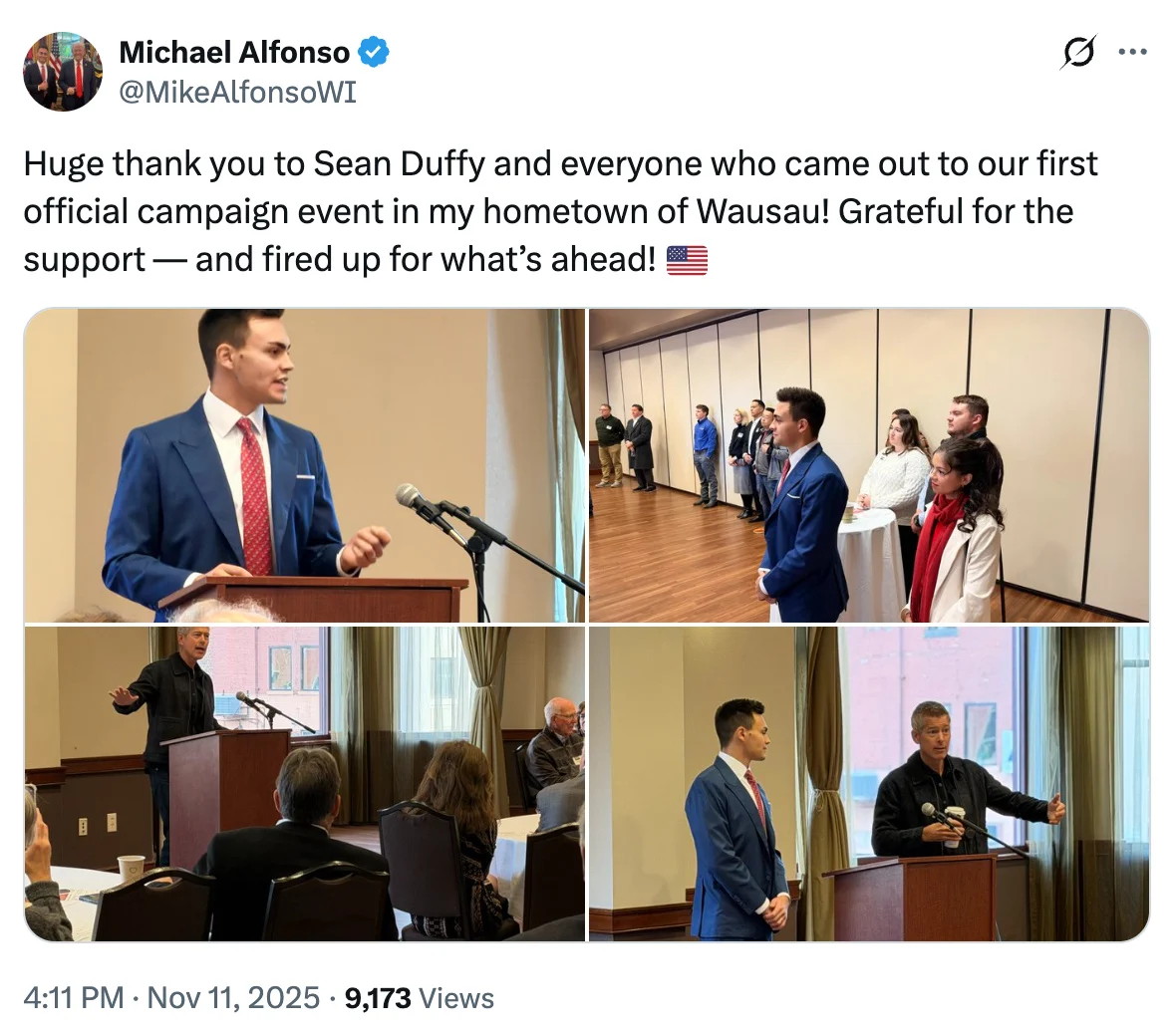
A nascent political campaign in northern Wisconsin, led by a 26-year-old Republican primary candidate, Michael Alfonso, has unexpectedly become a focal point in a national conversation about ethics, influence, and the blurred lines between family ties and federal policy. Alfonso, a political novice with a background in construction and podcasting, is running for Wisconsin’s 7th Congressional District seat. His campaign has garnered significant financial contributions from an array of lobbyists, business executives, and political action committees (PACs) with direct interests in industries regulated and funded by the U.S. Department of Transportation (DOT). The critical nexus of this scrutiny is Alfonso’s familial connection: he is the son-in-law of Sean Duffy, the current U.S. Secretary of Transportation.
The pattern of donations raises significant questions about the appearance of undue influence, especially given that many of these donors had no prior history of contributing to candidates in Wisconsin’s 7th Congressional District or to Secretary Duffy himself during his nearly decade-long tenure representing the district. The situation is particularly highlighted by a $2,500 donation from lobbyists connected to the $16 billion Hudson Tunnel Project, a critical infrastructure initiative between Manhattan and New Jersey. This contribution followed a controversial decision by the White House to freeze federal grant funding for the tunnel project in the fall, citing concerns over its diversity and equity measures. While Alfonso, as a congressional candidate, holds no direct sway over such federal funding decisions, his father-in-law, Secretary Duffy, presides over the very department responsible for these allocations.
The Nexus of Power and Donations: Michael Alfonso’s Candidacy
Michael Alfonso, endorsed by former President Donald Trump, entered the race for Wisconsin’s 7th Congressional District following incumbent Tom Tiffany’s decision to run for governor. Alfonso, a 2022 University of Wisconsin graduate with a math degree, married Evita Duffy, Secretary Sean Duffy’s daughter, in 2022 at one of Trump’s New Jersey golf courses. This personal connection to a high-ranking Cabinet official, coupled with a presidential endorsement, immediately positioned Alfonso as a formidable, if inexperienced, candidate.
A ProPublica analysis of campaign finance records has revealed a striking trend: Alfonso’s campaign has received numerous contributions from entities deeply invested in transportation infrastructure, a sector directly overseen by the DOT. These include industries spanning rails, highways, shipping, and air travel, as well as the Federal Aviation Administration (FAA), which falls under the DOT’s purview. The donations, while legally permissible under current campaign finance laws, have fueled a perception among ethics watchdogs that they are intended to curry favor or gain access with Secretary Duffy through his son-in-law. Daniel Weiner, director of the Elections and Government Program at the Brennan Center for Justice, articulated this concern, stating, "The law, as it stands, provides very little constraint. There’s a very large gulf between what is legal and what is ethical. Obviously, this raises numerous ethical questions."
The Hudson Tunnel Project: A Case Study in Influence
The $16 billion Hudson Tunnel Project is a cornerstone of East Coast infrastructure, vital for enhancing passenger rail service for hundreds of thousands of New York City commuters. Its progress, however, hit a significant snag in late 2025 when the White House temporarily froze its federal grant funding, citing concerns about the project’s adherence to diversity and equity measures. This unexpected halt sent ripples through the infrastructure community and underscored the immense power of federal funding decisions.
Shortly after this funding freeze, lobbyists representing the Hudson Tunnel Project contributed $2,500 to Michael Alfonso’s campaign. The timing and source of this donation have raised eyebrows, suggesting a potential strategy to influence the decision-making process at the DOT, even indirectly. Although a court intervened, ordering the release of the funds and allowing construction to resume in early 2026, the bistate commission overseeing the project has warned of potential disruptions if federal disbursements do not continue smoothly. The incident serves as a stark illustration of how seemingly distant political races can intersect with high-stakes federal projects, especially when family ties to Cabinet-level officials are involved. Venture Government Strategies, whose lobbyists for the tunnel project contributed to Alfonso, declined to comment on the matter.
Secretary Sean Duffy’s Role and Public Appearances
Secretary Sean Duffy’s active involvement in his son-in-law’s campaign further complicates the ethical landscape. Duffy, who held the 7th Congressional District seat for nearly a decade before resigning in 2019, has openly assisted Alfonso, leveraging his political stature and connections. Notices for a November "meet and greet" with Alfonso in Wausau, Wisconsin, prominently featured Duffy as a "special guest." A December fundraiser also included Duffy’s attendance, with the political action committee for Delta Air Lines listed among the sponsors. Although the invitation included a caveat stating, "Sean Duffy is not soliciting funds in connection with this event," his presence at such events undeniably lends credibility and attracts donors interested in engaging with a sitting Cabinet Secretary.
The legal framework surrounding such activities dictates that Cabinet secretaries can campaign for relatives, provided they do so in their "personal capacity," on their personal time, without using government resources, and without explicitly promising official action in exchange for contributions. Nathaniel Sizemore, a spokesperson for Secretary Duffy, provided a written statement affirming this stance: "The Secretary attends fundraising events in his personal capacity. Regulatory decisions are guided by career safety professionals, the law, and the facts."
However, the practical implications often extend beyond these legal stipulations. Alfonso’s campaign has notably employed Kirstin Hopkins, the same fundraising consultant used by Duffy during his own congressional campaigns. Furthermore, a super PAC, the Northwoods Future PAC, has provided significant assistance to Alfonso’s campaign for ads and mailers, funded by a substantial $1 million from Duffy’s former campaign committee. As of the end of 2025, Alfonso’s campaign committee had raised over $305,000, adhering to the legal limits of $3,500 from individuals and $5,000 from PACs per election. This robust financial backing, coupled with the high-profile support from his father-in-law, has not gone unnoticed by local Republicans, some of whom have expressed irritation at the "newcomer" seemingly "gliding" into a significant political position due to familial advantage.
Broader Patterns of Influence: Key Donors and Their Interests
The donations to Michael Alfonso’s campaign paint a broader picture of how industries seek to navigate the corridors of power.
Jeffrey Miller and the Rise of eVTOL Technology: Lobbyist Jeffrey Miller, a finance chair of former President Trump’s most recent inaugural committee, and his company’s chief operating officer, together donated $8,500 to Alfonso in December. FEC records indicate that no one from Miller Strategies had previously donated to Duffy or Tiffany. Miller’s lobbying disclosure reports for 2025 show extensive engagement with the Transportation Department on behalf of at least nine companies, one New York county, and one Native American tribe. His lobbying efforts covered diverse issues such as airport signage regulation, aviation permitting for supersonic airliner developers, and advancements in GPS technology. Crucially, Miller also advocated for Archer Aviation regarding electric vertical takeoff and landing (eVTOL) aircraft technology, often envisioned as "flying cars."

Just weeks after Miller’s donation, Secretary Duffy announced a "first-of-its-kind FAA pilot program" to test eVTOL technology across eight demonstration projects in 26 states. Archer Aviation was among the companies selected to participate. In a video accompanying the announcement, Duffy enthusiastically promoted eVTOLs, envisioning "Ubers in the air" and declaring that "eVTOLs are going to make the airspace far more interesting and far more fun, and we have to be prepared for that." The close temporal proximity between the donations, lobbying activities, and the official announcement underscores the appearance of a direct link between political contributions and policy outcomes. Miller did not respond to requests for comment.
Sharad Tak and Deep-Water Ports: Sharad Tak, CEO of ST LNG in Bethesda, Maryland, contributed $500 to Alfonso’s campaign, with his wife, Mahinder, donating an additional $7,000, despite not attending the fundraiser. Neither had previously donated to Duffy or Tiffany. ST LNG is a company actively seeking a DOT-issued license to construct and operate a deep-water port off Matagorda, Texas, for loading liquefied natural gas onto carriers. Ann Murphy, a consultant for Tak, stated that the Texas project had "absolutely no bearing" on the campaign contribution, attributing it to Tak’s support for causes endorsed by her and her husband. This explanation, while maintaining legal propriety, does little to dispel the perception of potential influence.
Brightline and Rail Safety Funding: The PAC for Brightline, a high-speed train service in Florida, donated $2,500 to Alfonso in December. Brightline has faced intense scrutiny for a high number of fatalities—over 180 pedestrians or drivers killed at crossings since 2017, according to investigations by the Miami Herald and WLRN. Secretary Duffy had publicly committed to "drive down the number of deaths" at a congressional committee hearing in July. In September, his department announced the distribution of $42 million to improve safety along the Brightline corridor. Brightline officials, in statements to Florida news organizations, attributed the deaths to suicides and "reckless" behavior, rather than inherent safety flaws in their operations. The donation from Brightline’s PAC, against this backdrop of DOT funding and safety concerns, adds another layer to the ethical questions surrounding Alfonso’s fundraising. Brightline, T-Mobile, and Lockheed Martin did not respond to requests for comment. Lockheed Martin’s website states its compliance with all applicable laws and regulations regarding political activities.
Other Transportation Sector Donors: Other significant contributors include PACs from military jetmaker Lockheed Martin, which is subject to FAA safety regulations and holds lucrative government contracts; T-Mobile, which is collaborating with the DOT on a project to enhance 5G infrastructure resilience; and various unions and trade associations representing heavy equipment operators, engineers, aeronautical services, and the travel industry. Peter Bartek, founder of FTS Rail, a manufacturer of railroad repair tools and sensors, donated $3,644 in November. Duffy had appointed Bartek to a DOT advisory committee in July. Bartek, who had never previously donated to a candidate in the district, expressed his admiration for Secretary Duffy, stating, "I like Secretary Duffy very much, and I thought very simply, boy, if he’s anything like his father-in-law, it would be nice to support him as well."
General Motors and a Promotional Corvette: Even the automotive giant General Motors (GM) has contributed, with its PAC donating $1,000 to Alfonso a couple of weeks after a significant promotional event involving Secretary Duffy. In mid-December, Duffy featured prominently in a promotional video uploaded to X, showcasing a sleek, black, limited-edition Corvette, valued at $200,000, adorned with patriotic insignia. Duffy lauded its "over 1,000 horsepower" and declared, "We’re going to take this bad boy on a little test drive to the Army-Navy game." The video, which garnered over 130,000 views, highlighted a travel app developed by GM in partnership with the Department of Transportation, effectively serving as valuable advertisement for Chevrolet’s "Stars and Steel" automotive series. GM regularly lobbies the DOT on issues including fuel economy, vehicle safety, and emissions standards. This sequence of events — a high-profile promotional appearance by the Secretary of Transportation, followed by a PAC donation from the involved company — further strengthens the perception of a quid pro quo or, at minimum, a transactional relationship between political support and official visibility. GM did not respond to requests for comment.
Historical Precedents and Ethical Concerns
The current situation involving Secretary Duffy and his son-in-law is not an isolated incident in the history of U.S. politics. Cabinet secretaries and other high-ranking officials have previously faced scrutiny over the fundraising activities and political ambitions of their relatives.
During the first Trump administration, then-Transportation Secretary Elaine Chao, wife of Senate Majority Leader Mitch McConnell, made headlines for allegations of appearing to give preferential treatment to Kentucky officials in the allocation of millions of dollars in infrastructure grants. Critics pointed to the disproportionate share of grants directed to her husband’s home state, raising questions about conflicts of interest. Chao’s office denied any favoritism, maintaining that Kentucky’s share was not unusual.
Similarly, under President Barack Obama in 2012, Agriculture Secretary Tom Vilsack fielded questions regarding the separation between USDA business and his wife Christie’s congressional campaign. Christie Vilsack, in an interview, emphasized the couple’s diligence in ensuring her husband’s non-involvement in her fundraising, stating he "never did any fundraising at all" for her campaign. These historical examples underscore the persistent challenge of maintaining ethical boundaries and public trust when family members of powerful officials enter the political arena. The "large gulf between what is legal and what is ethical," as noted by Daniel Weiner, remains a recurring theme in American governance.
Political Implications and Local Reaction
Michael Alfonso’s campaign, bolstered by significant financial contributions and the explicit backing of both President Trump and his influential father-in-law, presents a unique dynamic in Wisconsin’s 7th Congressional District. While Alfonso lists a dozen issues on his campaign website, ranging from education and health care to immigration and abortion, transportation issues are conspicuously absent from his stated priorities. This absence, juxtaposed with the heavy influx of donations from the transportation sector, only intensifies the ethical questions.
The situation has reportedly "irked some Wisconsin Republicans," who view Alfonso’s rapid ascent as potentially leveraging familial connections rather than earned political capital. The implications for the Republican primary are substantial, as the district is a key battleground. Beyond the immediate electoral outcome, the appearance of a system where access and influence can be purchased through donations to family members of powerful officials could erode public trust in government integrity. It suggests a potential pathway for industries to exert influence on federal policy decisions, circumventing direct lobbying efforts and instead channeling resources to individuals with indirect but powerful family ties.
Conclusion
The campaign of Michael Alfonso in Wisconsin’s 7th Congressional District has inadvertently brought into sharp relief the complex and often controversial interplay between family connections, political fundraising, and federal policy. While the donations to Alfonso’s campaign may adhere to the letter of campaign finance law, the sheer volume and source of contributions from industries directly regulated and funded by the Department of Transportation—headed by his father-in-law, Secretary Sean Duffy—raise profound ethical questions. The timing of certain donations, particularly those linked to the Hudson Tunnel Project and the eVTOL program, creates a troubling appearance of a transactional relationship, where political contributions might be perceived as a means to gain favor or influence official actions.
As the campaign progresses, and with Secretary Duffy continuing to participate in Alfonso’s events, the scrutiny on these financial flows and their potential implications for public trust will undoubtedly intensify. The case serves as a poignant reminder of the enduring challenge for public officials to separate their personal and family lives from their official duties, especially in an era where transparency and accountability are increasingly demanded by the electorate. The "gulf between what is legal and what is ethical" remains a critical fissure in American politics, demanding continuous vigilance and, perhaps, legislative reevaluation.

 Jia Lissa
 Joko Widodo
 Eva Lovia

 Pevita Pearce