
 Amara Maple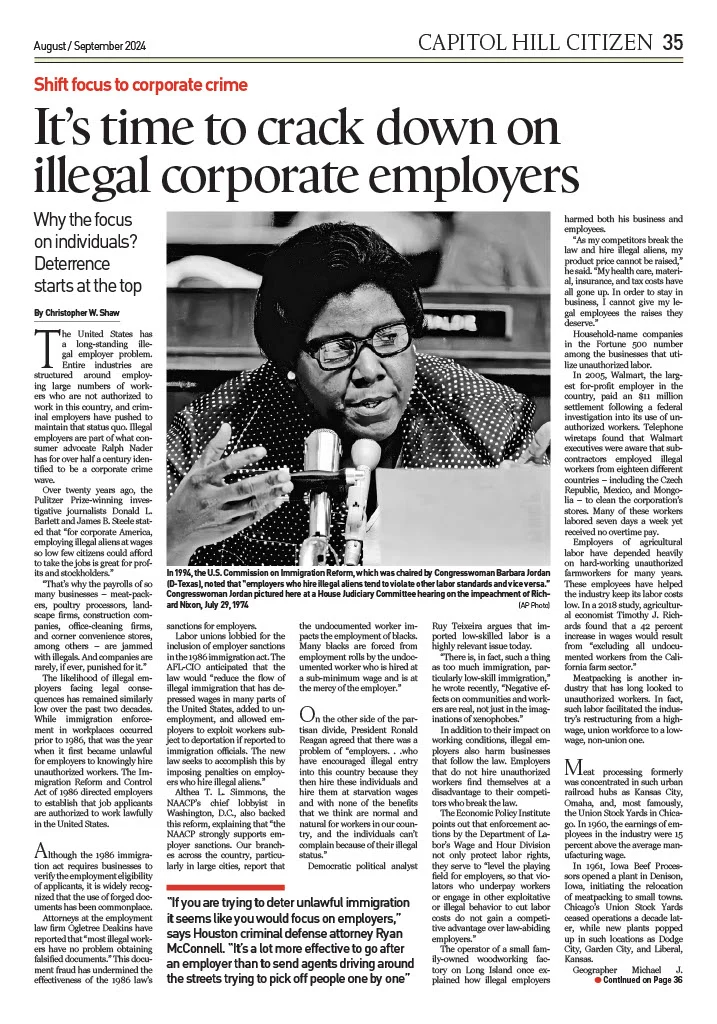
The United States grapples with a deeply entrenched issue of illegal employment, a pervasive problem that consumer advocate Ralph Nader has consistently identified for over half a century as a significant component of the nation’s broader corporate crime wave. This challenge is not merely incidental but, as detailed in Christopher Shaw’s report, "Shift focus to corporate crime: It’s time to crack down on illegal corporate employer," published in the February/March 2026 issue of the Capitol Hill Citizen, reveals entire industries structured around the deliberate employment of workers unauthorized to legally work within the country’s borders. These "criminal employers," as the report characterizes them, actively strive to maintain a status quo that prioritizes profit over legal compliance and ethical labor practices.
A System Built on Exploitation: Historical Context and Economic Drivers
The phenomenon of illegal employment is not new, nor is its link to corporate profitability. Over two decades ago, Pulitzer Prize-winning investigative journalists Donald L. Barlett and James B. Steele starkly articulated this dynamic, noting that "for corporate America, employing illegal aliens at wages so low few citizens could afford to take the jobs is great for profits and stockholders." Their assessment underscored that this practice was not a fringe activity but a core strategy for many businesses across various sectors. They specifically cited meat-packers, poultry processors, landscape firms, construction companies, office-cleaning firms, and even corner convenience stores as examples of businesses whose payrolls were "jammed with illegals." Crucially, Barlett and Steele highlighted a critical failing in the system: "And companies are rarely, if ever, punished for it." This observation from two decades past unfortunately resonates with contemporary assessments, suggesting that the likelihood of illegal employers facing significant legal consequences has remained persistently low.
The economic incentive behind this practice is undeniable. By hiring unauthorized workers, businesses can often circumvent minimum wage laws, overtime regulations, and benefits requirements, drastically reducing labor costs. This creates an unfair competitive advantage over law-abiding businesses that invest in compliant hiring practices, worker training, and fair compensation. The result is a race to the bottom, where ethical businesses are pressured to cut corners or risk being outpriced by those who exploit a vulnerable workforce. This dynamic not only harms authorized workers by depressing wages and increasing unemployment in certain sectors but also perpetates a cycle of exploitation for the unauthorized workers themselves, who often endure substandard working conditions, wage theft, and fear of reprisal due to their precarious legal status.
Legislative Intent vs. Enforcement Reality: The 1986 Immigration Reform and Control Act
The legislative framework designed to combat illegal employment traces its roots significantly to the Immigration Reform and Control Act (IRCA) of 1986. Prior to IRCA, while workplace immigration enforcement existed, it was not explicitly unlawful for employers to knowingly hire unauthorized workers. The 1986 act marked a pivotal shift, making it illegal for employers to engage in such practices and mandating that businesses verify the employment eligibility of all job applicants. This requirement aimed to create a robust system where employers would establish that individuals seeking employment were authorized to work lawfully in the United States.
However, the effectiveness of IRCA was almost immediately challenged by pervasive loopholes and systemic failures, primarily the widespread use of forged documents. Attorneys at the prominent employment law firm Ogletree Deakins have reported, quite candidly, that "most illegal workers have no problem obtaining falsified documents." This ease of access to fraudulent identification — including fake Social Security cards, green cards, and driver’s licenses — has significantly undermined the law’s original intent, allowing employers to claim plausible deniability while continuing to hire unauthorized workers. The reliance on paper-based verification systems, which are easily manipulated, meant that IRCA, despite its ambitious goals, struggled to deter illegal hiring effectively.
A 1994 report from the U.S. Commission on Immigration Reform, chaired by Congresswoman Barbara Jordan (D-Texas), further illuminated the interconnectedness of illegal hiring and other labor abuses. The commission noted that "employers who hire illegal aliens tend to violate other labor standards and vice versa." This critical insight highlighted that businesses willing to flout immigration laws were often also those disregarding wage-and-hour laws, safety regulations, and other protections for workers. This pattern creates a breeding ground for systemic worker exploitation, where unauthorized workers, fearing deportation, are less likely to report abuses, thus emboldening unscrupulous employers.
Advocacy for Employer Sanctions: A Unified Front for Labor and Civil Rights
The inclusion of employer sanctions in the 1986 immigration act was not without significant advocacy from key labor and civil rights organizations. Labor unions, particularly the AFL-CIO, were instrumental in lobbying for these provisions. Their rationale was clear and pragmatic: the influx of unauthorized immigration had depressed wages across many parts of the United States, exacerbated unemployment for authorized workers, and created a class of exploitable workers vulnerable to deportation if they dared to challenge their employers. The AFL-CIO anticipated that the new law, by imposing penalties on employers, would "reduce the flow of illegal immigration that has depressed wages in many parts of the United States, added to unemployment, and allowed employers to exploit workers subject to deportation if reported to immigration officials." This perspective underscored a belief that targeting the demand side of the equation – the employers – was a more effective strategy than solely focusing on individual migrants.
Echoing this sentiment, Althea T. L. Simmons, the NAACP’s chief lobbyist in Washington, D.C., also provided strong backing for employer sanctions. The NAACP’s support stemmed from reports from its branches nationwide, especially in large urban centers, detailing how the exploitation of unauthorized workers adversely affected the economic prospects and labor conditions of African American and other minority workers. Both organizations recognized that the availability of a cheap, exploitable labor pool undermined hard-won labor protections and civil rights advancements for all workers.
The logic behind targeting employers continues to hold sway among legal experts today. Houston criminal defense attorney Ryan McConnell succinctly captures this perspective: "If you are trying to deter unlawful immigration it seems like you would focus on employers. It’s a lot more effective to go after an employer than to send agents driving around the streets trying to pick off people one by one." This viewpoint emphasizes the strategic inefficiency of individual-focused enforcement compared to the potential systemic impact of holding businesses accountable. Targeting the root cause—the corporate demand for cheap, exploitable labor—is seen as a more potent deterrent and a more just approach to immigration enforcement.
The Broader Impact: Economic Disparity and Erosion of Labor Standards
The ramifications of illegal employment extend far beyond individual workplaces, impacting the broader economy and society. The Economic Policy Institute (EPI) consistently highlights that robust enforcement actions by agencies like the Department of Labor’s Wage and Hour Division serve a dual purpose. Not only do they protect fundamental labor rights for all workers, but they also function to "level the playing field for employers." This is crucial because "violators who underpay workers or engage in other exploitative or illegal behavior to cut labor costs do not gain a competitive advantage over law-abiding employers." When enforcement is lax, compliant businesses are at a distinct disadvantage, potentially facing pressures to cut their own labor costs or even go out of business. This creates a perverse incentive structure that rewards illegal behavior and punishes ethical conduct.
Beyond unfair competition, the shadow economy fueled by illegal employment results in substantial losses in tax revenue for federal, state, and local governments. Wages paid off the books mean lost income tax, Social Security, and Medicare contributions, diverting funds from public services and infrastructure. Furthermore, unauthorized workers often live in fear, making them hesitant to report crimes, seek medical care, or enroll their children in schools, leading to broader social integration challenges and potential public health risks. The presence of a large, vulnerable workforce can also strain social services if these workers require emergency care or support without contributing to the tax base that funds such services.
The issue also has significant implications for national security and the integrity of immigration systems. The widespread use of fraudulent documents not only undermines employment verification but also poses challenges for identity management and border security efforts. The continuous debate surrounding comprehensive immigration reform often circles back to the efficacy of employer sanctions and the need for more secure, reliable employment verification systems, such as E-Verify, which aims to address the shortcomings of IRCA’s paper-based system by cross-referencing employment eligibility with government databases.
Challenges in Enforcement and the Path Forward
Despite the clear legal framework and the economic and social costs, prosecuting illegal employers remains a complex and resource-intensive endeavor. Investigations into corporate hiring practices can be lengthy, requiring detailed audits, interviews, and often, cooperation from fearful workers. Prosecutors must prove that employers knowingly hired unauthorized workers, a high bar that can be difficult to meet when employers claim to have been deceived by fraudulent documents. This difficulty often leads to a focus on individual worker deportations rather than corporate accountability, perpetuating the cycle identified by Barlett and Steele decades ago.
However, a shift in focus, as advocated by Christopher Shaw and other proponents of corporate accountability, suggests a more effective approach. This involves increased collaboration between agencies such as the Department of Labor, Homeland Security Investigations (HSI), and the Department of Justice to mount comprehensive investigations that target entire corporate structures rather than isolated incidents. It also necessitates stronger penalties for convicted employers, including significant fines, asset forfeiture, and, where appropriate, criminal charges for corporate executives.
Moreover, strengthening labor protections for all workers, regardless of their immigration status, is seen as a crucial complementary strategy. By ensuring that all workers can report wage theft, unsafe conditions, or other abuses without fear of retaliation, the incentive for employers to exploit vulnerable populations is diminished. This approach recognizes that worker exploitation is a labor issue first and foremost, with immigration status often being a tool used by employers to facilitate that exploitation.
Ultimately, addressing the long-standing problem of illegal corporate employers requires a multifaceted strategy that combines robust enforcement of existing laws, the development of more secure and efficient employment verification systems, and a renewed commitment to protecting labor rights for every individual in the workforce. Only by targeting the demand for exploitable labor, rather than solely focusing on the supply of unauthorized workers, can the United States truly begin to dismantle the corporate crime wave that has undermined its labor markets and ethical standards for generations. The call to action from the Capitol Hill Citizen is a timely reminder that the battle for fair labor practices and corporate accountability is far from over.



 Yuyun Lusiyani
 Ana Megawati
 Joko Widodo
 Eva Lovia
 Jia Lissa
 Pevita Pearce