
 Jia Lissa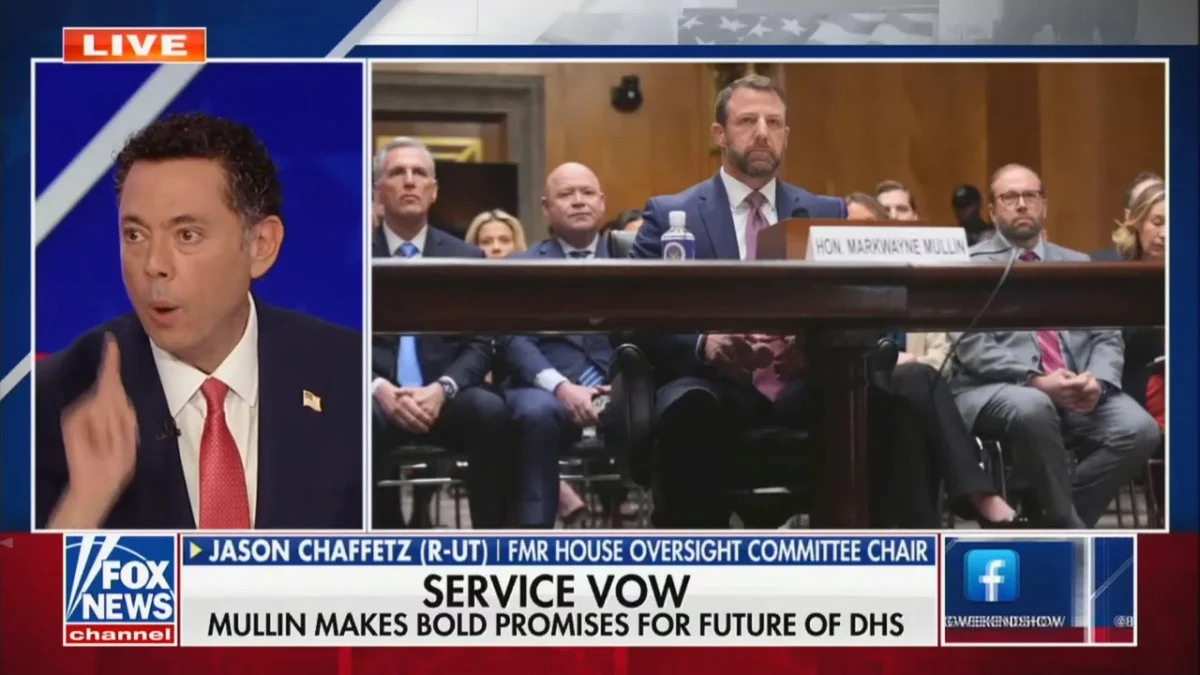
Former Utah Representative and current Fox News contributor Jason Chaffetz delivered a scathing critique of the United States Senate on Saturday, characterizing the recent confirmation hearing of Department of Homeland Security (DHS) secretary nominee Markwayne Mullin as an "embarrassment" for both political parties. Speaking as a co-host on "The Big Weekend Show," Chaffetz expressed profound disappointment in what he described as a lack of rigorous oversight and a failure by lawmakers to address critical security lapses within the department’s jurisdiction. Chaffetz, who previously served as the Chairman of the House Oversight Committee, argued that the proceedings prioritized personal grievances and collegial pleasantries over the urgent task of holding the executive branch accountable, particularly regarding the security failures surrounding the July 13 assassination attempt on former President Donald Trump.
The confirmation hearing, held before the Senate Homeland Security and Governmental Affairs Committee, was intended to vet Senator Markwayne Mullin (R-OK) for the role of DHS Secretary. While the committee ultimately advanced Mullin’s nomination in a bipartisan vote, the tone and content of the questioning drew sharp rebukes from observers like Chaffetz. The critic specifically targeted Republican Senator Joni Ernst of Iowa and other members of the "good old boys club" for failing to press Mullin on substantive policy issues and the operational failures of the agencies he is slated to lead. Chaffetz’s remarks underscore a growing tension within the conservative movement regarding the efficacy of legislative oversight and the perceived immunity of high-ranking officials within the national security apparatus.
The Critique of Legislative Oversight and the "Good Old Boys Club"
Chaffetz’s primary grievance centered on the perception that the Senate remains too insulated and protective of its own members, even when those members are nominated for high-ranking executive positions. Markwayne Mullin, currently serving as a junior senator from Oklahoma, was questioned by many of his direct colleagues, a dynamic that Chaffetz believes hindered the pursuit of truth. "I gotta tell ya, I think it was an embarrassment for both the Democrats and Republicans," Chaffetz vented during the broadcast. "A terrible embarrassment. They didn’t ask him hard questions… It’s not this good old boys club!"
The former lawmaker pointed to the lack of inquiry regarding the Secret Service, which operates under the umbrella of the DHS. Chaffetz highlighted a perceived lack of accountability following the security breach in Butler, Pennsylvania, where a gunman was able to fire upon a presidential candidate from a nearby rooftop. Chaffetz argued that Mullin should have been grilled on his plans to restructure the agency and his views on why no senior officials were terminated following the event. Instead, Chaffetz noted, the lead official involved in the security planning eventually became the Acting Director of the Secret Service, a move he found incomprehensible.
Contextualizing the DHS Leadership Transition
The nomination of Markwayne Mullin comes during a period of significant transition for the Department of Homeland Security. Initially, reports suggested that South Dakota Governor Kristi Noem was the primary candidate for the role; however, the focus shifted to Mullin, who has been a staunch ally of the incoming administration. Mullin, a former MMA fighter and businessman who served in the House of Representatives before moving to the Senate, represents a choice centered on political loyalty and a "tough-on-crime" persona.
The DHS is one of the largest and most complex departments in the federal government, with a budget exceeding $60 billion and a workforce of approximately 260,000 employees. Its responsibilities are vast, encompassing the U.S. Customs and Border Protection (CBP), the Transportation Security Administration (TSA), the Federal Emergency Management Agency (FEMA), and the U.S. Secret Service. Given the department’s role in managing the U.S.-Mexico border and domestic counter-terrorism efforts, the Secretary position is often considered one of the most scrutinized roles in the Cabinet. Chaffetz argued that because the "number one job" of the DHS is the protection of the president and the nation’s borders, the nominee should be subjected to the most rigorous questioning possible, regardless of their current standing as a Senator.
Notable Flashpoints: Personal Grievances and Political Litmus Tests
While Chaffetz criticized the lack of "hard" questions, the hearing was not entirely devoid of conflict. However, much of the friction was personal rather than policy-oriented. One of the most tense exchanges occurred between Mullin and Senator Rand Paul (R-KY). Paul, who has a history of public disagreements with Mullin, confronted the nominee over comments Mullin made regarding a 2017 assault on Paul by a neighbor. Mullin had previously stated that he "completely understood" why the neighbor had attacked the Kentucky Senator, a comment Paul found disqualifying for a man seeking to lead a law enforcement agency.
"Tell it to my face, if that’s what you believe," Paul challenged Mullin during the hearing. Paul argued that someone with "anger issues" and a history of condoning violence against political rivals should not be in charge of the nation’s premier domestic security agency. Chaffetz noted that this "beef" was clearly "very personal," suggesting that such theatrics distracted from the more pressing institutional questions regarding DHS management and border security.
On the Democratic side, Senator Elissa Slotkin (D-MI) utilized her time to press Mullin on his views regarding the 2020 presidential election. This line of questioning served as a political litmus test, aiming to determine Mullin’s commitment to the peaceful transfer of power and his alignment with "election denialism" narratives. While these questions are standard in the current political climate, critics like Chaffetz argue they do little to inform the public about the nominee’s specific plans for managing the complex logistical and security challenges facing the DHS.
Chronology of the Mullin Nomination and Confirmation Process
The path to Mullin’s potential confirmation has moved rapidly through the Senate committee structure:
- Late November: Markwayne Mullin is officially tapped for the DHS Secretary position following a vetting process by the transition team.
- December 4: The Senate Homeland Security and Governmental Affairs Committee convenes for the formal confirmation hearing. The session lasts several hours, featuring the aforementioned exchanges with Senators Paul and Slotkin.
- December 5: Following the hearing, the committee meets to vote on advancing the nomination. Despite the public fireworks, the nomination is advanced with a bipartisan majority, signaling a likely confirmation by the full Senate.
- Next Steps: The full Senate is expected to vote on Mullin’s confirmation in the coming week. If confirmed, he will resign his Senate seat, triggering a special process in Oklahoma to fill the vacancy.
Supporting Data: The State of the Department of Homeland Security
The incoming Secretary will inherit a department facing several statistical and operational crises. According to data from U.S. Customs and Border Protection, the 2024 fiscal year saw record-level encounters at the Southern border, placing immense strain on Border Patrol resources and detention facilities. Additionally, the Secret Service has faced a series of "red zone" security failures over the past decade, including several White House fence-jumpers and the recent events in Pennsylvania.
Furthermore, FEMA has come under fire for its response to recent natural disasters, with critics claiming the agency is overextended and mismanaging funds. The DHS also oversees the Cybersecurity and Infrastructure Security Agency (CISA), which is currently navigating an era of increased state-sponsored cyberattacks from foreign adversaries. Analysts suggest that the "soft" questioning lamented by Chaffetz missed an opportunity to extract specific commitments from Mullin regarding budget reallocation, technological upgrades for border surveillance, and internal disciplinary reforms within the Secret Service.
Broader Impact and Implications for the Administration
The controversy surrounding the hearing highlights a broader debate about the role of the Senate in the "advise and consent" process. When a sitting Senator is nominated for a Cabinet post, there is a long-standing tradition of "Senatorial courtesy," where colleagues are often less adversarial than they would be toward an outside nominee. However, as Chaffetz pointed out, this tradition can clash with the constitutional duty of oversight.
If Mullin is confirmed, his leadership style is expected to be more aggressive and confrontational than his predecessors. His background as a business owner and his reputation for being a "firebrand" suggest he may seek to bypass traditional bureaucratic channels to implement the administration’s border and security policies. However, the "anger issues" cited by Senator Paul could become a point of contention if Mullin finds himself at odds with career civil servants within the DHS or with members of Congress during future oversight hearings.
The lack of scrutiny regarding the Secret Service is particularly notable given the ongoing investigations by the House and Senate into the Butler, Pennsylvania shooting. By failing to force Mullin into a detailed stance on agency accountability, the Senate may have ceded some of its leverage to demand future reforms. Chaffetz’s critique resonates with a segment of the electorate that feels the federal government is more interested in protecting its own than in ensuring the safety of its citizens and leaders.
Conclusion and Future Outlook
As the full Senate prepares to vote on Markwayne Mullin’s nomination, the echoes of Jason Chaffetz’s "embarrassment" comment serve as a reminder of the high stakes involved in DHS leadership. The department remains at the center of the nation’s most polarizing debates, from immigration and border walls to the protection of democratic institutions. Whether Mullin can transition from a partisan legislator to an effective executive remains to be seen.
The confirmation process, while likely to result in Mullin’s installation as Secretary, has left many questions unanswered. The "softball" questions noted by Chaffetz and the personal animosity displayed by Paul suggest a legislative body that is struggling to balance its internal social codes with its public-facing responsibilities. As the DHS prepares for a new chapter under Mullin’s leadership, the focus will inevitably shift from the theater of the hearing room to the reality of securing the nation’s borders and protecting its highest officials—tasks that will require more than just political loyalty and "good old boy" connections.



 Yuyun Lusiyani
 Joko Widodo
 Eva Lovia
 Pevita Pearce
 admin
admin
 Lina Irawan