
 Jia Lissa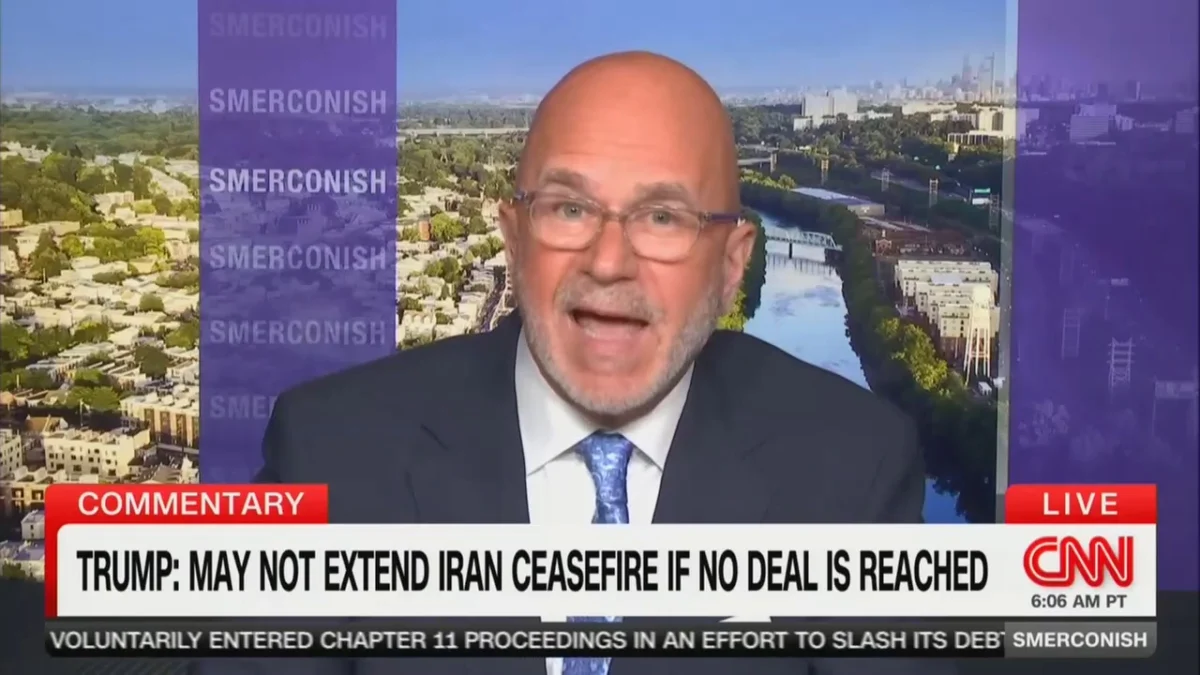
In a pivotal Saturday evening broadcast of his namesake CNN program, veteran anchor Michael Smerconish issued a direct challenge to the United States Congress, urging lawmakers to move beyond procedural debates and provide a formal military authorization for the ongoing conflict with Iran. The appeal comes at a critical juncture in "Operation Epic Fury," a military campaign that has fundamentally reshaped the geopolitical landscape of the Middle East over the past seven weeks. Smerconish’s commentary centers on a singular, high-stakes proposition: that if the United States considers a non-nuclear Iran to be a vital national security interest, the legislative branch must provide the legal framework to ensure that objective is met through a formal Authorization for Use of Military Force (AUMF).
The anchor’s remarks were delivered against the backdrop of an approaching legal deadline. Under the War Powers Resolution of 1973, a president must terminate any use of United States Armed Forces within 60 days of initiating hostilities unless Congress has declared war, provided a specific statutory authorization, or granted an extension. With the conflict currently on its 49th day, President Donald Trump has only eleven days remaining before the statutory clock expires, creating a constitutional showdown between the White House and Capitol Hill.
The Case for Congressional Accountability
Smerconish’s argument rests on the necessity of clarity and constitutional shared responsibility. During his opening segment, he posited that the ambiguity of the current legal standing serves neither the military mission nor the American public. By seeking a scoped authorization—one specifically tailored to the destruction of Iran’s nuclear infrastructure—Smerconish argues that Congress can fulfill its oversight role while providing the Commander-in-Chief with the necessary leverage to conclude the conflict effectively.
"The core question is simple: do you believe it’s essential that Iran not acquire a nuclear weapon?" Smerconish asked his audience. "If that answer is yes—and I believe the answer is obviously yes—then authorize the military action necessary to achieve that specific objective." He further contended that such an authorization would eliminate the "clock" that Tehran might be waiting out, signaling a unified American front that transcends the 60-day window.
The anchor was particularly critical of the Democratic minority and dissenting Republicans who have utilized procedural maneuvers to stall the administration’s requests. He characterized these daily votes as "press releases" rather than a coherent foreign policy strategy. Smerconish argued that the prism for evaluation should not be the political fate of President Trump, but rather the strategic necessity of the mission. "Stop using the War Powers deadline as cover for indecision," he said. "If you believe the war is wrong, then vote to end it. If you believe Iran must not go nuclear, then say so and authorize it."
Chronology of Operation Epic Fury
The current conflict, which many analysts have labeled the most significant military engagement in the region since the 2003 invasion of Iraq, began with a series of decapitation strikes and strategic bombardments. To understand the urgency of Smerconish’s call for authorization, a review of the timeline is essential:
- February 28, 2026: In a joint operation involving U.S. F-35 lightning II stealth fighters and Israeli intelligence assets, a precision strike targeted a secure compound in Tehran. The strike resulted in the death of Iranian Supreme Leader Ali Khamenei and several high-ranking members of the Islamic Revolutionary Guard Corps (IRGC).
- March 1, 2026: President Trump announced the commencement of "Operation Epic Fury," stating that the primary goal was the permanent neutralization of Iran’s nuclear enrichment capabilities at Natanz, Fordow, and Arak.
- March 10, 2026: Iran responded by deploying sea mines in the Strait of Hormuz and launching a series of ballistic missile strikes against U.S. assets in Iraq and the Al-Udeid Air Base in Qatar.
- March 25, 2026: U.S. naval forces engaged in the largest surface-to-surface naval battle since World War II, successfully clearing several Iranian blockade points but sustaining damage to two guided-missile destroyers.
- April 10, 2026: President Trump issued a controversial warning via social media and a televised address, stating that "a civilization will die tonight" if Iran attempted a breakout toward a nuclear payload. This rhetoric sparked immediate calls from domestic critics for the invocation of the 25th Amendment.
- April 18, 2026 (Present Day): The war reaches Day 49. While the U.S. maintains air superiority, the ground reality remains volatile, and the 60-day War Powers deadline looms on April 29.
Supporting Data and Economic Impact
The economic and logistical toll of the conflict has been a primary driver of the political debate in Washington. Since the onset of Operation Epic Fury, global energy markets have experienced unprecedented volatility.
- Oil Prices: Brent Crude spiked from $78 per barrel in late February to a peak of $154 per barrel following the closure of the Strait of Hormuz. While prices have stabilized near $122 as of mid-April, the "war premium" remains a significant burden on the global economy.
- Military Expenditures: The Department of Defense has requested a $140 billion emergency supplemental appropriation to cover the costs of munitions, carrier strike group deployments, and increased troop presence in the CENTCOM theater.
- Humanitarian Figures: While the U.S. has focused on "surgical" strikes against nuclear and military infrastructure, regional reports suggest significant displacement within Iran, with over 1.2 million civilians fleeing major urban centers toward the borders of Turkey and Iraq.
Smerconish argues that these data points underscore the need for a formal authorization. Without a clear mandate from Congress, the funding for these operations remains tied to temporary continuing resolutions, creating uncertainty for military planners.
The Domestic Political Landscape: The "Madman" Defense
A significant portion of Smerconish’s recent commentary has been dedicated to defending the President’s unconventional diplomatic and military style. This defense comes at a time when the administration faces pressure not only from traditional Democratic rivals but also from a faction of the Republican Party led by former Congresswoman Marjorie Taylor Greene. Greene, who has transitioned into a vocal critic of the administration’s foreign interventions, recently joined calls for the President’s removal via the 25th Amendment, citing his "civilization will die" rhetoric as evidence of instability.
Smerconish, however, views this as a misunderstanding of Trump’s tactical approach. He suggested that the President is intentionally playing the "madman card" in public—a reference to the Nixon-era strategy of making adversaries believe the leader is volatile enough to use extreme force—while pursuing a rational, objective-based strategy in private.
"Our only prism is what’s best for America," Smerconish stated, dismissing the 25th Amendment push as a distraction from the legislative duty of Congress. He argued that the President’s rhetoric, however jarring, has successfully prevented a broader regional escalation by keeping Iranian proxies like Hezbollah from launching a full-scale secondary front against Israel.
Official Responses and Broader Implications
The reaction to Smerconish’s call for authorization has been polarized along party lines. Senate Minority Leader Hakeem Jeffries issued a statement shortly after the broadcast, emphasizing that "no president has a blank check for an open-ended war without a clear exit strategy." Democrats have signaled that any authorization would need to include strict prohibitions on ground troop deployments and a hard sunset clause—conditions the White House has previously rejected.
Conversely, some hawkish members of the GOP, including Senator Tom Cotton, have echoed Smerconish’s sentiment, arguing that the 60-day limit is an unconstitutional infringement on the President’s power as Commander-in-Chief. They suggest that the killing of Khamenei has created a power vacuum that requires sustained American presence to prevent the rise of a more radical military junta.
The broader implications of the next eleven days are profound. If Congress fails to act by the April 29 deadline, the United States will enter a constitutional crisis. The President could choose to ignore the War Powers Resolution—as some of his predecessors have done in more limited engagements—or he could be forced to pause operations at a moment when Iranian nuclear facilities are partially disabled but not fully neutralized.
For the international community, the stakes are equally high. Allies in the European Union have called for a ceasefire, fearing a total collapse of the Iranian state. Meanwhile, regional partners such as Saudi Arabia and the United Arab Emirates have signaled quiet support for the U.S. position, provided that the American commitment remains steadfast.
Fact-Based Analysis of the Nuclear Objective
The strategic core of the debate remains the status of Iran’s nuclear program. Intelligence reports cited by the administration suggest that prior to the February 28 strikes, Iran had achieved 90% enrichment at the Fordow facility, the threshold required for weapons-grade material.
Military analysts suggest that while Operation Epic Fury has destroyed the primary cooling towers and access tunnels at Natanz, the deeply buried centrifuges at Fordow may require specialized "bunker-buster" munitions that have yet to be deployed. A formal authorization from Congress would, in Smerconish’s view, provide the political "cover" and legal certainty required to utilize the full spectrum of the U.S. arsenal to complete the mission.
As the 60-day clock continues to wind down, the eyes of the nation remain on Capitol Hill. Whether Congress will heed Smerconish’s call to "authorize or end it" remains to be seen, but the window for indecision is rapidly closing. The outcome will likely determine not only the fate of the Iranian nuclear program but also the future of the balance of power between the executive and legislative branches in matters of war and peace.

 Yuyun Lusiyani
 Joko Widodo
 Pevita Pearce
 admin
admin
