
 Jia Lissa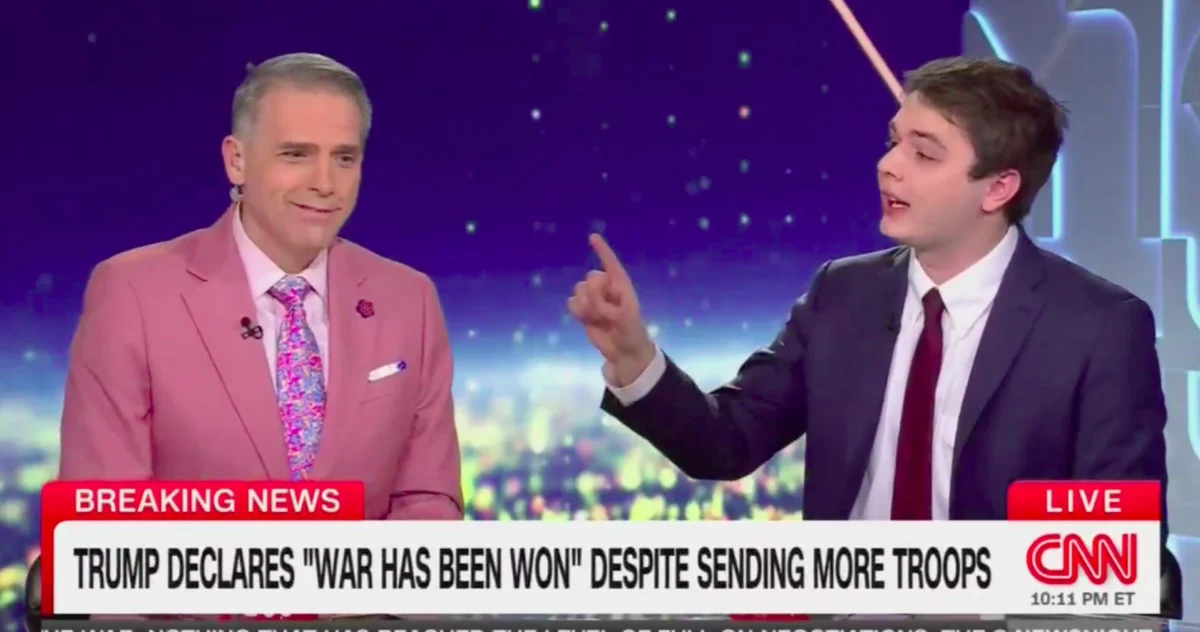
The political landscape surrounding the ongoing military operations in Iran intensified on Tuesday as MeidasTouch commentator Adam Mockler and CNN senior political commentator Scott Jennings engaged in a heated debate on CNN’s NewsNight. The central point of contention focused on former President Donald Trump’s repeated assertions that the United States has already secured a definitive victory in the three-week-old conflict. As the military campaign enters a critical phase, the discrepancy between the administration’s rhetoric and the operational realities on the ground has become a focal point for media scrutiny and political analysis.
During the broadcast, Mockler repeatedly pressed Jennings to clarify whether he supported Trump’s declaration of success. The exchange highlighted a growing divide in how political figures define military "victory" and the strategic implications of declaring an end to hostilities while military assets remain engaged in the region. The debate comes at a time when the Strait of Hormuz remains a contested zone, and international allies have shown hesitation in joining a U.S.-led maritime coalition.
The Definition of Success in the Iranian Campaign
The tension on NewsNight began when Scott Jennings outlined his criteria for what would constitute an "unequivocal win" for the United States. According to Jennings, a successful exit from the conflict would require a comprehensive degradation of Iran’s offensive capabilities. He argued that success hinges on a "defanged" Iranian military, specifically regarding its ballistic missile programs and its navy, which has historically threatened commercial shipping lanes.
"To me, if you exit this and Iran is defanged—as it relates to missiles, as it relates to an aggressive navy—you take away their ability to make nuclear weapons, and you leave the remnant here unable to be a supporter of terrorism, that is an unequivocal win for the United States of America," Jennings stated during the segment.
However, Adam Mockler was quick to identify what he characterized as "very careful wording" on Jennings’ part. Mockler pointed out that by using conditional language—specifically the word "if"—Jennings was effectively acknowledging that these objectives had not yet been met. This stood in direct contrast to Donald Trump’s public statements on Tuesday, in which the former president insisted, "We’ve won this. This war has been won."
Chronology of the Three-Week Conflict
To understand the weight of the debate, it is necessary to examine the timeline of the current military engagement. The conflict, which is now entering its twenty-first day, began following a series of escalations in the Persian Gulf and the Gulf of Oman.
Week 1: Initial Escalation and Air Strikes
The first week of the campaign saw a series of targeted U.S. airstrikes aimed at Iranian command-and-control centers and known missile launch sites. The Pentagon reported that these strikes were intended to preempt "imminent threats" to regional stability. During this phase, the international community remained largely in a state of diplomatic caution, with several European nations calling for restraint.
Week 2: The Coalition Proposal and the Strait of Hormuz
By the second week, the focus shifted to the Strait of Hormuz, a vital maritime artery through which approximately 20% of the world’s oil consumption passes. Donald Trump announced an initiative to form an international coalition of naval vessels to escort commercial ships through the strait. However, as Mockler noted during the CNN segment, the response from global partners was markedly lukewarm. Analysts attribute this hesitation to a lack of clear strategic objectives and lingering diplomatic tensions from previous foreign policy decisions.
Week 3: Declarations of Victory Amid Continued Hostilities
As the conflict moved into its third week, the rhetorical gap widened. While military reports indicated continued skirmishes and the ongoing presence of Iranian naval assets, Trump began declaring that the war was effectively over. This led to the confrontation on CNN, where Mockler challenged the logic of claiming victory while the Strait of Hormuz remained insecure and the coalition remained unformed.
The Strait of Hormuz and Economic Implications
The economic stakes of the conflict are centered on the Strait of Hormuz. Data from the U.S. Energy Information Administration (EIA) highlights that the strait is the world’s most important oil transit chokepoint. In 2023, oil flows through the strait averaged 21 million barrels per day (b/d), or the equivalent of about 21% of global petroleum liquids consumption.
Mockler utilized this data to counter Jennings’ claims of a military victory. He questioned how a war could be considered "won" if the primary strategic objective—securing the free flow of commerce through the strait—had not been achieved. "If that’s true, why can’t the Strait of Hormuz be open if their military is destroyed?" Mockler asked, pointing to the continued closure or restricted access of the waterway as evidence that the Iranian military had not been fully neutralized.
The closure of the strait has historically led to immediate spikes in global oil prices. During the first two weeks of the current conflict, Brent crude prices saw a 12% increase before stabilizing slightly. Economic analysts warn that a prolonged state of "declared victory" without actual maritime security could lead to sustained market volatility.
Political Reactions and Internal Disagreements
The CNN segment also featured input from former Representative Val Demings, who joined Mockler in questioning the administration’s approach to international cooperation. Demings highlighted a shift in the former president’s rhetoric regarding allies. Initially, the administration sought a coalition, but when few nations joined, the narrative shifted to a stance of unilateralism.
Mockler compared this shift to a social dynamic, stating, "He comes all the way back around to saying, ‘Listen, I didn’t break up with her. She didn’t break up with me. I broke up with her.’ I didn’t need them in the first place." This critique refers to the administration’s eventual claim that a coalition was unnecessary, despite the initial calls for global support.
Within the Republican party, support for the victory declaration is not universal. While some align with Jennings’ view that the degradation of Iranian assets is sufficient to claim a win, others in the defense community have expressed concerns about "mission creep" and the lack of a formal peace treaty or cessation of hostilities.
Comparative Analysis of "Victory" Declarations
Political historians have drawn parallels between the current rhetoric and previous American military engagements. Most notably, the "Mission Accomplished" speech delivered by President George W. Bush in 2003 on the USS Abraham Lincoln is being cited as a cautionary tale. In that instance, a declaration of victory was followed by years of prolonged insurgency and nation-building.
The current situation in Iran presents a different set of challenges. Unlike Iraq, the Iranian campaign has largely been conducted through air and sea power without a major ground invasion. This allows for a more ambiguous definition of victory. If the goal is merely "degradation," then a win can be claimed as soon as a certain percentage of targets are destroyed. However, if the goal is "regional stability" or "regime change," the current metrics suggest the conflict is far from over.
Strategic Implications and Broader Impact
The debate between Mockler and Jennings reflects a broader national conversation about the role of the United States in the Middle East. If the public accepts the "war is won" narrative, it provides the administration with the political capital to withdraw forces or pivot to other global priorities, such as the Indo-Pacific region. However, if the declaration is perceived as premature, it could lead to a credibility gap that complicates future military and diplomatic efforts.
Military analysts suggest that the Iranian "navy," which consists largely of fast-attack craft and midget submarines, is designed for asymmetric warfare. Even if the traditional navy is "defanged," these smaller assets can continue to harass shipping, making a traditional definition of naval victory difficult to apply.
Furthermore, the "defanging" of missile capabilities is difficult to verify without on-the-ground inspections, something that is currently not an option. This uncertainty fuels the skepticism voiced by commentators like Mockler, who argue that the rhetoric of victory is being used to mask a lack of clear geopolitical progress.
Conclusion of the NewsNight Exchange
The CNN segment concluded with Jennings attempting to redefine the parameters of winning as the destruction of military capabilities, while Mockler maintained that the lack of an open Strait of Hormuz was the ultimate proof that the conflict remained unresolved. The "chaotic exchange," as described by media observers, underscores the high stakes of the narrative war occurring alongside the physical conflict.
As the United States continues its operations in Iran, the pressure on the administration to provide verifiable evidence of a "won" war is likely to increase. For now, the debate remains centered on whether "victory" is a measurable military state or a political tool used to manage domestic expectations during a complex international crisis. The coming weeks will be instrumental in determining which perspective aligns with the emerging reality in the Persian Gulf.



 Yuyun Lusiyani
 Joko Widodo
 Eva Lovia
 Pevita Pearce
 admin
admin
 Lina Irawan