
 Jia Lissa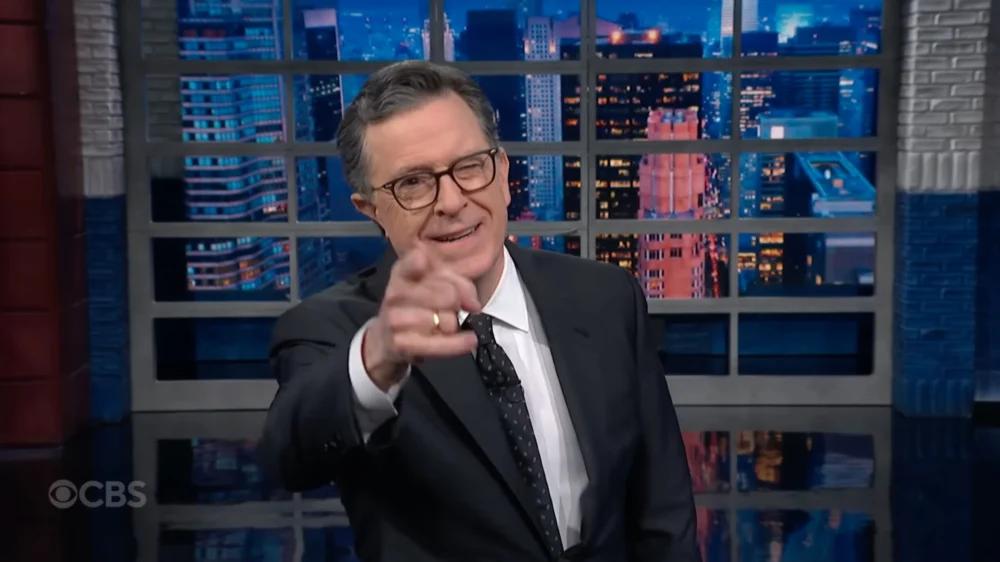
The annual State of the Union address, traditionally a cornerstone of American civic life and a guaranteed ratings juggernaut for major networks, saw a notable contraction in its television audience this year. According to official data released by Nielsen, President Donald Trump’s 2026 State of the Union address, delivered on a Tuesday evening, attracted approximately 32.6 million viewers across broadcast and cable networks. While the figure remains significant in the context of contemporary linear television, it represents an 11% decline from the 36.6 million viewers who tuned in for the president’s joint session address the previous year. This downward trend has sparked a wider conversation regarding the efficacy of long-form political broadcasts and the shifting habits of the American media consumer.
On the Thursday following the address, Stephen Colbert, host of CBS’s The Late Show, utilized his platform to analyze these figures, contrasting the president’s declining viewership with the performance of late-night satire. Colbert, whose tenure at CBS is scheduled to conclude in May, pointedly noted that while the executive branch saw a double-digit percentage drop in its primary television event, The Late Show experienced a 7% increase in ratings over the same period compared to the previous year. The discrepancy between the two figures served as the focal point for Colbert’s monologue, during which he suggested that the president’s penchant for lengthy addresses might be contributing to a broader fatigue within the broadcast medium.
The Statistical Breakdown of the 2026 State of the Union
The 2026 address was notable not only for its ratings but also for its duration. Clocking in at 108 minutes, the speech set a new record for the longest State of the Union address in United States history. This surpassed the previous record held by the president’s own 100-minute address from the prior year. Historically, State of the Union speeches have varied significantly in length; for instance, President Richard Nixon’s 1972 address lasted only 28 minutes, while President Bill Clinton frequently crossed the 60-minute mark, including an 88-minute speech in 2000.
The 32.6 million viewers recorded by Nielsen represent a composite of various platforms, including ABC, CBS, NBC, FOX, CNN, MSNBC, and Fox News. Despite the 11% year-over-year drop, the 2026 figures narrowly eclipsed the final State of the Union address of former President Joe Biden in 2024, which drew 32.2 million viewers. However, when placed in a broader historical context, the decline of the "television event" becomes more apparent. In the 1990s, it was not uncommon for these addresses to command audiences exceeding 45 or even 50 million viewers. The fragmentation of the media landscape, characterized by the rise of streaming services and social media highlights, has systematically eroded the monolithic audience blocks once enjoyed by broadcast networks.
Comparative Analysis of Late-Night Performance
During his monologue, Colbert highlighted a paradoxical trend in the television industry: while the "main event" of political discourse—the presidential address—saw a reduction in its audience, the secondary discourse—the comedic analysis of that event—showed signs of growth. Colbert informed his audience that The Late Show had seen a 7% rise in its ratings compared to the same week in the previous year.
"Donald Trump is really dragging down broadcast television," Colbert remarked, framing the ratings decline as a reflection of viewer exhaustion. He further joked about his own network’s status, referencing the upcoming conclusion of his show by stating, "I mean, if I were CBS, I’d cancel him." This comment alluded to the reality that Colbert’s show is currently in its final months, with a planned exit in May 2026.
The 7% increase in The Late Show’s viewership suggests a resilient market for political satire. Industry analysts often refer to this as the "satire dividend," where controversial or high-stakes political environments drive audiences toward late-night hosts who provide a curated, often critical, summary of the news. Colbert’s assertion that "people may not like watching Trump, but they do like watching me not like watching Trump" encapsulates a significant shift in how modern audiences consume political information—opting for the "filter" of a late-night personality rather than the unmediated source.
The Evolution of the State of the Union Format
The decline in viewership raises questions about the future of the State of the Union format. As the speeches grow longer—now exceeding an hour and forty-five minutes—they increasingly conflict with the programming schedules of linear television. The 108-minute runtime of the 2026 address forced many networks to preempt or delay their late-prime-time offerings, a move that can lead to "audience bleed-off" as viewers opt for shorter, on-demand content.
The timeline of State of the Union durations over the last several decades illustrates a clear trend toward expansion:
- 1960s-1980s: Speeches generally ranged from 30 to 50 minutes.
- 1990s (Clinton Era): Length increased to 60–80 minutes, often incorporating a "laundry list" of policy proposals.
- 2000s (Bush/Obama): Speeches stabilized around 50–65 minutes.
- 2020s (Trump/Biden): A return to longer formats, with the current administration pushing the boundaries of the two-hour mark.
Critics of the current format argue that the "talk-a-thon" approach, as Colbert described it, may be counterproductive. While a longer speech allows a president to address a wider array of domestic and foreign policy issues, it risks losing the attention of the "swing" viewer who is not already politically engaged.
Broader Implications for Media and Politics
The divergence between the ratings of the State of the Union and late-night programming highlights a fundamental change in the "attention economy." Nielsen data increasingly shows that younger demographics (18-49) are significantly less likely to watch a full political address on a traditional television set. Instead, these viewers consume the event through viral clips, social media threads, and YouTube highlights.
This shift places hosts like Colbert in a unique position of influence. As the "gatekeepers" of the post-speech narrative, late-night hosts often define the public perception of the address. If the primary speech is viewed by 32.6 million people, the subsequent clips and satirical breakdowns often reach an additional tens of millions across digital platforms.
Furthermore, the 11% drop in viewership for the president may signal a "saturation point" in the American public’s appetite for high-intensity political messaging. After years of continuous political cycles and a 24-hour news environment, the traditional "big moment" of the State of the Union may no longer carry the same novelty or perceived necessity it once did.
Official Reactions and Industry Sentiment
While the White House has not issued a formal statement regarding the Nielsen ratings, spokespeople for the administration have historically pointed to "non-traditional" viewership as a more accurate metric of reach. They argue that streaming numbers on platforms like YouTube, X (formerly Twitter), and Facebook Live more than compensate for the decline in traditional broadcast viewership. However, Nielsen’s figures remain the gold standard for advertisers and network executives who rely on linear television for revenue.
At CBS, the ratings boost for Colbert comes at a bittersweet moment. As the network prepares for a transition in its late-night lineup following Colbert’s departure in May, the 7% growth confirms that there is still a robust appetite for his brand of topical humor. The challenge for the network will be retaining that 7% growth once its primary star exits the stage.
Conclusion: The Future of the Televised Presidency
The 2026 State of the Union serves as a case study in the diminishing returns of the televised presidency. As the speeches get longer and the audiences get smaller, the ritual risks becoming a legacy event—one that is respected by political insiders but increasingly ignored by the general public in favor of curated summaries and satirical commentary.
The resilience of The Late Show’s ratings suggests that the public has not lost interest in politics, but rather in the delivery mechanism. The move toward satire and condensed digital content reflects a broader societal shift toward efficiency and entertainment-driven information. Whether future administrations will adapt by shortening the address or by leaning further into digital-first strategies remains to be seen. For now, the data suggests that while the President of the United States holds the podium, it is the late-night hosts who may hold the audience’s attention.


 Yuyun Lusiyani
 Joko Widodo
 Eva Lovia
 Pevita Pearce