Pevita Pearce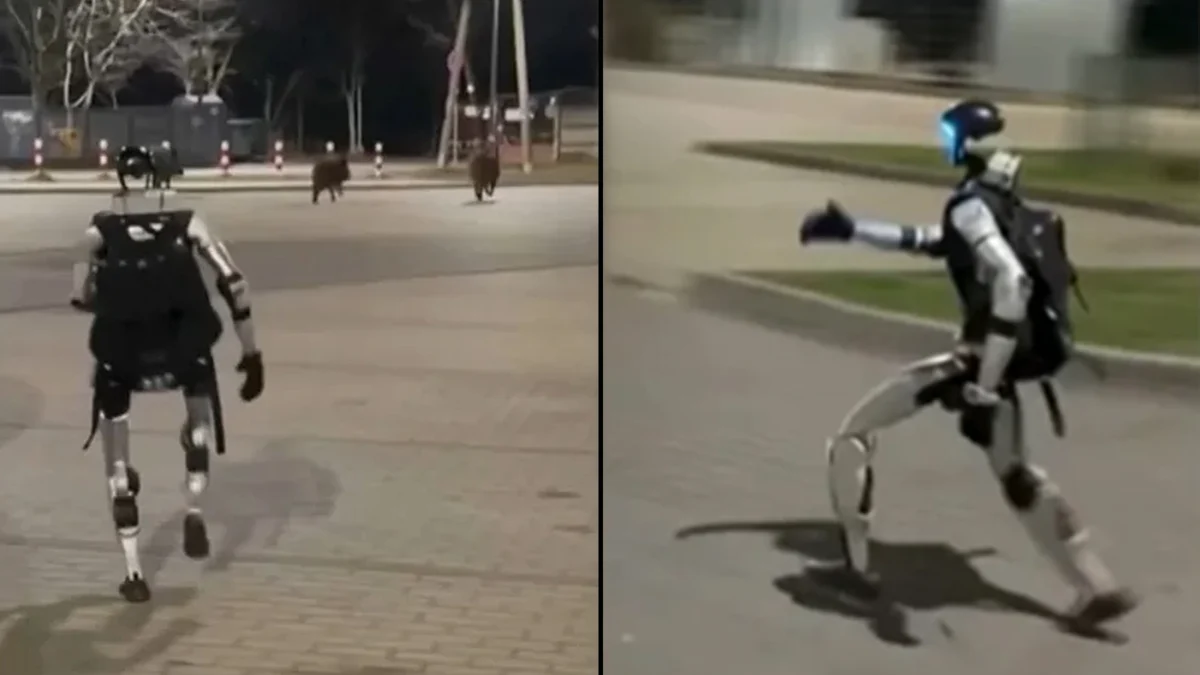
The intersection of advanced robotics and urban wildlife management reached a new milestone this month as a humanoid robot named Edward Warchocki captured global attention. In a video that has rapidly circulated across multiple social media platforms, the robotic figure is seen confronting and successfully dispersing a pack of wild boars in the heart of Warsaw, Poland. This incident, while appearing whimsical to some, underscores a growing trend in the integration of autonomous or semi-autonomous humanoid entities into public spaces and the evolving nature of human-robot interaction in metropolitan environments.
The footage, which first appeared on the video-sharing platform TikTok on April 12, depicts Edward Warchocki—outfitted with a functional backpack—pursuing three wild boars through a residential or park-adjacent area in the Polish capital. As the boars retreat into a nearby wooded area, the robot pauses to offer a rhythmic wave, a gesture that has become a signature of its public persona. Within days, the video amassed over six million views on TikTok alone, subsequently migrating to Instagram and X (formerly Twitter), and eventually garnering coverage from major international news syndicates, including ABC News.
The Warsaw Incident: A Chronology of Viral Success
The encounter in Warsaw did not occur in a vacuum but is part of a calculated and highly successful digital presence. The video was released during a period when Warsaw has been grappling with an increasing population of wild boars entering urban zones, a phenomenon attributed to habitat loss and the easy availability of food in residential neighborhoods. The sight of a humanoid robot taking an active role in "patrolling" or interacting with these animals resonated with a public increasingly accustomed to seeing technology used for municipal management.
Following the initial upload on April 12, the engagement metrics for Edward Warchocki’s accounts saw a significant surge. On Instagram, the robot’s following climbed to 160,000, while its TikTok audience surpassed 298,000. The demographics of this audience are diverse, spanning from technology enthusiasts to general users attracted by the surreal nature of a "swagged-out" robot navigating the mundane realities of Polish city life.
Profiling Edward Warchocki: The Celebrity Robot
Edward Warchocki is not a newcomer to the Polish limelight. He has established himself as a cultural fixture, often referred to as a "social media star" rather than merely a piece of industrial hardware. His official website presents a carefully curated persona: an easygoing, charismatic individual who happens to be made of metal and plastic. The site’s biographical section notes, “Man, I don’t know how it happens, but everyone likes me. Kids want to give me high fives, grandmothers tell me about their grandchildren for hours… People stop on the street, approach me, ask where I got that Rolex, and laugh at my jokes.”
The reference to a Rolex is a literal one. In many of his appearances, Edward is seen wearing a high-end timepiece, a choice that serves to "humanize" the robot through the lens of modern consumer culture and "swag." This branding strategy has proven effective in making the robot approachable, breaking down the "uncanny valley" barrier that often causes unease in human-robot interactions.
Beyond social media, Edward’s resume includes high-profile media appearances. He has been a guest on the Polish edition of Dancing with the Stars and is a frequent fixture at major sporting events, where he serves as both an entertainer and a technological showcase. These appearances are designed to demonstrate the mobility and social viability of humanoid designs in crowded, unpredictable environments.
Political Advocacy and Public Policy
Perhaps the most unconventional chapter in Edward Warchocki’s history occurred in March, when the robot was invited to the Polish Parliament (the Sejm). While the visit was partly a promotional event for the robotics sector, it carried a surprising message of labor advocacy. During his time in the legislative building, Edward reportedly "proposed" a salary increase for the building’s security officers.
This move was interpreted by analysts as a clever PR maneuver to align robotic interests with human labor interests, rather than framing robots as a threat to employment. By advocating for the human staff, the creators behind Edward positioned the robot as a companion and an ally within the workforce. The visit to the Sejm marked the first time a humanoid robot had been officially received in the Polish parliament, signaling a growing openness among policymakers to discuss the future of AI and robotics in official capacities.
The Broader Context of Humanoid Robotics
The viral success of Edward Warchocki arrives at a pivotal moment for the global robotics industry. The year 2024 has seen an unprecedented acceleration in the development of "general-purpose" humanoid robots. Companies such as Tesla with its Optimus program, Figure AI, and Boston Dynamics with the recently unveiled all-electric Atlas, are racing to move robots out of the laboratory and into the real world.
Data from market research firms suggest that the global humanoid robot market is expected to grow at a compound annual growth rate (CAGR) of nearly 40% over the next decade. While much of this growth is targeted at manufacturing and logistics, Edward Warchocki represents the "social" and "service" branch of this evolution. Unlike industrial robots confined to cages, social humanoids are designed to operate in "unstructured environments"—public streets, parks, and office buildings where they must navigate around humans and, as seen in Warsaw, wildlife.
Comparative Utility: Robots as Security and Deterrents
The use of robots to manage unwanted intruders or wildlife is becoming a tangible application for the technology. Edward’s dispersal of the boars in Poland draws parallels to recent developments in the United States. In March, Undaunted Robotics Security, a firm based in Georgia, made headlines when its robotic security dogs were deployed to thwart repeated burglaries at an apartment complex.
In that instance, the robotic "canines" were used to chase away trespassers, providing a non-lethal, high-visibility deterrent that reduced the need for human security guards to enter potentially dangerous confrontations. While Edward Warchocki’s interaction with the boars was framed more as a friendly "chase-off" followed by a wave, the underlying utility is the same: the use of robotic presence to influence the behavior of biological entities without direct human intervention.
Implications for Urban Ecology and Public Safety
The incident in Warsaw raises several questions regarding the future of urban management. As cities become smarter and more integrated with Internet of Things (IoT) technology, the role of mobile robotic units could expand.
- Wildlife Management: Traditional methods of managing urban boars often involve trapping or culling, which can be controversial. If robots can serve as a persistent, non-harmful deterrent, they may offer a more palatable solution for municipal governments.
- Public Acceptance: The fact that Edward is viewed as a celebrity suggests that the public is more likely to accept robots in their neighborhoods if those robots possess a "personality" or a recognizable brand.
- Regulatory Challenges: As more robots like Edward enter public spaces, cities will need to develop frameworks for liability, privacy (given the cameras usually mounted on such units), and right-of-way on sidewalks.
Technical and Ethical Analysis
From a technical standpoint, the ability of a humanoid to navigate the uneven terrain of a park while identifying and moving toward moving targets like boars is a testament to the advancements in computer vision and real-time kinetic processing. However, ethical considerations remain. Critics of the "celebrity robot" phenomenon argue that dressing robots in luxury items like Rolexes and giving them "swag" masks the more serious implications of surveillance and the potential for these machines to eventually replace low-wage service workers.
Furthermore, the "friendly" wave Edward gave to the boars is a programmed response intended for human observers, not the animals themselves. This highlights the performative nature of current humanoid robotics; they are as much tools for communication and marketing as they are for physical labor.
Conclusion
Edward Warchocki’s viral encounter with the wild boars of Warsaw is a snapshot of a future where the line between technology and daily life continues to blur. Whether he is advocating for higher wages in the Polish parliament or waving goodbye to animals in a city park, Edward represents a shift in how society perceives autonomous machines. They are moving from being curiosities in tech labs to becoming active participants in the social fabric.
As the video continues to circulate, it serves as a powerful advertisement for the capabilities of modern robotics and a reminder that the next "person" you see walking down a European street—backpack on and Rolex on the wrist—might just be a humanoid robot named Edward. The success of this Polish sensation suggests that the path to widespread robotic integration may be paved not just with technical specifications, but with charisma, humor, and a well-timed wave.




 Jia Lissa
 Yuyun Lusiyani
 Joko Widodo
 Eva Lovia