
 Yuyun Lusiyani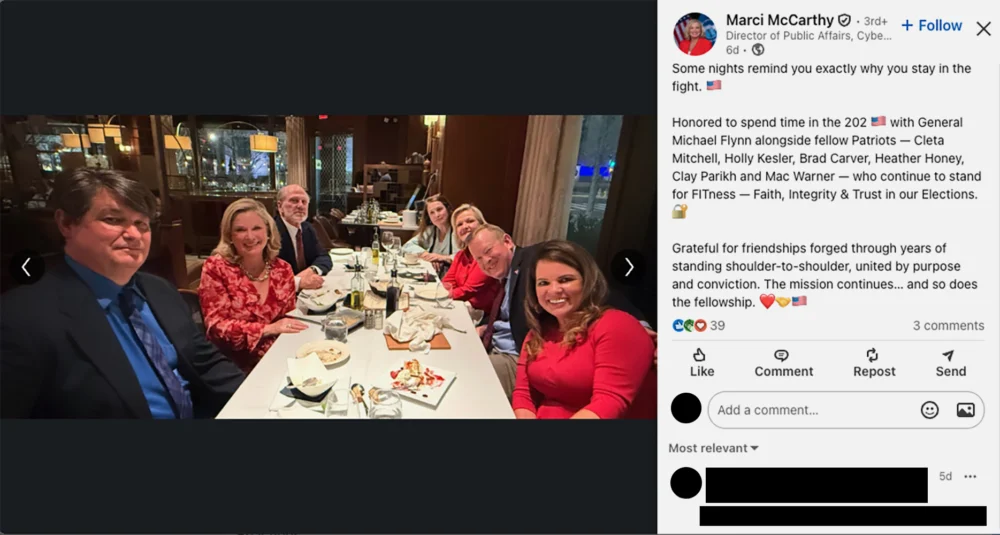
A clandestine summit held last week brought together several high-ranking federal election officials and prominent figures who actively sought to overturn the 2020 presidential election results, with discussions reportedly centered on pressuring the president to declare a national emergency to assert federal control over this year’s midterm elections. The extraordinary gathering, details of which were meticulously reviewed by ProPublica through videos, photos, and social media posts, has ignited alarm among election experts and pro-democracy advocates, who warn of an intensifying effort to undermine the integrity of the nation’s electoral system.
The Summit: A Nexus of Power and Disinformation
The Feb. 19 roundtable discussion, held at a downtown Washington, D.C., office building and sponsored by the conservative Gold Institute for International Strategy, represented a significant escalation in the ongoing campaign by certain factions to reshape American elections. Convened by Michael Flynn, former National Security Adviser to Donald Trump and a vocal proponent of election denial, the event served as a forum for activists and government insiders to coordinate strategies.
Among the notable attendees were Kurt Olsen, a White House lawyer specifically tasked with reinvestigating the 2020 election, and Heather Honey, a Department of Homeland Security (DHS) official responsible for election integrity. Cleta Mitchell, who directs the Election Integrity Network—a group widely known for propagating false claims about widespread election fraud and noncitizen voting—also participated. The presence of these individuals, particularly those holding federal positions with direct or indirect oversight of electoral processes, underscores the unprecedented nature of the discussions. Following the daytime meeting, several activists and government officials were photographed dining together, suggesting a deeper level of camaraderie and coordination.
Flynn himself articulated the purpose of the gathering to a social media personality, Tommy Robinson, on the sidelines of the event. Videos posted online by Robinson captured Flynn stating his desire to bring the group together physically, as "most of us have met online" while "fighting battles" in key swing states like Arizona and Georgia. He emphasized the overarching theme: "to make sure that all of us aren’t operating in our own little bubbles." This statement highlights the coordinated and networked nature of these efforts, moving beyond disparate online interactions to consolidated in-person strategy sessions. Flynn has consistently advocated for Trump to declare a national emergency, even posting on social media after the summit, "We The People want fair elections and we know there is only one office in the land that can make that happen given the current political environment in the United States."
Proposed Actions: A Radical Shift in Electoral Governance
The core of the summit’s discussions revolved around a radical proposition: the declaration of a national emergency by the president to seize federal control over the midterm elections. This concept is not new; Trump has previously expressed openness to a federal takeover, particularly as a means to counter projected Republican losses. In a recent interview with conservative podcaster Dan Bongino, Trump explicitly stated that Republicans need "to take over" elections and "to nationalize the voting."
Activists at the summit presented various methods to transform American elections, which they believe would benefit conservatives. Reports from conservative media, including LindellTV, a streaming platform created by Mike Lindell, indicated that the group was divided into two strategic camps: those advocating for a more incremental legal and legislative approach, and those pushing for the immediate declaration of a national emergency. Crucially, multiple activists left the meeting convinced that the latter course of action was necessary. They believe a national emergency would allow the president to bypass the Constitution’s directive, which largely reserves election administration to individual states.
A draft executive order, reportedly circulated by activists associated with the summit attendees, outlines specific measures for such a federal takeover. These include a nationwide ban on mail-in ballots and the elimination of voting machines. Peter Ticktin, a lawyer involved in drafting the executive order who had a client at the summit, confirmed to ProPublica that these actions were "all part of the same effort." Former Overstock.com CEO Patrick Byrne, a prominent financial backer of efforts to overturn the 2020 election, candidly told LindellTV that Trump has "played nice" so far in not seizing control, but that "at some point, he’s got to do something, the muscular thing: declare a national emergency." Byrne, when questioned by ProPublica, responded by sending a screenshot of a poll he claimed indicated "2/3 of Americans correctly do not trust" voting machines—the very target of the proposed emergency declaration.
Will Huff, a campaign manager for a Republican candidate for Arkansas secretary of state and an advocate for abolishing voting machines, told a conservative vlogger that Olsen, the White House lawyer, and other administration representatives would relay the "consensus" from the gathering back to Trump. Huff reiterated the sentiment, stating, "It’s got to be a national emergency." In a follow-up email to ProPublica, Huff affirmed that Olsen and Trump would exercise their judgment regarding a national emergency declaration, adding, "The President has been briefed on findings of shortcomings in election infrastructure. I believe there are steady hands around the President wanting to ensure that any action taken is, first, constitutional and legal, but also backed by evidence." However, critics argue that the very premise of a federal takeover based on unsubstantiated claims of "shortcomings" fundamentally challenges the constitutional framework of American elections.
Federal Officials in Attendance and Ethical Quandaries
Beyond Olsen and Honey, four other federal officials from agencies critical to the upcoming elections were present at the summit, with at least four of the six also attending the dinner afterward. Their participation raises significant questions about ethical conduct, the blurring of lines between official duties and political advocacy, and the potential for improper influence.

- Clay Parikh: A special government employee at the Office of the Director of National Intelligence (ODNI), Parikh is assisting Olsen with the 2020 inquiry. An ODNI spokesperson stated that Parikh attended the summit "in his personal capacity," a distinction that experts often find problematic when an official’s personal and professional spheres overlap on such sensitive issues.
- Mac Warner: A Justice Department official who handled election litigation, Warner’s attendance was particularly scrutinized. A department spokesperson confirmed that Warner resigned the day after the event and had not received the required ethics approval from agency officials to participate. This revelation underscores a significant breach of established government ethics protocols. The Justice Department spokesperson reiterated the department’s commitment to "upholding the integrity of our electoral system and will continue to prioritize efforts to ensure all elections remain free, fair, and transparent."
- Marci McCarthy: Director of communications for the nation’s cyber defense agency, which oversees the security of elections infrastructure like voting machines. Her presence is noteworthy given her agency’s critical role in safeguarding the very systems being targeted by the proposed executive order. McCarthy later expressed solidarity with her fellow attendees in a LinkedIn post about the summit, writing, "Grateful for friendships forged through years of standing shoulder-to-shoulder, united by purpose and conviction. The mission continues… and so does the fellowship." Her post included a photo featuring herself, Heather Honey, Cleta Mitchell, General Michael Flynn, Holly Kesler, Brad Carver, Clay Parikh, and Mac Warner at a restaurant.
- Kari Lake: Appointed by Trump as a senior adviser to the U.S. Agency for Global Media, Lake was a featured speaker. Lake famously worked with Olsen and Parikh in her unsuccessful legal challenges to overturn her loss in the 2022 Arizona gubernatorial election. In an email, Lake stated she "showed up to the event, spoke for about 20 minutes about the overall importance of election integrity, a non-partisan issue that matters to all citizens — both in the United States and abroad. I left without listening to any other speeches." She added, "Elections should be free from fraud or any other malfeasance that subverts the will of the people."
The involvement of these officials, particularly from departments like DHS, DOJ, and ODNI, which play crucial roles in election security and legal oversight, has drawn sharp criticism.
A Pattern of Coordination and Eroding Guardrails
The Feb. 19 summit is not an isolated incident but rather the latest in a series of private interactions between conservative election activists and administration officials, many of which had not been previously reported. Emails, documents, and recordings obtained by ProPublica reveal a pattern of coordination stretching back to at least last fall. Many of these interactions have involved Cleta Mitchell’s Election Integrity Network. Both Heather Honey and Marci McCarthy were leaders in the Election Integrity Network before assuming their current government posts, illustrating a concerning "revolving door" phenomenon.
Previously unreported emails obtained by ProPublica show that just weeks after Heather Honey began her tenure at DHS, she briefed election activists, a Republican secretary of state, and another federal official on a conference call arranged by her former boss, Cleta Mitchell. Mitchell’s email introducing presenters on the call explicitly stated, "We are excited to welcome her on our call this morning to hear about her work for election integrity inside DHS." Honey did not respond to questions about this call.
Experts argue that Honey’s briefing provided her former employer with privileged access that would likely have violated ethics rules under previous administrations, including the first Trump administration, but not the current one. Brendan Fischer, a director at the Campaign Legal Center, a nonpartisan pro-democracy organization, lamented this erosion of norms: "The prior ethics guardrails would have prevented some of the revolving door issues we’re seeing between the election denial movement and the government officials. Those prior rules were supposed to prevent former employers and clients from receiving privileged access." This breakdown of crucial guardrails, according to experts on U.S. elections, represents a severe threat to the impartiality of government agencies.
Official Denials and Expert Concerns
The White House, while acknowledging attendance, sought to downplay the significance of the officials’ presence. An anonymous White House official stated that federal officials’ attendance should not be construed as support for a national emergency declaration, asserting it was "common practice" for staffers to communicate with outside advocates sharing policy ideas. The official pointed to comments made by Trump to PBS News denying he was considering a national emergency or had read the draft executive order, concluding, "Any speculation about policies the administration may or may not undertake is just that — speculation." However, these denials stand in contrast to Trump’s public statements advocating for a federal takeover of elections.
Despite official attempts to dismiss concerns, election experts are sounding the alarm. Brendan Fischer emphasized the danger: "The meeting shows that the same people who tried to overturn the 2020 election have only grown better organized and are now embedded in the machinery of government. This creates substantial risk that the administration is laying the groundwork to improperly reshape elections ahead of the midterms or even go against the will of the voters."
Courts have largely blocked past efforts by the president to reshape elections through executive orders, and legislation aiming to mandate strict voter ID requirements nationwide has stalled in Congress. This lack of success through conventional channels appears to be fueling the push for more drastic, potentially unconstitutional measures.
Broader Implications and the Constitutional Crisis
The implications of such a federal takeover, should it be attempted, are profound and far-reaching. The U.S. Constitution explicitly grants states the authority to administer elections, with federal intervention typically limited to enforcing voting rights and ensuring fair access. A presidential declaration of a national emergency to seize control of elections would represent an unprecedented challenge to this fundamental principle of federalism and could trigger a constitutional crisis. It would also undermine public trust in democratic institutions, further polarizing an already divided electorate.
The proposals discussed at the summit—banning mail-in ballots and eliminating voting machines—are rooted in unsubstantiated claims of widespread fraud that have been repeatedly debunked by election officials, cybersecurity experts, and courts across the country. Implementing such measures would not only disenfranchise millions of legitimate voters but also dismantle the very infrastructure that has been carefully built to ensure accessible and secure elections. Mail-in voting, for instance, has a long history in the U.S. and was widely expanded during the COVID-19 pandemic to ensure safe participation, with robust security measures in place in most states. Voting machines, while subject to ongoing scrutiny and improvement, are critical components of modern election administration, and their outright elimination without viable, secure alternatives would create chaos and logistical impossibility for states.
The coordination between government officials, even those claiming "personal capacity" or quickly resigning, and a network of activists pushing for radical electoral changes based on discredited theories, signals a dangerous escalation. It suggests a strategic effort to leverage positions of power to implement policies that could fundamentally alter the democratic landscape of the United States, circumventing established legal and constitutional norms. As the midterm elections draw closer, the revelations from this summit underscore the urgent need for vigilance and robust defense of democratic principles against attempts to subvert the will of the voters.


 Jia Lissa
 Joko Widodo
 Eva Lovia

 Pevita Pearce