
 Jia Lissa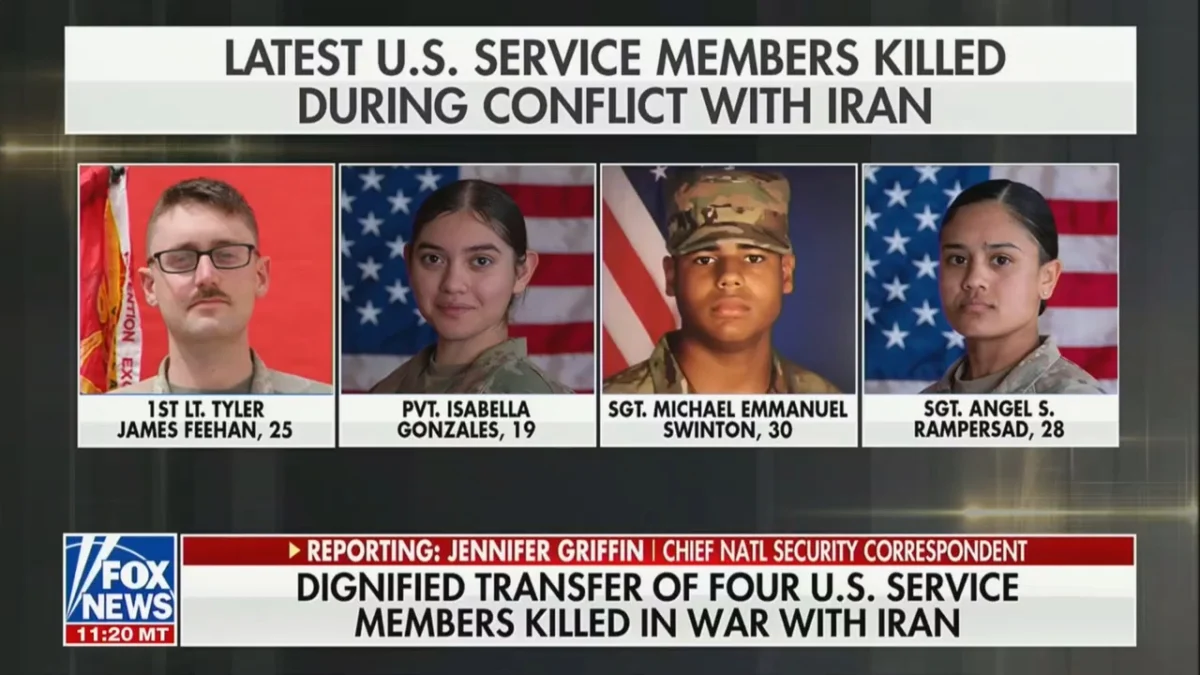
President Donald Trump joined senior military leadership and grieving families at Dover Air Force Base on Wednesday to witness the dignified transfer of four U.S. service members killed during recent operations in the ongoing conflict with Iran. The solemn event, characterized by a lengthy moment of silence and the rhythmic precision of military carry teams, marks a significant moment of national mourning as the human cost of the regional escalation continues to mount. The President was joined by Secretary of Defense Pete Hegseth, Army Secretary Dan Driscoll, and General Dan Cain, highlighting the gravity of the losses sustained in recent days across the Middle East theater.
The four individuals returned to American soil—First Lieutenant Tyler James Feehan, Private Isabella Gonzales, Sergeant Michael Swinton, and Sergeant Angel Rampersad—represent a cross-section of the American volunteer force, each with distinct backgrounds and aspirations cut short by the volatility of the current conflict. Their arrival at Dover follows a three-hour private meeting between the President and the families of the fallen, a standard but grueling protocol where the Commander-in-Chief offers personal condolences before the public portion of the transfer begins.
Profiles in Sacrifice: The Four Fallen Soldiers
The biographical details emerging from the families of the fallen paint a vivid picture of the individual lives behind the military ranks. First Lieutenant Tyler James Feehan, a resident of Utah and an alumnus of the University of Southern Utah, was described by his family as a lifelong adventurer. Feehan’s military service was a point of immense pride for his community; he was an ROTC graduate who had previously trekked to the Mount Everest base camp and completed the Camino de Santiago trail in Spain.
In a gesture of enduring legacy, the Feehan family announced the establishment of a scholarship fund for ROTC students at his alma mater. They intend to fund this initiative using the $100,000 death gratuity provided by the government. Feehan, who was scheduled to return home shortly to be married, is remembered by his peers as a leader who balanced a spirit of adventure with a deep commitment to his platoon.
Private Isabella Gonzales, 19, of Carrollton, Texas, was among the youngest casualties of the recent strikes. A 2025 high school graduate, Gonzales had enlisted in the Army with the primary goal of securing a college education through the G.I. Bill. Her former English teachers described her as a determined student who saw military service as a pathway to professional advancement. Her death, occurring so soon after her entry into the service, has resonated deeply within her Northern Texas community.
Sergeant Michael Swinton, stationed at Fort Bragg (now officially designated Fort Liberty) and a resident of Fayetteville, North Carolina, was a seasoned non-commissioned officer. Swinton was killed in northern Iraq during an operation to intercept and disable a one-way Iranian attack drone. He is survived by his wife, Mia, and two young children—a six-year-old son and a four-year-old daughter. A final photograph shared by his wife captured Swinton in uniform, hugging his daughter through a car window just before his deployment, a poignant image that has become a symbol of the domestic toll of the conflict.
The fourth soldier, Sergeant Angel Rampersad, 28, of Queens, New York, was recovered from the rubble of a drone strike on a base in Jordan. While her remains are still undergoing the formal identification process at the Armed Forces Medical Examiner System at Dover, she has been officially listed among the fallen. Rampersad’s recovery followed an intensive search-and-rescue operation at the site of the impact, where several other service members were also injured.
The Escalating Conflict: A Timeline of Recent Losses
The death of these four soldiers represents the latest chapter in a series of high-casualty events that have defined the U.S. military’s involvement in the region over the past several months. According to Department of Defense records and reporting from Fox News chief national security correspondent Jennifer Griffin, this marks the third time President Trump has presided over a dignified transfer at Dover since the onset of the current hostilities with Iran.
The timeline of major losses includes:
- The Kuwait Drone Strike: Early in the conflict, six service members were killed when a loitering munition struck a support base in Kuwait. This event marked a significant expansion of the geographic scope of Iranian-backed attacks, targeting locations previously considered rear-echelon areas.
- The KC-135 Disaster: Six additional service members were lost when a KC-135 Stratotanker, an aerial refueling aircraft, went down over Iraq. While the incident remains under investigation, it highlighted the high-risk nature of logistical and support missions in contested airspace.
- The Jordan and Iraq Attacks: The current group of fallen soldiers includes those killed in a drone strike on a base in Jordan and during counter-drone operations in northern Iraq over the most recent weekend.
This sequence of events has brought the total number of American combat-related deaths in this specific theater to a level not seen in several years, prompting renewed debates in Washington regarding the rules of engagement and the long-term strategy for regional stability.
The Mechanics and Significance of the Dignified Transfer
The dignified transfer is not a funeral but a solemn process of moving the remains of a fallen service member from the aircraft to a waiting vehicle, which then transports the remains to the mortuary facility at Dover Air Force Base. The process is governed by strict military protocols designed to show the utmost respect for the deceased.
At Dover, the Air Force Mortuary Affairs Operations (AFMAO) takes custody of the remains. The facility is the only one of its kind in the United States, staffed by specialists who handle everything from forensic identification to the preparation of the fallen for their final resting place. For families, the transfer at Dover is often the first time they are physically near their loved ones since their deployment, making the three-hour private session with the President and military leaders a critical component of the grieving process.
President Trump’s attendance at these events is a continuation of a tradition where the Commander-in-Chief acknowledges the personal weight of sending citizens into harm’s way. As noted by correspondents on the ground, every president has described the visits to Dover as among the most difficult duties of the office. The presence of the Secretary of Defense and the Army Secretary underscores the institutional commitment to the families left behind.
Geopolitical Context and National Security Implications
The deaths of Sgt. Swinton and Sgt. Rampersad, specifically linked to Iranian-manufactured drone technology, highlight the evolving nature of the threat in the Middle East. The use of "one-way" or "suicide" drones has leveled the playing field for non-state actors and regional powers, allowing them to strike fortified U.S. positions with relatively low-cost but highly effective munitions.
Military analysts suggest that the frequency of these attacks indicates a concerted effort to test U.S. air defense capabilities, such as the C-RAM (Counter Rocket, Artillery, and Mortar) systems and various electronic warfare suites. The loss of Sgt. Swinton during an attempt to disable one of these drones suggests that manual or close-proximity neutralization remains a dangerous necessity when automated systems are bypassed or overwhelmed.
The political fallout of these deaths is expected to manifest in upcoming congressional hearings regarding the "Department of War" (the terminology used in recent legislative shifts to describe the centralized military authority). Lawmakers are likely to scrutinize the funding and deployment of advanced counter-drone technologies and the adequacy of the $100,000 death gratuity in supporting families in the modern economic landscape.
Supporting the Families: The Role of the Death Gratuity
The mention of the $100,000 death gratuity by the Feehan family brings attention to the immediate financial support provided to the next of kin. This tax-free payment is designed to assist families with immediate expenses following the death of a service member on active duty. While the gratuity is a standard benefit, the decision by the Feehan family to pivot those funds into a scholarship highlights a growing trend of "service-after-death" initiatives within the military community.
In addition to the gratuity, families of the fallen are typically eligible for Servicemembers’ Group Life Insurance (SGLI) and ongoing survivor benefits. However, as the casualties in the Iran conflict rise, veterans’ advocacy groups are calling for a review of these benefits to ensure they keep pace with the needs of young families, such as those of Sgt. Swinton, who leaves behind two children under the age of seven.
Conclusion
The dignified transfer at Dover Air Force Base remains one of the most powerful symbols of the cost of American foreign policy. As the flag-draped caskets were carried from the transport plane on Wednesday, the silence at the base served as a stark reminder of the individual lives—adventurers, students, and parents—that comprise the statistics of war.
With the conflict showing few signs of immediate de-escalation, the military community and the nation at large remain braced for the possibility of further losses. The commitment shown by the President and top military officials at Dover is intended to provide solace to the families, yet it also serves as a public acknowledgment of the heavy burden borne by the few who serve in the nation’s most dangerous theaters of operation. As the identification of Sgt. Rampersad continues and the Feehan family begins the work of their scholarship, the legacy of these four soldiers will likely become a touchstone for the ongoing national conversation regarding the United States’ role and risks in the Middle East.

 Yuyun Lusiyani
 Joko Widodo
 Pevita Pearce
 admin
admin
