
 Yuyun Lusiyani
In the predawn hours of August 25, the Tohono O’odham Nation in Southern Arizona found itself at the nexus of a deepening conflict over tribal sovereignty and federal border security, as U.S. government contractors, backed by heavily armed federal agents, moved onto their ancestral lands to begin soil testing for a 62-mile border wall. Verlon Jose, the Nation’s 59-year-old chairman, received an email at 4:59 a.m. from acting chief patrol agent Henry N. Laxdal of the U.S. Border Patrol’s Tucson Sector, notifying him that work would commence in exactly one minute. The email, which offered the tribe the option to have cultural monitors present without interfering, served as a stark, 60-second prelude to an incursion that tribal leaders condemned as an "illegal" act of trespass and an unprecedented assault on their self-determination.
The notification, arriving just as heavy machinery and Border Patrol convoys were already observed entering the reservation, highlighted a profound disconnect between the federal government’s assurances of "ongoing coordination" and the lived reality of the Tohono O’odham people. For months, the Nation had vigorously opposed the wall’s construction through federal litigation, arguing that it would sever their homeland, disrupt vital cultural ceremonies and family connections across the U.S.-Mexico border, and irrevocably damage sacred landscapes. Their lawsuit framed the Trump administration’s relentless pursuit of the wall as a historic violation of tribal sovereignty, a principle foundational to the relationship between Native American nations and the United States.
A History of Land, Culture, and a Divided Nation

The Tohono O’odham, "Desert People," have inhabited the vast Sonoran Desert for millennia, long before any modern border delineation. Their traditional lands stretch from what is now Southern Arizona deep into Mexico’s Sea of Cortez. Today, approximately 14,000 of the Nation’s 37,000 enrolled members reside on their 2.8 million-acre reservation, the largest on the southern border. Another 3,000 tribal members live in Mexico, making routine border crossings for ceremonies, family visits, and economic activities not just customary, but essential to their cultural survival and identity. The proposed 62-mile wall threatened to physically and spiritually dismember a community already divided by an international boundary imposed centuries ago.
For a quarter-century, the Tohono O’odham leadership had sought to preempt a physical wall by cooperating with the Department of Homeland Security (DHS) in implementing advanced border security measures. These collaborations included the deployment of vehicle barriers, sophisticated surveillance towers—some supplied by Israeli defense firm Elbit Systems—and partnerships with federal agencies like Border Patrol and Immigration and Customs Enforcement (ICE), including the famed "Shadow Wolves" unit comprised entirely of Native American trackers. This proactive approach was intended to demonstrate the Nation’s commitment to border security while preserving their land and way of life, an arrangement that had largely kept their extensive border section free from wall construction during President Donald Trump’s first term, even as 226 miles of barriers were erected elsewhere in Arizona.
Shifting Tides: From Cooperation to Coercion
The cooperative dynamic shifted dramatically in February when Customs and Border Protection (CBP) informed the tribe of plans to seal off their entire southern boundary, earmarking substantial funds from what the Trump administration termed the "One Big Beautiful Bill Act." This legislation, intended to fast-track border barrier construction, provided billions for the project.

In an attempt to avert the looming construction, tribal leaders met with DHS Secretary Markwayne Mullin, an enrolled citizen of the Cherokee Nation and the first Native American to head the department. Chairman Jose initially held a glimmer of hope, thinking, "Maybe we can work with this guy." However, Mullin’s message was unequivocal: the wall would be built, and the Justice Department was prepared to defend the project to the Supreme Court. Tohono O’odham council member Vivian Juan-Saunders recalled Mullin’s chilling warning: "Don’t mess with me."
The pressure intensified the following month during a meeting with CBP Commissioner Rodney Scott. According to Jose, Juan-Saunders, and council member Jesse Navarro, Scott explicitly threatened that if the Nation pursued legal action, they risked losing access to three crucial border gates used by tribal members for travel to and from Mexico. These gates, maintained at CBP’s discretion, are lifelines for cross-border families and cultural practices. CBP declined to comment on these alleged threats.
Legal Battles and Broken Promises
On June 16, the Tohono O’odham Nation filed a lawsuit in the U.S. District Court for the District of Columbia to halt the "Tucson 5" project, a $1.3 billion contract awarded to Sullivan Land Services Co. (SLSCO), a Texas firm with a history of Republican political donations and significant border wall contracts under the previous administration. The lawsuit argued that the wall would illegally reduce the reservation’s size—an action only Congress can authorize—and constitute a perpetual trespass on sovereign lands, destroying sacred sites.

The Nation underscored the perceived incongruity of the project, citing official CBP data reporting a 94% drop in border apprehensions during the Biden presidency compared to the Trump administration, and Border Patrol "encounters" hitting their lowest levels in over 50 years. James Cook, the tribe’s interim chief of police, provided a sworn declaration attesting to a 90% decrease in illegal entry reports and the virtual disappearance of smuggling-related crimes on the reservation. Conversely, Benjamin S. Hollinder, a senior Border Patrol official, argued that the absence of a wall on Tohono O’odham land created a "funneling effect," channeling smugglers onto the reservation, a dynamic he contended would worsen once other sections of Arizona’s border were walled off.
The Nation sought a preliminary injunction to bar construction activity while the litigation proceeded. On the eve of a July 22 hearing, DHS issued a notice formally waiving over 30 federal laws, including statutes mandating tribal consultation, to expedite the project. In court, government attorneys acknowledged a "cooperative" history with the tribe but asserted that the Nation "does not hold veto power over the United States’ sovereign duty to secure its borders." They contended that the injunction was premature, as planning was ongoing, and any issues could still be addressed. The government insisted construction would be confined to the 60-foot-wide "Roosevelt Reservation," a historical strip of land along the border. Riyaz Kanji, the tribe’s lead attorney, countered that this reservation did not extend onto tribal land, and even if it did, the rugged terrain would force construction far beyond its narrow confines. He argued that DHS’s sweeping powers could not override a sovereign government, calling the administration’s plans a "blatant and unprecedented disregard for the tribe’s rights." Justice Department attorney Adam R.F. Gustafson maintained that the tribe had previously approved a barrier, and the type of barrier was for DHS to decide, reiterating the department’s "commitment" to consultation. The judge, appearing swayed by DHS’s assurances, stated, "I don’t think the government is trying to go outside of that 60-foot strip," and took time to deliberate.
The Las Playas Intaglio and the Seeds of Direct Action
The Tohono O’odham’s suspicions about the government’s mindfulness were tragically confirmed. Just two days after the meeting with Secretary Mullin, a border wall contractor "inadvertently disturbed a cultural site" west of the reservation. A 70-foot swath had been bulldozed through the Las Playas Intaglio, a 200-foot long earthen etching in the shape of a fish, estimated to be at least 6,500 years old. This sacred site was well-marked and known to archaeologists, its destruction fueling outrage and confirming tribal fears about the administration’s disregard for cultural heritage.

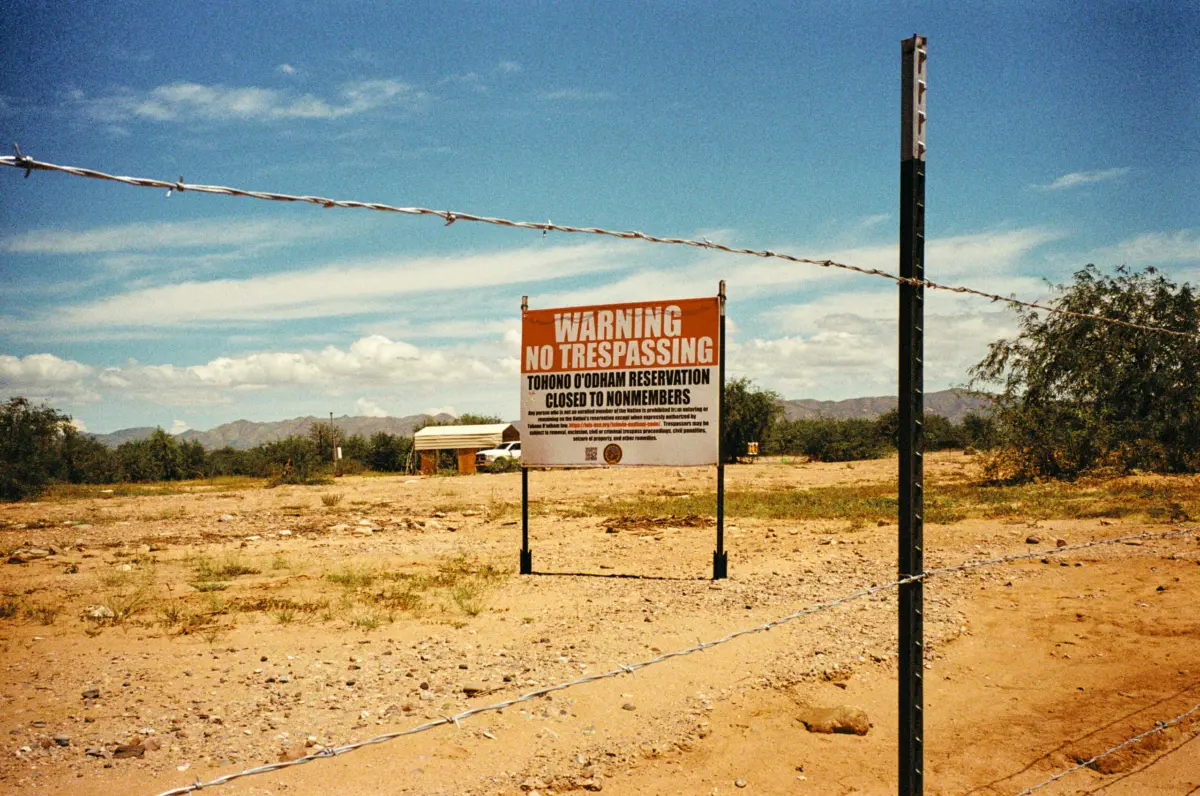
Wynona P. Larson Yazzie, an O’odham tribal elder, Marine Corps veteran, and former tribal police officer who had organized prayer runs to the intaglio, closely followed the lawsuit. On August 6, a disturbing court filing by the tribe’s attorneys revealed that contractors would enter the reservation in four days to conduct tests, signaling DHS was "exploiting" the judge’s deliberation period. In response, tribal leaders erected dozens of 8-foot-wide "no trespassing" signs along the main access roads. Larson Yazzie, however, began making plans of her own.
She was joined by Amy Juan, a 40-year-old O’odham activist. Juan had witnessed the increasing militarization of the border since 9/11, with the closure of traditional crossings like Ko:li Ki:jig, the establishment of Border Patrol forward operating bases, and checkpoints restricting tribal members’ movements. Human rights groups had documented arrests, deportations of U.S.-born tribal members, and instances of verbal and physical abuse by Border Patrol agents on the reservation. Juan lamented the "cost" of the Nation’s collaborations with DHS, which she felt had sacrificed safety and civil liberties without achieving true security.
The Prayer Camp: A Spiritual Stand Against the Wall
Driven by a deep concern that the Nation might yield to DHS pressure, Larson Yazzie and Juan initiated a prayer fire, an important O’odham tradition convened in times of communal struggle. The chosen site was Ko:li Ki:jig, a traditional border crossing. They named their camp Tadai Me:i, meaning "roadrunner on fire," symbolizing resilience and spiritual protection. The fire was lit on August 9, just as federal contractors were poised to enter the reservation.

The camp was not a protest in the conventional sense, eschewing confrontation for spiritual devotion. Participants focused on keeping the sacred flame burning with sugai (creosote bush), engaging in morning prayers and nightly cleanses. The atmosphere was one of familial solidarity amidst uncertainty. However, the presence of the camp immediately drew federal attention. The first drone sighting was recorded at 11:43 p.m. on August 10, marking the beginning of intense surveillance.
Detailed handwritten logs, compiled minute-by-minute by camp participants and shared with ProPublica, documented a steady escalation of DHS activity. Over the first seven days, nearly 665 observations were recorded, primarily involving federal agents buzzing around their location. Agents would park and watch, some snapping photos of campers, while Mexican security forces were observed conversing and exchanging information with Border Patrol agents across the boundary. Amy Juan noted, "Surveillance has heightened. Drones, helicopters, a lot of air activity." Choppers, including marked CBP and military-style Black Hawks, and handheld quadcopters flew directly over the camp, even during prayer songs.
The camp’s presence, though peaceful, was not without fear. Collin Quasule, a 24-year-old visitor, expressed profound apprehension: "My fear is that they gonna start shooting us." He recounted personal experiences of federal agents trailing him, stopping him without cause, and refusing to accept his legal identification. Concerns about potential violent confrontations, reminiscent of the 2016 Standing Rock Sioux protest against the Dakota Access Pipeline, led some legislative council members to oppose the gathering, fearing it could draw outsiders and escalate tensions in the unforgiving desert terrain. The tragic memory of Ray Mattia, a 58-year-old unarmed O’odham man shot and killed by Border Patrol agents on the reservation in 2023, loomed large.
The August 25 Incursion and Beyond

On August 14, Judge Richard J. Leon denied the Nation’s injunction request, writing, "I fully expect the government in the months ahead to follow through on its guarantees of consultation and cooperation with the Nation to address the Nation’s concerns regarding border wall construction!"
Eleven days later, the Border Patrol’s 60-second notice arrived. Larson Yazzie immediately drove to the border to document the contractors, only to be stopped by an agent who had laid a spike strip ahead. When the tribal police chief arrived, he too was blocked by a Border Patrol roadblock. He encountered BORTAC agents, the agency’s special operations wing, dressed in desert camouflage, masks, and tactical gear reminiscent of U.S. military units in Iraq and Afghanistan. This elite cadre had previously been deployed in citywide sweeps in Minneapolis and Chicago, operations that resulted in three deaths, including two U.S. citizens. The chief was only permitted to record after promising not to interfere. He observed drilling rigs and agents guarding them, noting that the heavy vehicles were operating beyond the 60-foot "Roosevelt Reservation" that government attorneys had assured the judge they would not leave. Bureau of Indian Affairs agents were also present, claiming orders from Washington D.C. to "preserve the peace and monitor activities."
In response to this blatant disregard for the judge’s expectation of cooperation, the prayer camp participants reignited their sacred fire. Davy Cross, a 57-year-old tribal member, recalled hearing weapons being chambered and seeing drones flying dark and low, their rotors felt against his skin. Soon, an airplane and helicopter joined the surveillance. A caravan of over 30 Border Patrol and construction vehicles, accompanied by Mexican state police, formed a semicircle around the camp. "We got surround[ed] by over 30 vehicles," Cross wrote in the activity log, a moment captured in a video that quickly spread across social media.
The tribe’s attorneys filed an appeal, pleading for a halt to the government’s activities and arguing that the administration was making "a mockery" of the court’s expectations.

A Tale of Two Borders: Hypocrisy and Disparity
The Tohono O’odham’s struggle stood in stark contrast to events unfolding simultaneously in Texas. There, the Trump administration’s plans for a wall through Big Bend National Park had united an unlikely coalition of environmental nonprofits, river guides, hunters, ranchers, and local sheriffs in opposition. Just one week before the armed incursion onto the Tohono O’odham reservation, Republican Governor Greg Abbott announced a pause on the controversial Big Bend project after discussions with the DHS secretary. "There are technology tools that don’t include barriers," Abbott stated, referencing drones and fiber optics – precisely the advanced surveillance technology that had been extensively tested and deployed on the Tohono O’odham Nation for decades. Last week, a judge granted a preliminary injunction halting construction in the Big Bend area.
For Amy Juan, the disparity was a bitter pill. "What makes Texas the exception to us is very clear," she stated. "It’s good old boy conversations that are happening between the politicians and the CBP commissioners and Markwayne Mullin." This perceived double standard underscored a painful reality for the Tohono O’odham: despite their long history of cooperation and their deep cultural ties to the land, their sovereignty and rights were being systematically undermined by a federal government prioritizing a physical barrier over the well-being of a sovereign nation.
Dystopia and an Unyielding Spirit

The surveillance at Tadai Me:i continued unabated. Liz Quiroga, a 28-year-old tribal member, meticulously logged observations: 379 entries over five days, nearly two-thirds detailing Border Patrol units near the fire, six instances of Mexican authorities, 39 mentions of unmarked vehicles and suspected "undercovers," and a dozen aircraft overhead. "Nobody has any idea what’s actually happening out here," Quiroga remarked, "This is true dystopia."
As its legal challenge grinds on, the Tohono O’odham Nation has ceased attempting to physically remove border wall contractors from its lands, recognizing the overwhelming force arrayed against them. Yet, the prayer camp and the constant federal surveillance persist, a testament to the unyielding spirit of a people determined to protect their sacred lands, cultural heritage, and inherent sovereignty against what they view as an existential threat. The battle for the border wall on the Tohono O’odham Nation is more than a dispute over land; it is a profound struggle for self-determination and the very soul of a people.



 Joko Widodo
 Eva Lovia
 Pevita Pearce
 admin
admin
 Lina Irawan