
 Jia Lissa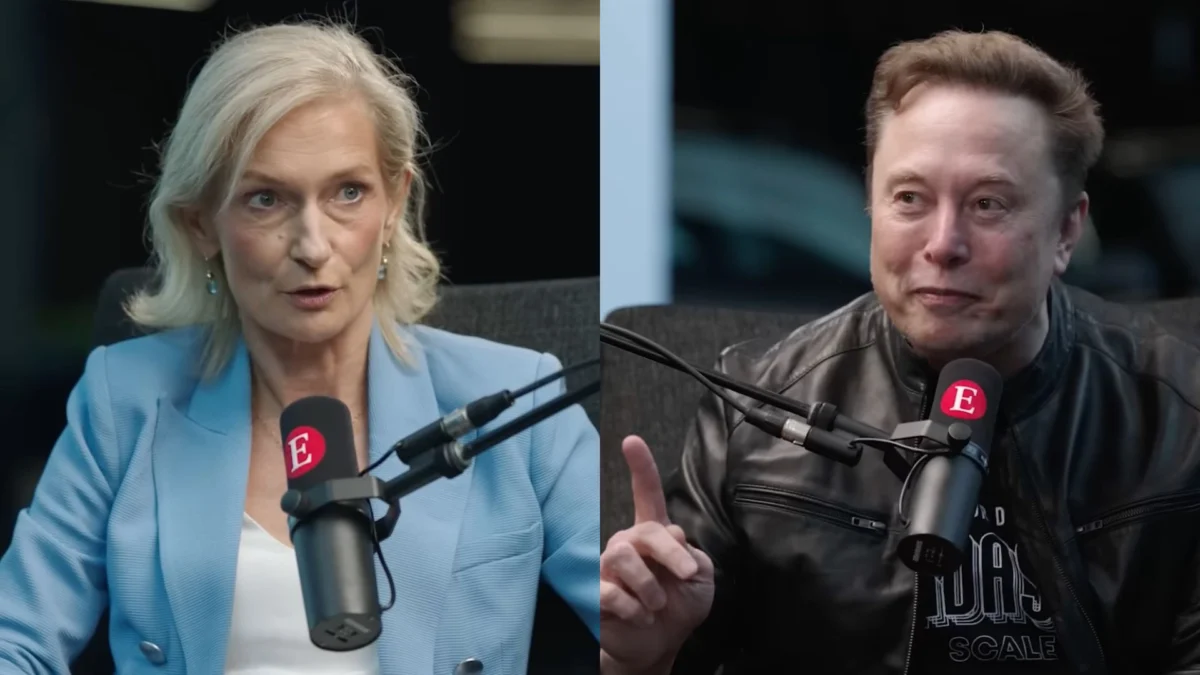
In a wide-ranging and often contentious 90-minute interview released on Thursday, SpaceX and Tesla CEO Elon Musk engaged in a sharp rhetorical battle with Zanny Minton Beddoes, the editor-in-chief of The Economist. The discussion, which spanned topics from global demographics to the future of Western civilization, centered significantly on Musk’s recent assertions regarding the United Kingdom’s social stability. During the exchange, Beddoes directly challenged Musk’s public prediction that a "civil war" in Britain is "inevitable," dismissing the claim as "nonsense" and "misleading." Musk, however, remained steadfast, doubling down on his assessment while accusing the traditional media and British elites of living in a "cloistered" bubble that ignores the grievances of the working class.
The interview serves as a pivotal moment in the ongoing tension between the world’s wealthiest man—who now wields significant influence over global discourse through his ownership of the social media platform X—and the established journalistic institutions of the West. The confrontation highlighted a fundamental divide in how modern social challenges, particularly those involving immigration and cultural integration, are perceived and reported.
The "Civil War" Controversy and Musk’s Defense
The friction between Beddoes and Musk reached its peak when the conversation turned to Musk’s recent activity on X. In August 2024, following a period of civil unrest in several British towns and cities, Musk posted to his 250 million followers that "civil war is inevitable" in the United Kingdom. When asked by Beddoes if he stood by this claim, Musk replied, "On the current trends, yes."
Beddoes, who is based in London, countered Musk’s narrative by pointing out his lack of recent physical presence in the country. She noted that Musk had not visited the U.K. in several years, whereas she experiences the daily reality of British life firsthand. "Exactly, so I live there. I’m there the whole time. That is nonsense," she remarked, referring to his prediction of imminent societal collapse.
Musk responded by suggesting that Beddoes’ professional and social status shielded her from the realities facing many British citizens. "You live in quite a cloistered existence," Musk argued. He further elaborated on his theory of "reckoning," stating that if a country has a "large and rapidly growing group of people whose beliefs are antithetical to Western beliefs, at some point there will be a reckoning." He defined civil war not necessarily as a formal military conflict, but as a state where "they will try to implement their views, and those who oppose it will oppose it."
Contextual Background: The Summer 2024 Unrest
To understand the weight of these comments, it is necessary to look at the timeline of events that preceded them. In late July 2024, a tragic stabbing incident in Southport, England, resulted in the deaths of three young girls. Following the attack, false information spread rapidly on social media—including on X—claiming that the suspect was an undocumented immigrant and a radical Islamist. These rumors sparked a week of violent riots across England and Northern Ireland, targeting mosques and hotels housing asylum seekers.
It was during this period of volatility that Musk began posting his "civil war" commentary. His engagement with controversial figures, such as Stephen Yaxley-Lennon (known as Tommy Robinson), and his criticism of Prime Minister Keir Starmer’s "two-tier policing" (the theory that right-wing protesters are treated more harshly than left-wing or minority groups) drew sharp rebukes from the British government. A spokesperson for the Prime Minister stated at the time that there was "no justification" for Musk’s comments and that social media companies have a responsibility to prevent the spread of inflammatory misinformation.
Statistical Analysis: Crime and Safety in the UK vs. the US
A central point of contention in the interview was the safety of British cities. Beddoes argued that Musk’s rhetoric has convinced many Americans that London and other British cities have become "no-go zones" overrun by violent crime and "grooming gangs." She insisted that "the numbers" disprove Musk’s claims, asserting that London remains significantly safer than any major city in the United States.
Data from the UK’s Office for National Statistics (ONS) and the US Federal Bureau of Investigation (FBI) largely support Beddoes’ assertion regarding violent crime. In the year ending March 2024, the homicide rate in London stood at approximately 1.2 per 100,000 people. In contrast, New York City—often considered one of the safer large US cities—recorded a homicide rate of roughly 4.8 per 100,000 in 2023. Other major US cities, such as Chicago or Philadelphia, maintain rates significantly higher, often exceeding 20 per 100,000.
Furthermore, ONS data indicates that overall "violence against the person" in England and Wales has seen a general downward trend or remained stable over the last decade, despite high-profile incidents. However, Musk argued that these statistics do not capture the underlying cultural tensions that he believes will eventually lead to a breaking point. He challenged Beddoes to a "walking tour" of Britain to see the reality of segregated communities and cultural friction, an invitation Beddoes accepted.
The Rhetoric of the "Far-Right"
Throughout the interview, Musk pushed back against the label of "far-right" that has been frequently applied to him by media outlets. He framed his positions as common-sense principles that were once the bedrock of liberal politics. "It’s just normal people and here are the principles, and tell me which of these is terrible: that we should have secure borders, that we should have safe cities, that we should have sensible spending," Musk asked. "Which of those three are far-right, fringe?"
He went on to "admonish" the media for what he described as an "absurd characterization" of modern conservative or populist views. Musk’s argument is that the political "Overton Window"—the range of policies acceptable to the mainstream population—has shifted so far to the left that traditional centrist views on national sovereignty and law and order are now branded as extremist.
Critics, however, argue that it is not Musk’s support for "secure borders" that earns him the far-right label, but rather his amplification of "Great Replacement" conspiracy theories and his interactions with fringe accounts that promote racial and religious animosity. In the UK context, the term "far-right" was specifically used by the government to describe the organized groups that led the attacks on migrant housing and religious sites during the August riots.
Broader Implications for Global Discourse
The exchange between Beddoes and Musk highlights a growing concern among European leaders and media figures about the influence of American tech moguls on domestic European politics. Beddoes expressed frustration that Musk’s posts shape the opinions of millions of Americans who may never visit the UK but believe it is on the verge of collapse based on his "posts on X."
This phenomenon, often referred to as "digital diplomacy" or "digital interference," depending on one’s perspective, represents a shift in how international relations are conducted. Historically, a private citizen’s views on a foreign country’s internal affairs carried little weight. However, Musk’s ownership of X allows him to bypass traditional diplomatic channels and speak directly to the citizens of those countries, as well as to a global audience.
The British government’s response to Musk has been one of cautious confrontation. While they have condemned his "civil war" remarks, they are also mindful of Musk’s role as a major industrial partner. SpaceX remains a critical provider for satellite launches, and Tesla is a significant player in the UK’s transition to electric vehicles. This creates a complex dynamic where the government must balance the defense of its national reputation with the practicalities of its economic and technological dependencies.
Chronology of Musk’s Engagement with British Politics
To track the evolution of Musk’s relationship with the UK, one can look at a series of key interactions over the past year:
- November 2023: Musk attends the AI Safety Summit at Bletchley Park. He participates in a friendly "fireside chat" with then-Prime Minister Rishi Sunak, discussing the risks of artificial intelligence and the future of work. The tone is collaborative and respectful.
- July 2024: Following the Southport attack, Musk begins criticizing the UK’s legal system and immigration policies on X.
- August 2024: Musk posts "civil war is inevitable" during the height of the riots. He engages in a public spat with Prime Minister Keir Starmer, calling him "#TwitterKeir" and accusing the government of being soft on certain types of crime while cracking down on online speech.
- September 2024: Reports emerge that the UK government has excluded Musk from a major international investment summit, citing his recent inflammatory comments as a reason for the snub.
- October 2024: The Economist interview is recorded and released, showing that Musk has not backed down from his assertions despite the de-escalation of physical violence on British streets.
Conclusion: A Deepening Divide
The interview with Zanny Minton Beddoes underscores that Elon Musk views himself not merely as a businessman, but as a cultural and political disruptor. By challenging the "cloistered" views of the media elite, Musk seeks to position himself as a voice for a silent majority. Conversely, journalists like Beddoes view Musk as a dangerous provocateur who uses his massive platform to spread distorted versions of reality that have real-world consequences for social cohesion.
As Musk and Beddoes concluded their exchange with an agreement to take a "walking tour" of the UK, the fundamental disagreement remained unresolved. Whether the UK is indeed on a path toward a "civilizational reckoning" or is simply navigating the standard challenges of a diverse, modern democracy remains a subject of intense debate. What is certain, however, is that the friction between global tech platforms and national governments is entering a new and more confrontational era, with the stability of Western institutions hanging in the balance.


 Yuyun Lusiyani
 Joko Widodo
 Pevita Pearce
 admin
admin
