
 Jia Lissa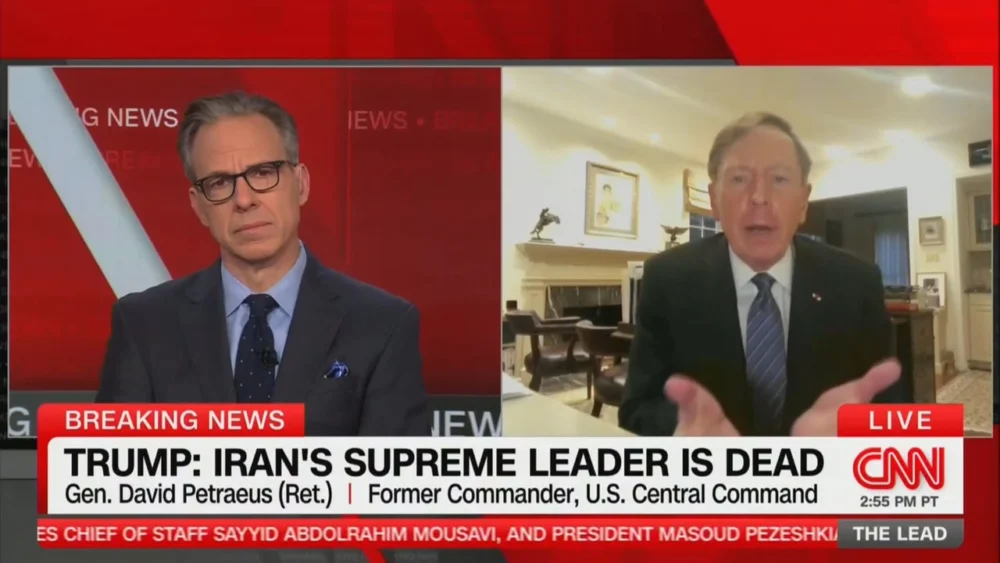
The geopolitical landscape of the Middle East underwent a seismic shift on Saturday following a high-precision joint military operation by United States and Israeli forces that resulted in the death of Iran’s Supreme Leader, Ayatollah Ali Khamenei. Former U.S. Army General and CIA Director David Petraeus, appearing on CNN’s State of the Union, characterized the operation as a "stunning achievement," marking a definitive end to the decades-long reign of the Islamic Republic’s most powerful figure. In a wide-ranging interview with host Jake Tapper, Petraeus analyzed the tactical brilliance of the strike while expressing profound surprise at the apparent lapse in security and intelligence on the part of the Iranian regime.
The strike, which reportedly took place in broad daylight, targeted a high-level gathering of the Iranian leadership. According to preliminary reports from defense officials and field correspondents, the operation eliminated not only the Supreme Leader but also more than 40 senior members of the regime’s military and political apparatus. The success of the mission has ignited a global debate regarding the legality of targeted assassinations, the future of the Iranian state, and the immediate security implications for the "Axis of Resistance" across the Levant and the Persian Gulf.
Tactical Execution and the Element of Surprise
General Petraeus highlighted the unorthodox timing of the strike as a primary factor in its success. Standard military doctrine for high-value target (HVT) extractions or eliminations typically favors the "dark of night" to utilize superior night-vision technology and minimize civilian presence. However, the Saturday strike defied these conventions. Petraeus noted that the Iranian leadership appeared to have succumbed to a sense of "stunning arrogance," assuming that the daylight hours provided a window of safety from Western intervention.
"I think they really thought they were in the clear for another period of daylight because we didn’t go in the normal time—almost all of our operations begin in the early hours of the morning," Petraeus told Tapper. He suggested that the gathering of senior officials in a single location during the day indicated a catastrophic failure of Iranian counter-intelligence. The precision of the strike, facilitated by what Petraeus called "superb military strikes" and "precise intelligence," allowed the joint forces to decapitate the regime’s leadership with minimal collateral damage, according to initial Pentagon assessments.
The operation reportedly utilized a combination of stealth technology and advanced signal intelligence (SIGINT). Sources familiar with the mission suggest that the gathering was being monitored in real-time, allowing the joint command to confirm the presence of Khamenei before authorizing the final kinetic phase. The elimination of 40 other senior leaders suggests that the strike hit a central command-and-control node, potentially a meeting of the Supreme National Security Council or a high-level IRGC (Islamic Revolutionary Guard Corps) briefing.
Historical Context: The Reign of Ali Khamenei
To understand the gravity of this event, one must look at the 35-year tenure of Ali Khamenei. Since succeeding Ayatollah Ruhollah Khomeini in 1989, Khamenei served as the ultimate arbiter of Iranian domestic and foreign policy. Under his guidance, Iran expanded its "strategic depth" by fostering a network of proxy militias, including Hezbollah in Lebanon, Hamas in Gaza, and the Houthi movement in Yemen.
His leadership was defined by a steadfast "Look to the East" policy, strengthening ties with Russia and China while maintaining a posture of "Maximum Resistance" against the United States and Israel. Domestically, his rule was marked by the consolidation of power within the IRGC and the systematic suppression of dissent, most notably during the 2009 Green Movement and the more recent "Woman, Life, Freedom" protests following the death of Mahsa Amini. The removal of such a central figure creates an immediate and unprecedented power vacuum within the theocratic structure of the Iranian state.
A Timeline of the Operation and Immediate Aftermath
The events of Saturday unfolded with rapid intensity, leading to a state of high alert across global capitals:
- 14:00 GMT: Reports begin to circulate of a massive explosion in a secure district of Tehran. Initial rumors suggest a technical failure or a localized drone strike.
- 15:30 GMT: Fox News correspondent Trey Yingst, reporting from the region, confirms through high-level sources that the strike was a coordinated US-Israeli effort targeting a senior leadership summit.
- 17:00 GMT: President Donald Trump takes to Truth Social to confirm the death of the Supreme Leader, labeling him "one of the most evil people in history."
- 18:00 GMT: The Israeli Defense Forces (IDF) and the U.S. Department of Defense issue a joint statement confirming the success of the mission, citing the necessity of the strike to prevent imminent threats to regional stability.
- 19:30 GMT: UN Secretary-General António Guterres convenes an emergency meeting of the Security Council, condemning the strike as a "grave threat to international peace" and calling for immediate de-escalation.
- 21:00 GMT: Large-scale celebrations break out in cities with significant Iranian diaspora populations, most notably in Los Angeles and London, as news of the regime’s decapitation spreads.
Official Responses and Global Reaction
The reaction to the strike has been sharply divided along geopolitical lines. President Donald Trump’s statement emphasized justice for victims of Iranian-sponsored terrorism. "This is not only Justice for the people of Iran, but for all Great Americans, and those people from many Countries throughout the World, that have been killed or mutilated by Khamenei and his gang of bloodthirsty THUGS," Trump declared. This sentiment was echoed by several congressional leaders who viewed the strike as a necessary measure to dismantle the "head of the snake" in the Middle East.
Conversely, the international diplomatic community has expressed deep concern over the potential for a regional conflagration. UN Secretary-General António Guterres’s condemnation highlights the legal complexities of the strike. Critics argue that such actions bypass traditional diplomatic channels and risk provoking a massive retaliatory response from the remaining elements of the IRGC and Iran’s regional proxies.
In the United States, public reaction reflected the complex history of US-Iran relations. In Los Angeles, home to "Tehrangeles," CNN captured scenes of ecstatic protesters. Witnesses reported people jumping, hugging, and crying with joy, viewing the event as the first step toward the liberation of their homeland. However, security analysts warn that the "ecstasy of the moment" must be balanced against the "agony of uncertainty" regarding what comes next.
The Succession Crisis: Who Follows the Ayatollah?
One of the most critical points raised by General Petraeus during his CNN appearance was the uncertainty surrounding Iran’s future leadership. The Islamic Republic’s constitution mandates that a committee known as the Assembly of Experts must appoint a new Supreme Leader. However, the elimination of 40 other senior leaders likely included several members of this very assembly, as well as potential successors.
"The problem is that the people that usually prevail in situations like this are not the Democrats on a white horse here—you know, the George Washington figures," Petraeus observed. "These are the guys with the most guns and who are the most ruthless."
Analysts point to two primary paths for Iran in the coming weeks:
- Military Coup/IRGC Consolidation: With the clerical leadership decimated, the IRGC may move to take direct control of the state, transitioning Iran from a theocracy to a more traditional military autocracy.
- Internal Collapse and Civil Unrest: The sudden disappearance of the central authority figure could embolden the domestic opposition, leading to a renewed revolutionary movement. However, without a unified leadership structure, this could also devolve into a protracted civil war.
The names previously floated as successors, such as Khamenei’s son Mojtaba Khamenei, now face an environment where their survival is not guaranteed. The IRGC’s Quds Force, though recently weakened by the loss of Qasem Soleimani and now further degraded by this Saturday strike, remains a potent force capable of enforcing order through sheer brutality.
Broader Implications for Regional Stability
The death of Khamenei sends shockwaves through the "Ring of Fire"—the network of Iranian-backed groups surrounding Israel. Hezbollah, already under significant pressure, finds itself without its primary benefactor and ideological guide. Similarly, the Houthi rebels in Yemen and various Shia militias in Iraq may face a sudden shortage of funding, intelligence, and high-level strategic direction.
However, the risk of a "dead man’s switch" scenario cannot be ignored. Iranian military doctrine has long included plans for asymmetric retaliation in the event of a decapitation strike. This could include cyberattacks on Western infrastructure, the closure of the Strait of Hormuz—a vital artery for global oil—or a surge in terrorist activities across Europe and North America.
From a market perspective, global oil prices saw an immediate spike following the news, as traders factored in the risk of supply disruptions in the Persian Gulf. Economists suggest that while the strike may lead to long-term stability by removing a primary sponsor of regional conflict, the short-term volatility will be significant.
Conclusion: A New Chapter in the Middle East
The joint US-Israeli operation to eliminate Ali Khamenei is arguably the most significant military intervention in the Middle East since the 2003 invasion of Iraq. As General Petraeus noted, the technical success of the mission is "extraordinary and truly historical." Yet, the strategic success will be measured by what fills the vacuum left behind.
The international community now watches Tehran with bated breath. Will the death of the Supreme Leader lead to a "Persian Spring" and a transition to a representative government, or will it usher in a darker era of military rule and regional chaos? While the "stunning achievement" of the strike is undeniable, the geopolitical consequences are only beginning to unfold. For now, the world remains in a state of high vigilance, recognizing that while a "bloodthirsty thug" may be gone, the system he built over three decades will not disappear overnight without a struggle.

 Yuyun Lusiyani
 Joko Widodo
 Eva Lovia
 Pevita Pearce