
 Jia Lissa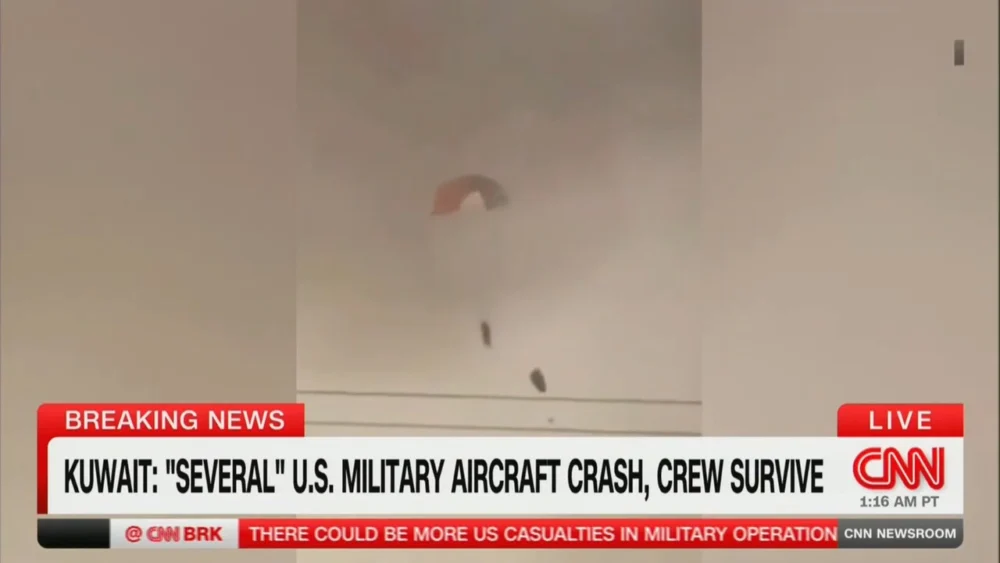
In a significant and tragic escalation of the ongoing conflict in the Middle East, United States Central Command (CENTCOM) confirmed on Monday morning that three U.S. Air Force F-15E Strike Eagles were destroyed in a friendly fire incident over Kuwait. The incident occurred late Sunday night as Kuwaiti air defense batteries were actively engaging a massive wave of Iranian ballistic missiles, drones, and manned aircraft. Despite the loss of three multi-million dollar airframes, military officials reported a fortunate outcome regarding the personnel involved: all six crew members successfully ejected and are currently in stable condition at a regional medical facility.
The downing of the aircraft took place at approximately 11:03 p.m. ET on March 1, 2026, amid the chaotic "fog of war" that has characterized the recent surge in hostilities between Iran and coalition forces. The F-15E Strike Eagles were operating in support of Operation Epic Fury, a high-stakes military campaign aimed at neutralizing Iranian launch sites and protecting critical infrastructure across the Persian Gulf.
The Circumstances of the Incident
According to official statements and verified video footage circulating on social media, at least one of the jets was seen spiraling toward the desert floor in a ball of flame. Onlookers captured the moment a parachute deployed, signaling the successful escape of a crew member just moments before the aircraft impacted the ground. The crash site is reportedly located roughly six miles from the Ali Al Salem Air Base, a vital hub for U.S. and coalition air operations in the region.
At the time of the incident, the airspace over Kuwait was heavily saturated. Iranian forces had launched a coordinated strike involving ballistic missiles and "suicide" drones, many of which were aimed directly at Ali Al Salem and other strategic installations. Kuwaiti air defense units, equipped with advanced surface-to-air missile (SAM) systems, were operating at maximum readiness to intercept the incoming threats.
CENTCOM’s Monday morning briefing clarified the nature of the error. "During active combat that included attacks from Iranian aircraft, ballistic missiles, and drones, the U.S. Air Force fighter jets were mistakenly shot down by Kuwaiti air defenses," the statement read. The command emphasized that the incident was a result of the extreme complexity of the combat environment, where identifying friendly versus foe targets becomes a split-second necessity under immense pressure.
Detailed Timeline of the March 1-2 Engagement
To understand the sequence of events that led to this rare and costly friendly fire incident, a chronological reconstruction of the night’s activities is essential:
- 9:45 p.m. ET, March 1: Early warning systems detect a large-scale launch of ballistic missiles from western Iran. U.S. and Kuwaiti forces move to "Condition Red."
- 10:15 p.m. ET: A second wave, consisting of low-flying Shahed-series drones and cruise missiles, is detected crossing the Persian Gulf. F-15E Strike Eagles from the 332nd Air Expeditionary Wing are scrambled to intercept the subsonic threats.
- 10:40 p.m. ET: Iranian manned aircraft are reported near the border, prompting intensified air patrols. The airspace over Kuwait becomes a "kinetic zone" with multiple layers of defense operating simultaneously.
- 11:03 p.m. ET: The friendly fire incident occurs. Three F-15Es, returning from a successful intercept mission, are tracked by Kuwaiti ground-based radar. Due to a catastrophic failure in deconfliction protocols or Identification Friend or Foe (IFF) synchronization, the Kuwaiti batteries fire.
- 11:15 p.m. ET: Search and Rescue (SAR) teams are dispatched from Ali Al Salem Air Base immediately following the "eject" signals.
- 2:00 a.m. ET, March 2: The Kuwaiti Ministry of Defense confirms that all six crew members (three pilots and three Weapon Systems Officers) have been recovered and transported to a military hospital.
- 6:52 a.m. ET: CENTCOM issues a formal public acknowledgment of the incident, confirming the loss of the aircraft and the status of the airmen.
Technical Profile: The F-15E Strike Eagle
The loss of three F-15E Strike Eagles represents a significant blow to the U.S. Air Force’s regional capabilities. The Strike Eagle is a dual-role fighter designed for long-range, high-speed interdiction without relying on escort or electronic-warfare aircraft.
Each aircraft carries a crew of two: a pilot in the front seat and a Weapon Systems Officer (WSO) in the rear. The F-15E is prized for its ability to operate in all weather conditions, day or night, using the LANTIRN (Low Altitude Navigation and Targeting Infrared for Night) system. In the context of Operation Epic Fury, these jets were likely equipped with a mix of AIM-120 AMRAAMs for air-to-air defense and precision-guided munitions for ground strikes.
The financial cost of the incident is substantial. While the base cost of an F-15E is approximately $80 million to $100 million, the modern variants used in 2026, equipped with advanced AESA (Active Electronically Scanned Array) radar and updated electronic warfare suites, are valued significantly higher. Combined, the loss of three airframes, specialized pods, and expended munitions likely exceeds $350 million.
Official Responses and International Coordination
The Kuwaiti government was quick to issue a statement through its Defense Ministry spokesman, expressing regret over the incident while highlighting the intensity of the Iranian provocation. "The relevant authorities immediately launched search and rescue operations, evacuated the crews, and transported them to a hospital to assess their condition and provide necessary medical care," the spokesman stated.
Kuwaiti officials emphasized that they are working in lockstep with U.S. military investigators to determine exactly how the misidentification occurred. "We took joint technical measures immediately following the incident to ensure that our integrated air defense systems are fully synchronized with our American partners," the ministry added.
U.S. Secretary of Defense and the Joint Chiefs of Staff were reportedly briefed on the incident overnight. While the loss of equipment is lamented, the primary focus remains on the survival of the crew. In Washington, sources close to the Pentagon indicated that a formal "Safety Investigation Board" (SIB) and an "Accident Investigation Board" (AIB) will be convened. These boards will scrutinize radar logs, IFF transponder data, and communication transcripts between the Kuwaiti battery commanders and U.S. Air Operations Centers (AOC).
Analysis of Air Defense Challenges
Military analysts point out that "friendly fire" or "blue-on-blue" incidents involving air defense are among the most difficult risks to manage in modern warfare. Several factors likely contributed to this specific tragedy:
- Saturation of the Airspace: When dozens of incoming missiles and drones are detected simultaneously, air defense operators have seconds to categorize targets. In a "target-rich" environment, the margin for error is razor-thin.
- Electronic Warfare (EW) Interference: It is highly probable that Iranian forces employed electronic jamming to confuse coalition radars. Such tactics can cause "ghost" images on radar screens or suppress the IFF signals that tell a missile battery not to fire on a friendly plane.
- Cross-Platform Integration: While Kuwait uses U.S.-made Patriot missile systems and other Western hardware, the integration of these systems into a seamless, real-time data link with flying aircraft is a constant technical challenge.
- The Proximity of the Attack: With Iranian missiles targeting the very base the F-15Es were defending, the engagement took place at extremely close range, reducing the time available for visual confirmation or secondary verification.
Broader Implications for Operation Epic Fury
The downing of these jets comes at a pivotal moment for Operation Epic Fury. The U.S.-led operation was initiated to restore deterrence in the region after a series of maritime provocations and drone strikes on energy infrastructure. However, the loss of three front-line fighters to friendly fire may force a temporary pause or a significant tactical shift in how air patrols are conducted over Kuwait and Saudi Arabia.
There are also geopolitical considerations. Kuwait remains one of the United States’ most reliable allies in the region, designated as a Major Non-NATO Ally (MNNA). This incident, while clearly an accident of war, puts a spotlight on the friction points of multinational military cooperation. It is expected that the U.S. will provide additional training or technical upgrades to Kuwaiti air defense units to prevent a recurrence.
Furthermore, the Iranian regime may attempt to use this incident for propaganda purposes, portraying the coalition as disorganized or incapable of managing a high-intensity conflict. Despite this, CENTCOM’s transparency in quickly admitting the error is seen by many as a move to maintain credibility and prevent the spread of misinformation.
Conclusion and Future Outlook
As of Monday afternoon, the six airmen remain under observation. Their survival is being hailed as a testament to the reliability of modern ejection systems and the efficiency of the joint U.S.-Kuwaiti Search and Rescue protocols.
The investigation into the "joint technical measures" mentioned by the Kuwaiti spokesman will likely focus on the Link 16 data exchange protocols, which are supposed to provide a common tactical picture to all friendly forces. If a glitch is found in how the F-15Es were broadcasting their position to the ground-based batteries, it could trigger a fleet-wide software update for U.S. assets globally.
For now, the skies over Kuwait remains heavily contested. While the physical wreckage of the Strike Eagles is being recovered for sensitive technology protection, the mission of Operation Epic Fury continues. The incident serves as a sobering reminder of the inherent dangers of high-tech warfare, where even the most advanced systems can fail in the heat of a multi-vector assault. The focus of the coming days will be on refining the "rules of engagement" to ensure that as coalition forces look to the horizon for enemies, they do not accidentally strike their own in the process.


 Yuyun Lusiyani
 Joko Widodo
 Eva Lovia
 Pevita Pearce