
 Amara Maple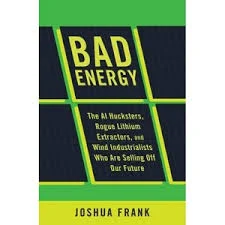
The rapidly accelerating global transition to green energy, widely hailed as humanity’s best hope against climate catastrophe, is facing a stark and provocative challenge from a new book, Bad Energy: The AI Hucksters, Rogue Lithium Extractors, and Wind Industrialists Who Are Selling Off Our Future. Authored by Joshua Frank, a prominent editor at Counterpunch, and published by Haymarket Books in 2026, the book dissects what Frank argues is a profit-driven, ecologically destructive expansion of renewable infrastructure that mirrors the extractive industries it seeks to replace. This critical perspective emerges at a moment when mainstream environmental figures, such as Bill McKibben, advocate for the unprecedented pace and affordability of green technology, framing it as a source of "energetic wealth" and a viable path to a sustainable future.
The Dual Narrative: Hope and Accelerating Crisis
The current environmental discourse often oscillates between alarming warnings of accelerating climate change and burgeoning optimism about technological solutions. This tension was recently encapsulated during an appearance by Bill McKibben, a leading voice in climate activism, on Ezra Klein’s podcast. Klein’s summary of their discussion highlighted a paradox: "there’s bad news and good news." The "bad news," as widely acknowledged, is the undeniable acceleration of climate change, with global temperatures rising faster than anticipated, leading to more frequent and intense extreme weather events. Scientific consensus, particularly from reports by the Intergovernmental Panel on Climate Change (IPCC), consistently underscores the urgency of decarbonization efforts to avert the most catastrophic scenarios.
However, the "good news" side of Klein’s assessment, echoed by McKibben, points to the astonishing progress in renewable energy. Klein enthusiastically noted, "Green energy is getting better and cheaper, faster than we had ever dared hope." He highlighted a remarkable statistic: "This next sentence was unimaginable even a few years ago: In April, the energy think tank Ember found that all of the new electricity demand around the world in 2025 was met with green power." This achievement suggests a tipping point, where renewables are not just supplementing but actively meeting the growth in global energy consumption. For advocates like McKibben, this signals the dawn of "clean energy abundance, a new form of energetic wealth," offering a future of "more and better – not less and worse." The sentiment is one of palpable relief and opportunity: "But now we cannot only imagine it, we can see it, touch it, live in it. It is here."
Introducing the Counterpoint: Joshua Frank’s "Bad Energy"
Yet, this optimistic narrative of green abundance is precisely what Joshua Frank’s Bad Energy seeks to scrutinize and critique. Frank, known for his incisive investigative journalism and a history of challenging established power structures, argues that "It is here. And not everyone is cheering." His book posits that the prevailing green energy transition, far from being a selfless endeavor to save the planet, is fundamentally driven by the same profit incentives that underpinned the fossil fuel era.
In Bad Energy, Frank outlines a compelling case against the current trajectory of renewable development. He contends that while the imperative to cease burning fossil fuels is undeniable, the "significant, haphazard expansion of green energy in recent years – from large solar projects to wind energy to mining for renewables – has destroyed communities and ecosystems." Furthermore, he challenges the fundamental premise that renewables, as currently deployed, can sustainably match an "ever-expanding demand for energy," a demand significantly exacerbated by the "rapid proliferation of data centers in the world’s wealthiest nations."
The Hidden Costs of "Green" Growth
Frank’s investigation takes readers on a global journey, illustrating the environmental and social costs of the rush for renewables. He details the impacts from copper mines in Montana and Bolivia, vital for electrical wiring; to vast wind farms in Wyoming, requiring extensive land use and transmission lines; and the contentious geopolitical scramble over deep-sea mining in the South Pacific for critical minerals like nickel, cobalt, and manganese. His assessment is stark: the current approach to renewable energy development is a continuation, rather than a departure, from destructive extractive practices.
The core of Frank’s argument is that humanity "cannot consume our way out of climate chaos." Instead, he advocates for a radical re-evaluation, demanding a "rejection of the capitalist interests driving planetary collapse and a radical vision for a truly sustainable future." This perspective directly confronts the "green growth" paradigm that assumes economic expansion can continue indefinitely, provided it’s powered by renewables.
Local Battlegrounds: California as a Microcosm
Frank’s inspiration for Bad Energy stems from his firsthand observations in Southern California. In an interview with Corporate Crime Reporter, he described the alarming sight of "industrial sized so-called renewable developments in the Mojave Desert." He noted, "For someone who spends a lot of time out there, it is alarming." This desert, often perceived as a barren wasteland, is a fragile ecosystem home to endangered species and serves as a natural carbon sink. Developing it for large-scale solar projects not only displaces wildlife but also diminishes its capacity to absorb atmospheric carbon.
Simultaneously, Frank investigated the changes to California’s residential solar program under Governor Gavin Newsom. He observed a "total gutting of the residential solar program in California, which was making great headway." His research revealed a clear motivation: "PG&E and these large utilities – they don’t want to decentralize the grid. They want to control the grid, they want to expand the grid – all under the guise of fighting climate change." This critique highlights the tension between centralized, utility-scale power generation and decentralized, community-based energy solutions. Frank points to Governor Newsom’s "deep ties to PG&E" and a "revolving door" of personnel, suggesting that corporate influence shapes energy policy at the expense of genuine environmental progress and public benefit.
The Resource Dilemma: Critical Minerals and Endless Extraction
A significant portion of Frank’s critique focuses on the escalating demand for critical minerals. The electrification of the global economy, from electric vehicles (EVs) and their batteries to solar panels and wind turbines, necessitates vast quantities of copper, lithium, nickel, cobalt, and other elements. Frank warns, "Their answer to climate change is more growth and more mining." He posits that this trajectory necessitates "hundreds of new huge mines all over the globe," representing "a continuation of the extractive industries that came before it. There is really not much difference."
Frank argues that many "Big Green groups" and environmentalists, while well-intentioned, "blindly accepted policies because they are labeled Green." He challenges the notion that industrial-scale projects like six-square-mile solar panel arrays in the Mojave or massive wind farms in Wyoming, complete with extensive transmission lines, are the optimal or most sustainable solutions. Instead, he advocates for "scaling down and producing energy locally," emphasizing that these large projects are often "rolled out for profit, not for the environment." He highlights the often-ignored "externalities" of these projects, particularly their impact on "rural and indigenous communities all over the globe who are going to be impacted by these new mining projects."
Beyond Electric Cars: Rethinking Transportation and Consumption
Frank extends his critique to the realm of transportation, specifically electric vehicles. While not inherently opposed to EVs, he questions their role as a panacea. Responding to McKibben’s advocacy for cheaper Chinese EVs over Tesla, Frank asserts, "that is not an answer to the pollution that our transportation industry produces." He argues that merely replacing gas-guzzling trucks with electric "Cybertrucks" fails to address the fundamental issues of excessive consumption and car-dependent infrastructure.
Instead, Frank champions a radical rethinking of urban landscapes, prioritizing "expanding public transit," "bikeability, walkability," and reducing overall reliance on private vehicles. He acknowledges that McKibben would likely agree with such goals but emphasizes that the current focus on EV adoption alone misses the larger systemic problem.
The "Degrowth" Imperative and China’s Carbon Conundrum
Frank directly challenges the idea that "green growth" is sufficient, asserting, "I would embrace degrowth. That’s the only way we are going to navigate ourselves out of this." He critiques the narrative that booming solar capacity in countries like Australia and China signifies true environmental progress. While acknowledging Australia’s solar boom, he points out its status as the second-largest exporter of fossil fuels. Similarly, regarding China, he notes that while its solar capacity is expanding rapidly, "Solar last year kept up with the growth China had – which is about five percent."
Frank emphasizes a critical distinction: "When we talk about expanding renewables, unless it is replacing fossil fuels on a real scale, we are not moving in the right direction. Just keeping up with economic growth isn’t the answer. We need to be replacing fossil fuels with renewables." He highlights China’s substantial fossil fuel emissions, stating, "China produces thirty percent of fossil fuel emissions in the world. Unless that number comes down, we are not going to get out of this." The continued construction of coal plants and increasing pollution, even alongside renewable development, undermines global climate goals.
A Radical Vision: Beyond Capitalism
At the heart of Frank’s proposed solution is a fundamental shift away from capitalism. He argues, "The point of the book is to get people to think beyond capitalism. We need a criticism of fossil fuel capitalism and how that has dominated this problem. Replacing fossil fuel capitalism with critical mineral capitalism isn’t going to solve the problem." He connects various social justice movements, such as opposing war and working for affordable housing, as inherently linked to "fighting capitalism."
Frank proposes a "democratized mining" approach, contrasting it with the current model of "selling off private lands to multinational corporations that want to come in, extract and leave biologically important lands desecrated." He suggests models like public power authorities, similar to the Tennessee Valley Authority, as a step towards public control over energy production. He also advocates for localized battery storage and exploring alternatives to lithium, such as sodium batteries, which may have a lower environmental impact. Critically, he stresses that large mining operations, often on public and indigenous lands, provide "minimal at best" benefit to the public and desecrate sacred sites.
Models for a Degrowth Future
While acknowledging that no country has fully implemented a degrowth policy by choice, Frank points to Cuba’s experience under blockade as a compelling example of a society forced to rethink its food system, energy, and transportation, demonstrating resilience and adaptation. He also highlights urban models like New York City, known for its low emissions due to walkability and extensive mass transit, and Nordic cities like Copenhagen and Stockholm, which emphasize local food consumption and reduced car dependency, even while maintaining growing economies. These examples, he concedes, are not perfect solutions but offer valuable lessons for scaling down and fostering sustainable living.
Frank’s book stands as an "indirect critique of the abundance movement," examining its real-world consequences "on the ground and in the oceans." He draws parallels between the historical exploitation by fossil fuel giants and the emerging practices of the renewable energy industry, particularly concerning deep-sea mining. He questions whether extracting metals from the sea floor, at the expense of marine ecosystems, can genuinely be called "renewable." His conclusion is unequivocal: "Abundance requires exponential mining indefinitely. There is no closed loop system in which we can have abundance for everybody."
A Journalist’s Perspective: Connecting Theory to Reality
Frank situates his work within a lineage of critical thinkers, mentioning E.F. Schumacher (Small is Beautiful), Kohei Saito (Slow Down: The Degrowth Manifesto), and Murray Bookchin (The Ecology of Freedom). However, he clarifies, "I don’t think of myself as a theorist or academic. I’m a journalist. I’m looking at how these technologies are playing out in the real world, on the ground." His book serves as a tool for a critical examination of even seemingly "good" technologies like wind and solar, insisting they "have to be done in a way that minimizes their impacts."
Frank broadens the environmental crisis beyond climate change to include the "loss of biodiversity," linking it to overfishing, deforestation, and industrial agriculture. He consistently returns to the "underlying issue" of capitalism, critiquing Bill McKibben for rarely addressing it in his contemporary discourse. Frank firmly believes, "I don’t believe there is any solution to the climate crisis without radically changing the economic system that underpins it."
The Political Landscape and the Path Forward
Frank admits that his viewpoint is largely absent from mainstream policy discussions, particularly among politicians. He notes that while some within the Democratic Socialists of America (DSA) are engaging with these ideas, it’s not a prevalent conversation at higher policy levels, reflecting a broader failure within the environmental movement to address systemic economic issues. He anticipates criticism, including accusations of being a "shill for Big Oil," but believes a thorough reading of his book, which also critiques hydropower and nuclear power, would dispel such notions.
Joshua Frank’s Bad Energy injects a vital, albeit uncomfortable, dose of skepticism into the prevailing narrative of a seamless green energy transition. It forces a reckoning with the uncomfortable truth that even well-intentioned climate solutions, if pursued within an unexamined capitalist framework, risk replicating the very injustices and ecological destruction they aim to overcome. The book serves as a potent call for a deeper, more systemic analysis of our energy future, urging a shift from mere technological replacement to a fundamental re-evaluation of consumption, growth, and economic paradigms. The debate ignited by Frank’s work underscores the complex challenges ahead, requiring not just technological innovation but also profound social, economic, and political transformation to achieve a truly sustainable and equitable future.



 Yuyun Lusiyani
 Joko Widodo
 Jia Lissa
 Pevita Pearce
 admin
admin
