
 Jia Lissa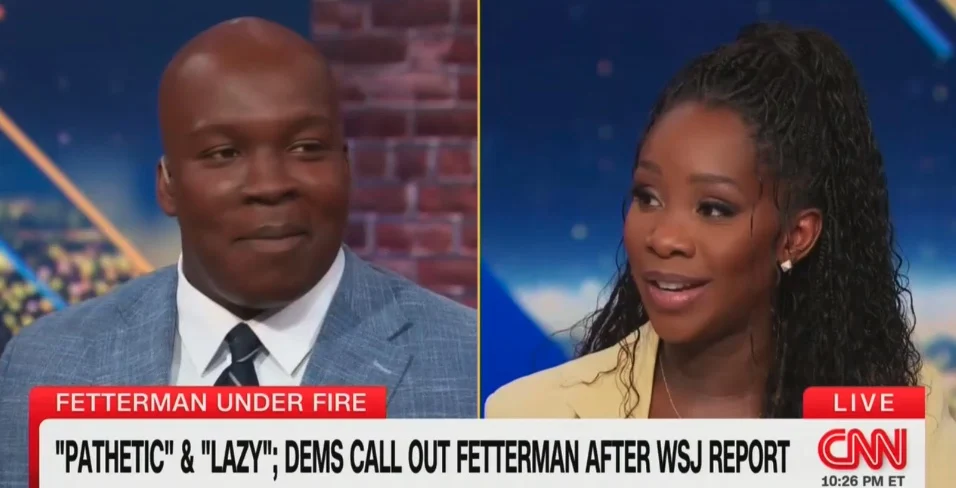
The political landscape in Pennsylvania and the broader halls of the United States Senate were thrust into a period of intense scrutiny this week following a series of high-profile media appearances and a damning investigative report concerning Senator John Fetterman (D-PA). During a Friday segment of CNN’s "NewsNight," host Abby Phillip engaged in a pointed discussion with Republican strategists regarding Fetterman’s increasingly adversarial relationship with his own party and whether the GOP would welcome the junior senator into its ranks. The conversation highlighted a growing rift between Fetterman and the progressive wing of the Democratic Party, while simultaneously revealing a lack of appetite among Republicans to adopt a senator whose commitment to traditional legislative duties has come under fire.
The discourse on CNN followed a particularly turbulent week for Fetterman, whose public persona has undergone a radical transformation since his election in 2022. Once a darling of the progressive movement, Fetterman has recently pivoted toward a more contrarian, center-right rhetorical style, frequently appearing on Fox News to criticize Democratic leadership and voice staunch support for military interventionism and Israeli defense policies. This shift culminated in a Wall Street Journal report that painted a picture of a senator increasingly detached from the fundamental responsibilities of constituent service and legislative engagement.
The CNN Exchange and the GOP Response
During the "NewsNight" panel, Abby Phillip directed the conversation toward the implications of Fetterman’s behavior for his political future. Turning to Republican operative Scott Jennings, Phillip asked whether Fetterman should be prioritizing his constituents over his burgeoning career as a media commentator. Jennings, a veteran GOP strategist, emphasized the pragmatic necessity of "retail politics" and constituent advocacy.
"My advice to anyone who gets elected to the U.S. Congress or the Senate is, the number one thing you should spend your time on? Tending to your constituents, the people," Jennings stated. He noted that regardless of party affiliation, those who maintain the strongest constituent services are typically the ones who survive turbulent political cycles and maintain long-term popularity.
The conversation took a sharper turn when Phillip asked Republican strategist Tim Parrish a direct question: "Do you want him?" The question referred to whether the Republican Party would be open to Fetterman switching parties, a move that has been the subject of quiet speculation in Washington circles as Fetterman’s voting record and public statements have drifted away from his party’s platform.
Parrish’s response was immediate and dismissive. "Uh, no," he replied, asserting that Fetterman "is where he’s supposed to be." Parrish noted that millions of Pennsylvanians voted for Fetterman as a Democrat and pointed out that the state already has a Republican representative in the Senate, Senator Dave McCormick, who won his seat in 2024. The rejection by Parrish underscores a broader sentiment within the GOP: while they may enjoy Fetterman’s criticisms of the Democratic Party, they view him as an unreliable ally whose personal brand of politics does not necessarily align with the Republican platform.
The Wall Street Journal Report: A Record of Neglect?
The backdrop to the CNN discussion was a comprehensive investigative piece published by The Wall Street Journal on Thursday. The report detailed several instances where Fetterman allegedly prioritized media appearances and personal preferences over his official duties as a United States Senator. The most striking allegation involved a scheduled meeting with a group of paralyzed veterans. According to the report, Fetterman’s office informed the veterans that the senator was too ill to attend the meeting. However, shortly after the veterans departed his office, Fetterman reportedly arrived and proceeded to conduct a live interview with Fox News.
The report also highlighted an incident involving executives from children’s hospitals who traveled to Washington D.C. to discuss the impact of potential Medicaid cuts. Fetterman reportedly dismissed their concerns, characterizing their visit as a desire for "free trips to DC" rather than a legitimate advocacy effort for healthcare funding.
Furthermore, the Journal documented Fetterman’s refusal to attend the funeral of three police officers killed in the line of duty in his home state. When informed that the service was expected to last three hours, Fetterman reportedly described the duration as a "nonstarter" and declined to attend. These incidents have fueled a narrative that Fetterman is "uninterested" in the grueling, often unglamorous work of a senator, preferring instead the spotlight of national cable news.
A Timeline of Ideological Divergence
To understand the current friction, it is necessary to trace Fetterman’s trajectory since his 2022 victory over Republican Mehmet Oz.
- November 2022: Fetterman wins the Pennsylvania Senate seat, running on a populist, progressive platform that emphasized labor rights, marijuana legalization, and healthcare reform.
- Early 2023: Fetterman undergoes treatment for clinical depression following a near-fatal stroke during his campaign. Upon his return to the Senate, his staff notes a change in his demeanor and communication style.
- Late 2023 – Early 2024: Following the October 7 attacks on Israel, Fetterman emerges as one of the most vocal pro-Israel voices in the Democratic Party. He breaks with progressives like Senator Bernie Sanders (I-VT) and Representative Alexandria Ocasio-Cortez (D-NY) by opposing calls for a ceasefire and criticizing the pro-Palestinian protest movement on college campuses.
- Mid-2024: Fetterman begins making regular appearances on Fox News, often using the platform to mock "woke" culture and criticize the Biden-Harris administration’s handling of the southern border.
- August 2026: Senator Bernie Sanders publicly criticizes Fetterman’s media strategy, calling his frequent Fox News hits a "sad state of affairs" and lamenting the loss of a former progressive ally.
- September 2026: The Wall Street Journal publishes its investigation into Fetterman’s constituent service record, leading to the current debate over his party loyalty and professional conduct.
Reactions from the Democratic Base and Leadership
The reaction from within the Democratic Party has been a mix of frustration and strategic silence. While leadership has largely avoided public confrontations with Fetterman to maintain a slim functional majority, the progressive wing has been less restrained. Senator Bernie Sanders’ recent comments reflect a growing sense of betrayal among those who campaigned heavily for Fetterman in 2022.
Progressive activists in Pennsylvania have also expressed dismay. Data from recent town halls and local Democratic committee meetings suggest a cooling of enthusiasm for the senator. In a 2022 exit poll, Fetterman carried the progressive vote by a wide margin; however, internal polling from 2026 indicates a significant drop in approval ratings among voters under the age of 35, many of whom cite his foreign policy stances and his perceived abandonment of the "everyman" persona that defined his early career.
Fetterman has pushed back against these criticisms, insisting that he remains a Democrat but refuses to be "beholden to a checklist" of progressive orthodoxy. In a recent interview, he stated, "I’m not a Republican, but I’m also not a performance artist for the far left. I’m doing what I think is right for Pennsylvania."
Broader Implications for the Senate and Pennsylvania Politics
The controversy surrounding Senator Fetterman has broader implications for the 2028 election cycle and the internal dynamics of the U.S. Senate. If Fetterman continues to alienate his base while failing to find a home in the GOP, he faces the prospect of a serious primary challenge in his next reelection bid.
The situation also highlights the changing nature of political communication. Fetterman’s reliance on Fox News as a primary medium for reaching voters—even as a Democrat—suggests a breakdown of traditional media silos. However, as Scott Jennings noted on CNN, media presence is rarely a substitute for the "bread and butter" of constituent services. In a state like Pennsylvania, where elections are often decided by razor-thin margins in rural counties and suburban swing districts, the perception that a senator is "too busy" for veterans or local law enforcement could be politically fatal.
Moreover, the split delegation in Pennsylvania—with Fetterman as a maverick Democrat and Dave McCormick as a traditional Republican—creates a unique legislative environment. Analysts suggest that Fetterman may be attempting to position himself as a "new Manchin," a swing vote who can command national attention and extract concessions for his state. However, unlike former Senator Joe Manchin, who represented a deep-red state, Fetterman represents a purple state where his base expects a degree of ideological consistency.
Conclusion
As the 119th Congress continues, the scrutiny on John Fetterman is unlikely to abate. The allegations of neglected duties, combined with his ideological drift, have placed him in a political "no man’s land." While he remains a member of the Democratic caucus, his relationship with the party is increasingly transactional rather than ideological. The refusal of GOP strategists to welcome him into their fold suggests that Fetterman’s "maverick" status may leave him isolated. Whether he can mend fences with his constituents and his party, or if he will continue his current path toward political independence, remains the central question of his turbulent Senate tenure. For now, the "sad state of affairs" described by his colleagues remains the defining narrative of a senator who was once seen as the future of the American left.

 Yuyun Lusiyani
 Pevita Pearce
 Eva Lovia
 Nana Wu
 Amara Maple