
 Jia Lissa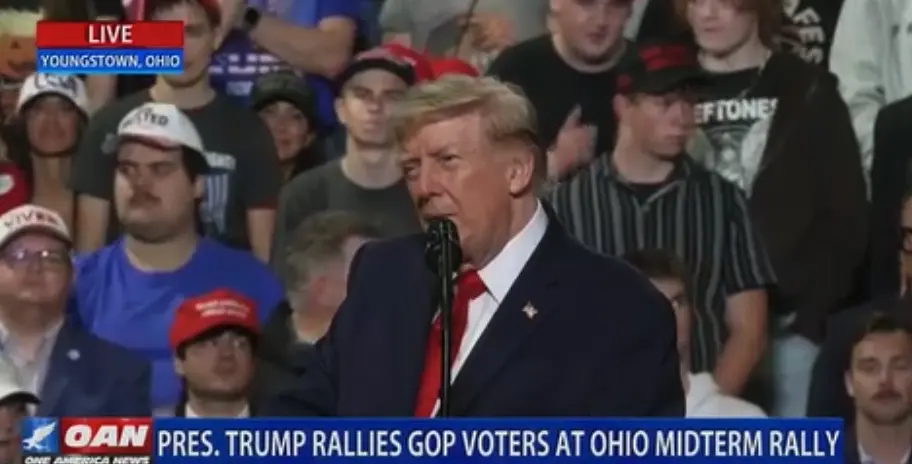
Former President Donald Trump delivered a stark warning to supporters during a high-stakes campaign rally in Youngstown, Ohio, asserting that a Democratic sweep of the federal government would signal the permanent end of the Republican presidency. Speaking before a capacity crowd on Monday night, Trump framed the upcoming elections as an existential turning point for the GOP, claiming that legislative and structural changes proposed by the Democratic Party would effectively "rig" the American electoral system in perpetuity. The rally served as a major campaign stop for Republican Senatorial candidate Jon Husted, who is currently locked in a competitive race against Democratic incumbent Sherrod Brown, as well as Republican gubernatorial nominee Vivek Ramaswamy.
Throughout his remarks, the former president painted a dire portrait of the nation’s future under a unified Democratic government. He argued that if Democrats were to secure the White House in the next cycle while maintaining control of both the House of Representatives and the Senate, they would leverage their power to implement sweeping institutional reforms. According to Trump, these reforms would include the addition of new states to the union, the expansion of the U.S. Supreme Court, and the overhaul of voting laws—moves he believes would mathematically eliminate the possibility of a Republican ever winning the presidency again.
The Existential Warning: I Will Be the Last Republican President
The centerpiece of Trump’s address was the assertion that his own tenure or the potential victory of a successor in the immediate future might represent the final chapter of Republican executive power. Addressing the crowd directly, Trump suggested that the Democratic legislative agenda is designed to create a permanent electoral advantage.
"If they get in and you have a bad presidential election… you will look at me right now and you will say, ‘He’s going to be the last Republican president in the history of our country,’" Trump told the audience. He repeated the phrase "I will be" three times for emphasis, underscoring his belief that the structural integrity of the GOP’s path to the White House is under immediate threat.
Trump’s argument rests on a series of projected Democratic policy goals. He specifically cited the potential for Democrats to grant statehood to territories such as Washington, D.C., or Puerto Rico, which he claimed would add "four more senators" and approximately "10 more congresspeople" to the Democratic columns. Furthermore, he alleged that Democrats would "add about 12 more electoral votes" to their base, fundamentally shifting the math of the Electoral College. These claims align with long-standing Republican concerns that shifting the composition of the Senate and the House through statehood would create a nearly insurmountable hurdle for the GOP in federal elections.
The Battle for the Supreme Court and the Filibuster
A significant portion of Trump’s speech focused on the judiciary and the procedural rules of the Senate. He accused the Democratic Party of planning to "rig" the Supreme Court by increasing the number of justices from the current nine to as many as 23. This practice, often referred to as "court-packing," has been a subject of debate within the progressive wing of the Democratic Party, though it has not been adopted as official platform policy by the party’s moderate leadership. Trump’s rhetoric suggests that such a move would be inevitable under a Democratic trifecta, leading to a judiciary that would favor liberal interpretations of the Constitution for generations.
To counter these perceived threats, Trump called for a strategic shift in Republican tactics, specifically regarding the Senate filibuster. Currently, the filibuster requires a 60-vote threshold to advance most legislation in the 100-member Senate. Trump reiterated his desire to see the filibuster eliminated—a move he has previously advocated for—to allow Republicans to pass key legislation with a simple majority.
The primary target for this procedural change is the SAVE Act (Safeguard American Voter Eligibility Act). The bill, which has already passed the Republican-controlled House, would mandate proof of citizenship for voter registration and require photo identification at the polls nationwide. Trump argued that the passage of this act is essential for the legitimacy of future elections. "We’ll never lose an election again because we’ll have really good safeguards," Trump said, claiming that the Democratic Party relies on "cheating" to win.
Campaigning for Husted and Ramaswamy in a Reddening Ohio
The Youngstown rally was strategically located in a region of Ohio that has seen a dramatic political shift over the last decade. Once a stronghold for labor-union Democrats, the Mahoning Valley has become increasingly supportive of Trump’s "America First" platform. This geographic shift is critical for Jon Husted, who is attempting to unseat Sherrod Brown, a veteran Democrat known for his appeal to blue-collar workers.
Trump praised Husted’s record and physical stature, referring to him as a "great athlete" in a moment that drew laughter and headlines alike. The race between Husted and Brown is considered one of the most pivotal contests in the battle for control of the U.S. Senate. According to recent polling data, the race remains within the margin of error, with Brown maintaining a slight edge in name recognition while Husted benefits from the state’s overall trend toward the Republican Party.
Simultaneously, Trump used the platform to bolster Vivek Ramaswamy’s gubernatorial bid. Ramaswamy, who rose to national prominence during the 2024 presidential primaries, has aligned himself closely with Trump’s populist agenda. By stumping for both Husted and Ramaswamy, Trump sought to solidify a unified Republican front in Ohio, a state that has transitioned from a quintessential "purple" bellwether to a reliably "red" stronghold in recent cycles.
Timeline and Legislative Context of the SAVE Act
The legislative timeline of the SAVE Act provides necessary context for Trump’s remarks. The bill was introduced earlier this year as a response to concerns regarding non-citizen voting. While federal law already prohibits non-citizens from voting in federal elections, proponents of the SAVE Act argue that current enforcement mechanisms are insufficient.
- May 2024: The SAVE Act is introduced in the House of Representatives with strong backing from the GOP leadership.
- July 2024: The bill passes the House primarily along party lines.
- August-September 2024: The bill stalls in the Senate, where Democrats hold a slim majority and the 60-vote filibuster remains an obstacle.
- October 2024: Trump makes the SAVE Act a central theme of his campaign rallies, linking it to the broader survival of the Republican Party.
The White House and Democratic leaders have largely opposed the SAVE Act, characterizing it as a redundant measure that serves to intimidate eligible voters and create unnecessary hurdles for registration. They point to studies from the Brennan Center for Justice and other non-partisan organizations that indicate non-citizen voting is extremely rare and has never affected the outcome of a federal election.
Broader Implications and Political Analysis
Trump’s rhetoric in Youngstown reflects a broader strategy of "institutional alarmism," a tactic designed to mobilize the base by framing the election not just as a choice between candidates, but as a choice between the survival or the destruction of the party. By focusing on the Electoral College, the number of Supreme Court justices, and the composition of the Senate, Trump is tapping into deep-seated anxieties among conservative voters regarding the changing demographics and political norms of the United States.
From a historical perspective, the claim that one party will "never win again" is a common trope in American politics, often used by both sides to heighten the stakes of an election. However, the specific focus on structural changes—such as statehood for D.C. or court-packing—represents a more modern evolution of this rhetoric. If Democrats were to successfully add four new Senate seats, the path to a Republican majority would indeed become statistically more difficult, though not impossible, as parties historically adapt their platforms to appeal to new constituencies.
Furthermore, Trump’s call to end the filibuster marks a significant departure from traditional Senate conservatism, which has historically viewed the 60-vote threshold as a necessary "cooling saucer" to prevent radical shifts in law. By advocating for its removal to pass the SAVE Act, Trump is signaling a preference for a more majoritarian, "winner-take-all" legislative process, provided his party holds the majority.
Reactions from the Democratic Camp
In response to the rally, spokespeople for the Sherrod Brown campaign and the Democratic National Committee (DNC) dismissed Trump’s claims as "baseless conspiracy theories" intended to distract from policy issues. Senator Brown’s office released a statement emphasizing his focus on "the dignity of work" and Ohio’s manufacturing sector, rather than what they termed "theatrical grievances" from the former president.
"The idea that the Democratic Party is trying to ‘destroy the country’ is a tired script," said one DNC strategist. "What the voters in Ohio care about are healthcare costs, infrastructure, and jobs. The former president is focused on the rules of the game because he knows his policies are unpopular with the majority of the American people."
Conclusion: The Road to November
As the midterm elections approach, the rhetoric coming out of Youngstown underscores the polarization of the current political landscape. For Trump and his supporters, the election is a defensive battle against a perceived radical overhaul of the American system. For his opponents, it is a referendum on the former president’s influence over the Republican Party and the future of democratic norms.
With the races for the Senate and the governorship in Ohio serving as a microcosm of the national struggle, the outcome in November will provide the first real test of whether Trump’s warnings resonate with the broader electorate or if they are viewed as hyperbole. Regardless of the outcome, the debate over the SAVE Act, the filibuster, and the future of the Supreme Court is likely to remain at the forefront of the American political discourse for the foreseeable future.



 Yuyun Lusiyani
 Ana Megawati
 Eva Lovia
 Pevita Pearce
 admin
admin