Jia Lissa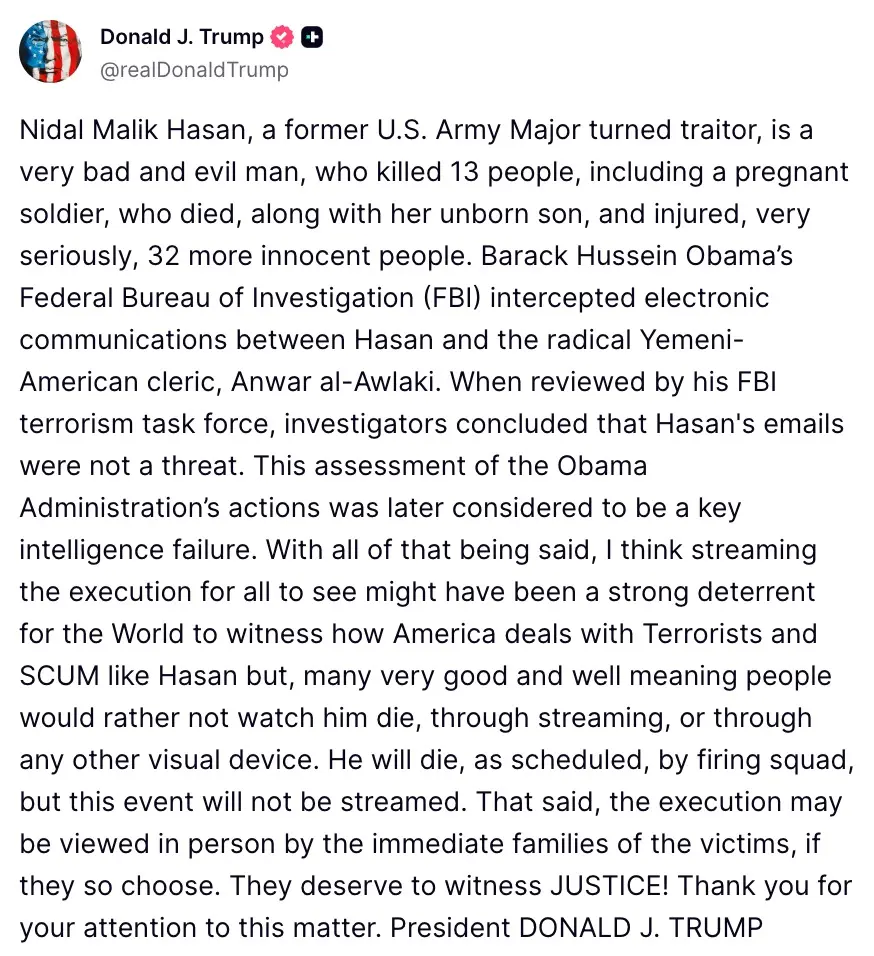
President Donald Trump officially announced on Thursday that the federal government has abandoned a controversial proposal to livestream the upcoming execution of Nidal Hasan, the former Army psychiatrist convicted of the 2009 mass shooting at Fort Hood. The decision, revealed in a detailed statement on Truth Social, marks a significant reversal of a policy initially championed by Secretary of Defense Pete Hegseth. While the livestreaming component has been scrapped, President Trump confirmed that the execution will proceed as scheduled in December, with the death penalty to be carried out via firing squad.
The initial proposal to broadcast the execution sparked an immediate and intense national debate regarding the ethics of state-sanctioned capital punishment in the digital age and the potential security risks of creating a public spectacle out of a terrorist act. In his statement, the President acknowledged the deterrent intent behind the original plan while conceding to the concerns raised by various political allies and the general public.
“I think streaming the execution for all to see might have been a strong deterrent for the World to witness how America deals with Terrorists and SCUM like Hasan but, many very good and well-meaning people would rather not watch him die, through streaming, or through any other visual device,” Trump wrote. He concluded by reaffirming the finality of the sentence: “He will die, as scheduled, by firing squad, but this event will not be streamed.”
The 2009 Fort Hood Massacre: A Dark Chapter in Military History
The path to this December’s scheduled execution began on November 5, 2009, in one of the deadliest mass shootings ever to occur on a United States military installation. Nidal Hasan, then a U.S. Army Major and psychiatrist, entered the Soldier Readiness Processing Center at Fort Hood, Texas, armed with a semi-automatic pistol.
Shouting "Allahu Akbar," Hasan opened fire on unarmed soldiers who were preparing for deployment to Iraq and Afghanistan. The attack resulted in the deaths of 13 people—12 soldiers and one civilian—and left more than 30 others wounded. The victims ranged in age from 19 to 52, including Pfc. Francheska Velez, who was 21 years old and pregnant at the time of her death.
Hasan was eventually stopped when he was shot by civilian police officers, an exchange that left him paralyzed from the waist down. Subsequent investigations revealed that Hasan had been in contact with Anwar al-Awlaki, a radical cleric and key figure in al-Qaeda in the Arabian Peninsula. The massacre was later classified by the Department of Defense as workplace violence, a designation that remained controversial for years until it was eventually recognized as an act of terrorism, allowing victims to receive the Purple Heart.
Legal Chronology and the Military Death Penalty
The legal proceedings against Nidal Hasan were protracted and complex, highlighting the unique nature of the military justice system. In August 2013, a military jury at Fort Hood convicted Hasan of 13 counts of premeditated murder and 32 counts of attempted premeditated murder. Under the Uniform Code of Military Justice (UCMJ), a death sentence requires a unanimous vote by the jury, which was achieved in Hasan’s case.
Since his conviction, Hasan has been incarcerated at the United States Disciplinary Barracks at Fort Leavenworth, Kansas. The military appeals process is notoriously slow, designed to ensure that every legal avenue is exhausted before a service member is executed. However, the current administration has made it a priority to expedite the resolution of long-standing capital cases involving high-profile acts of terrorism.
The execution of a service member is a rare event in modern American history. The last time the U.S. military carried out a death sentence was on April 13, 1961, when Army private John Bennett was hanged for the rape and attempted murder of an 11-year-old girl. If the December execution proceeds, Hasan will be the first person executed by the U.S. military in over 60 years.
The Rise and Fall of the Livestream Proposal
The idea of livestreaming Hasan’s execution was first introduced by Defense Secretary Pete Hegseth earlier this month. Hegseth, a proponent of what he describes as "transparent justice," argued that a public broadcast would serve as a powerful psychological deterrent against future radicalization and domestic terrorism. The Pentagon initially signaled its support for the move, viewing it as a demonstration of the consequences awaiting those who betray the nation.
However, the proposal immediately met with resistance from both sides of the political aisle. Critics argued that broadcasting an execution would be "barbaric" and beneath the dignity of the United States. Furthermore, security experts warned that a live broadcast could provide a platform for Hasan to be viewed as a martyr by extremist groups.
House Speaker Mike Johnson was among the most vocal critics within the Republican party. Johnson warned that the broadcast could inadvertently serve as a "recruiting tool for future terrorists," providing a visual manifesto for radicalization. Vice President JD Vance also signaled a lack of personal appetite for the spectacle, stating publicly that he would not watch the broadcast if it were to occur.
Legal scholars also raised concerns that a livestreamed execution might violate the Eighth Amendment’s prohibition against "cruel and unusual punishment" by turning a legal procedure into a public "snuff film." The President’s decision to rescind the plan appears to be a calculated move to avoid these legal challenges and maintain the focus on the execution itself rather than the medium of its delivery.
Methodology of the Firing Squad
While the livestream has been canceled, the method of execution remains the firing squad. The use of a firing squad is a traditional military method of execution, though it has largely been supplanted by lethal injection in most U.S. jurisdictions.
In recent years, several states have moved back toward the firing squad as an alternative to lethal injection, primarily due to the difficulty of obtaining the necessary drugs for lethal cocktails. Proponents of the firing squad argue that it is a more reliable and humane method than lethal injection, which has been plagued by reports of "botched" procedures.

For Hasan, the firing squad carries symbolic weight within the military context. Protocol typically involves a team of marksmen, one of whom is given a blank round so that no single individual can be certain they fired the fatal shot. Despite his paralysis, the military has indicated that the standard protocols will be adapted to ensure the sentence is carried out in accordance with military law.
Impact on Victims’ Families and the Public
The President’s Truth Social post clarified that while the general public will not be able to view the execution via a digital stream, the immediate family members of Hasan’s victims will still be permitted to witness the event in person. This follows the long-standing tradition of allowing survivors and families to seek closure through the witnessing of justice.
For many of the families of the 13 people killed in 2009, the news that the execution is finally moving forward—nearly 17 years after the event—is a bittersweet milestone. Many have spent years advocating for the case to reach its conclusion, frustrated by the lengthy appeals process.
"The goal has always been justice, not entertainment," said a spokesperson for a group representing the Fort Hood survivors. "While some families may have wanted the world to see the end of this terrorist, many more are relieved that the focus will remain on the lives lost and the service of our soldiers, rather than a media circus."
Broader Implications and Analysis
The decision to cancel the livestream reflects a rare moment of policy calibration for the Trump administration. By moving away from the broadcast, the administration avoids a potential Supreme Court battle over the definition of public access to executions and prevents the creation of a permanent digital record that could be co-opted by adversarial propaganda machines.
However, the insistence on the firing squad and the expedited timeline continue to signal a "law and order" approach that distinguishes this administration from its predecessors. The execution of Nidal Hasan will likely serve as a benchmark for how the U.S. military handles high-stakes capital cases in the future.
From a geopolitical perspective, the execution of a high-profile "homegrown" terrorist remains a sensitive issue. Intelligence agencies will likely be on high alert during the month of December, monitoring for any retaliatory threats or extremist chatter. By removing the livestreaming element, the administration has reduced the immediate "theatrical" value of the event, potentially lowering the risk of it being used as a flashpoint for extremist mobilization.
As December approaches, the focus shifts to the United States Disciplinary Barracks at Fort Leavenworth. The technical preparations for the firing squad and the logistics of hosting the victims’ families will be managed by the Department of the Army. For Nidal Hasan, the legal road has reached its end, and for the nation, a long-standing wound from the War on Terror era moves one step closer to a final, if somber, resolution.



 Yuyun Lusiyani
 Joko Widodo
 Eva Lovia
 admin
admin