Pevita Pearce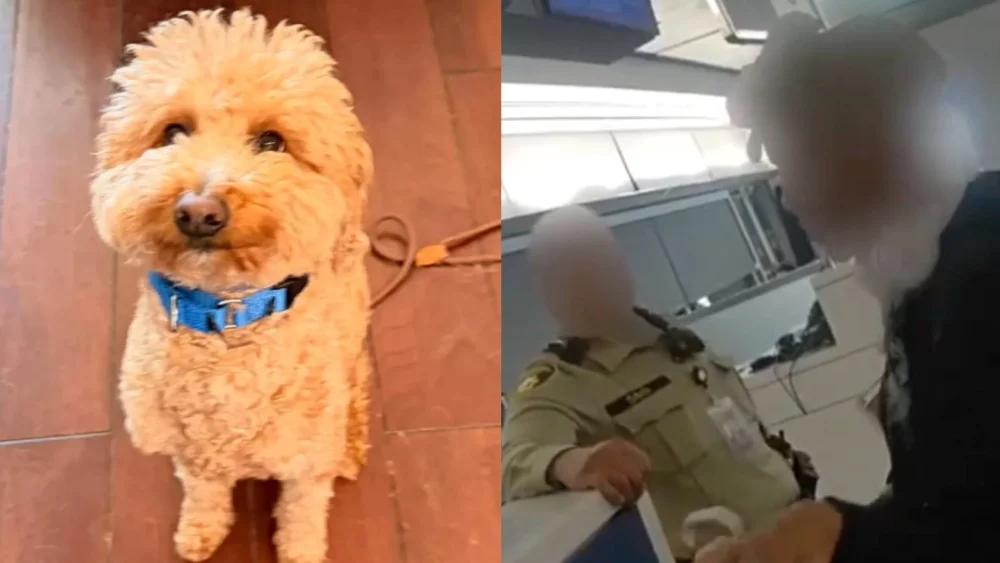
The tranquility of Harry Reid International Airport was disrupted during the late hours of February 2 when a traveler allegedly abandoned her canine companion at a ticket counter after being barred from boarding her flight. The incident, which has sparked widespread condemnation and highlighted the complexities of traveling with animals, resulted in the arrest of the dog’s owner on multiple charges, including animal abandonment and resisting a public officer. According to the Las Vegas Metropolitan Police Department (LVMPD), the animal was discovered tied to a metal carry-on baggage sizer, left behind as the owner attempted to continue her journey without him.
The events unfolded at approximately 11:30 p.m. local time near the JetBlue ticket counter. Witnesses and airline staff reported seeing a woman engaged in a dispute over the status of her dog, which she claimed was a service animal. Under federal regulations and individual airline policies, passengers traveling with service animals must provide specific documentation to ensure the animal meets the legal criteria for air travel. When the woman failed to produce the necessary paperwork or complete the required forms, JetBlue employees informed her that she would not be issued a boarding pass with the animal.
Rather than making alternative arrangements for the dog’s care or opting to remain behind, police say the woman chose to tether the animal to a baggage sizer—a device used by passengers to measure the dimensions of their luggage—and proceeded through the security checkpoint toward her departure gate.
A Detailed Chronology of the Incident
The timeline of the evening suggests a rapid escalation from a logistical travel issue to a criminal matter. At 11:30 p.m., JetBlue staff initially encountered the woman at the check-in counter. The discussion regarding the dog’s documentation lasted for several minutes, during which the passenger was informed of the Department of Transportation (DOT) requirements for service animals. Following the denial of her boarding pass, the woman reportedly walked away from the counter, leaving the dog behind in a high-traffic area of the terminal.
By 11:39 p.m., LVMPD officers assigned to the airport were dispatched to the JetBlue counter following reports of an abandoned animal. Upon arrival, they found the dog alone and tethered to the metal frame. While airport staff and animal control were notified to take custody of the dog, officers began a search for the owner using terminal surveillance and passenger manifests.
The woman was eventually located at Gate D1, where she was waiting to board her flight. When questioned by law enforcement as to why she had left the animal unattended at the ticket counter, the woman allegedly provided a justification that stunned officers. According to police reports, she claimed that because the dog was equipped with a tracking device, she believed it was acceptable to leave him behind, implying that the animal would somehow be able to return to her or be recovered later through the technology.
As officers attempted to take the woman into custody, the situation turned volatile. Authorities noted that the suspect became "hostile" and actively resisted efforts to detain her. The confrontation occurred in full view of other passengers, eventually requiring officers to use physical force to secure her. She was subsequently transported to the Clark County Detention Center and booked on charges of animal abandonment and resisting arrest.
The Regulatory Landscape of Air Travel with Animals
The incident at Harry Reid International Airport underscores the rigorous standards currently in place for transporting animals on commercial flights. In January 2021, the U.S. Department of Transportation revised its rules regarding service animals, a move that significantly narrowed the definition of which animals are permitted to fly in the cabin free of charge.
Under current federal guidelines, a service animal is strictly defined as a dog that is individually trained to do work or perform tasks for the benefit of a person with a disability. This definition excludes "emotional support animals," which were previously allowed on many carriers but are now largely treated as pets, requiring a fee and a specialized carrier.
To fly with a service dog, passengers must typically submit the "U.S. Department of Transportation Service Animal Air Transportation Form" at least 48 hours before departure. This form requires the owner to attest to the animal’s health, training, and behavior. In the case of the February 2 incident, the failure to complete this documentation was the primary catalyst for the denial of boarding.
Industry analysts suggest that the tightening of these rules has led to increased friction at ticket counters. "Travelers are often caught off guard by the specificity of the paperwork required," says aviation safety consultant Mark Richards. "However, the responsibility remains with the owner to ensure compliance. Abandoning an animal because of a paperwork failure is an extreme and illegal response to a common travel hurdle."

Support for the Abandoned Dog: "JetBlue" Finds a Temporary Home
While the owner faces legal repercussions, the dog—now affectionately referred to by some as "JetBlue" in honor of the staff who first assisted him—has become a symbol of resilience. Immediately following the incident, the animal was taken into the care of The Animal Foundation before being transferred to Retriever Rescue of Las Vegas, a non-profit organization specializing in the rehabilitation and rehoming of dogs.
Danielle Roth, a spokesperson for Retriever Rescue of Las Vegas, praised the swift action of airport personnel and law enforcement. "From the moment airport staff realized what had happened, he was surrounded by kindness," Roth stated. She highlighted the collaborative effort between the TSA, LVMPD, and airline employees to ensure the dog’s safety in the immediate aftermath of the abandonment.
According to the rescue organization, the dog has shown no signs of aggression or trauma despite the chaotic nature of his abandonment. "He is affectionate, gentle, and incredibly social," Roth added. "He greets everyone with trust and warmth, which is honestly remarkable given what he went through. It speaks volumes about his temperament."
The rescue is currently conducting a full medical and behavioral assessment of the dog. Once cleared, he will be placed in a foster home before being made available for adoption. The organization has reported a surge in inquiries from members of the public moved by the dog’s story, though they emphasized that they will be "carefully considering next steps" to ensure he is placed in a stable, permanent environment.
Legal Implications and Animal Welfare in Nevada
In Nevada, animal abandonment is a serious offense. Under state law, a person who owns or has charge of an animal and leaves it in a public place without providing for its care can face misdemeanor or even felony charges, depending on the circumstances and the harm caused to the animal. In this instance, the addition of a charge for resisting a public officer complicates the legal outlook for the defendant.
Legal experts note that "hostility" toward law enforcement during an airport arrest often leads to enhanced scrutiny by prosecutors. "The airport is a highly regulated and secured environment," says legal analyst Sarah Thompson. "Resisting arrest in such a setting is viewed with particular severity due to the potential for broader disruption of public safety."
The case also brings to light the broader issue of pet abandonment at transportation hubs. While rare, similar incidents have occurred at airports in Pittsburgh and Des Moines over the last three years, often involving owners who realize too late that they cannot afford the pet transport fees or lack the proper crating.
Broader Impact and Industry Reactions
The incident has prompted discussions within the airline industry regarding how to better handle similar situations in the future. While JetBlue has received praise for its staff’s compassionate handling of the dog, the event serves as a reminder of the emotional and logistical stress associated with modern air travel.
"Airlines are in a difficult position," says Richards. "They must enforce federal laws and safety protocols, but they are also the first line of contact for passengers who may be under significant stress. The key takeaway here is the importance of pre-travel education for pet owners."
For the staff at Harry Reid International Airport, the successful recovery of the dog is a rare silver lining in a distressing situation. The Animal Foundation and Retriever Rescue of Las Vegas continue to advocate for responsible pet ownership, reminding travelers that there are always alternatives to abandonment, including boarding facilities, pet-sitting services, or simply rescheduling a flight.
As the legal case against the owner proceeds through the Clark County court system, the focus remains on the well-being of the dog. His journey from a cold metal baggage sizer to a "stable, loving home" is expected to be completed in the coming weeks, marking the end of a harrowing chapter for the animal and a cautionary tale for travelers nationwide.



 Jia Lissa
 Yuyun Lusiyani
 Joko Widodo
 Eva Lovia