
 Pevita Pearce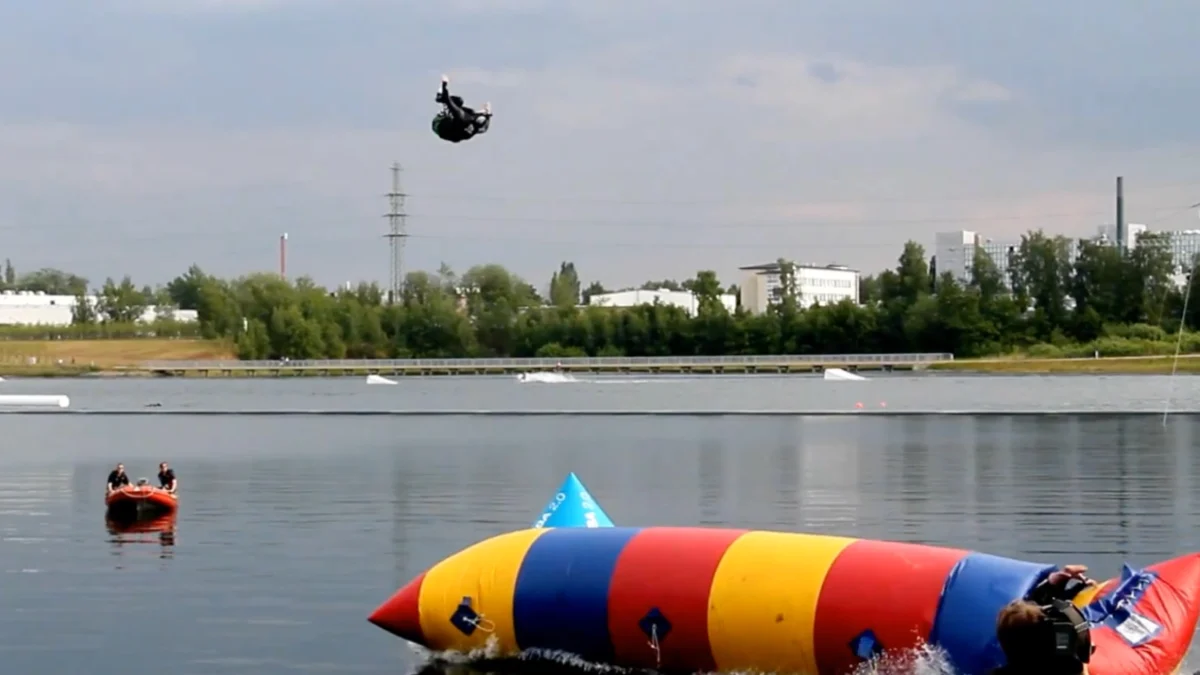
In a display of precision physics and extreme athleticism, a new world record was established in 2026 as an international team successfully launched a man to the unprecedented height of 92.58 feet (28.22 meters) using a water-based airbag system. The achievement, which has been officially verified by Guinness World Records, marks a significant milestone in the niche but growing sport of "blobbing." The event took place under the supervision of Adrian and Eric Baumann, the owners of the experience provider Paintballfarm, who orchestrated the attempt alongside a specialized four-man unit.
The record-breaking flight was the culmination of years of preparation and technical refinement. The team responsible for the feat consisted of Robin Steiner and Luc Siegenthaler from Switzerland, Lennart Florczak from Germany, and Tristan Kuhn from the United States. Steiner served as the "blobber"—the individual positioned at the edge of the airbag—while the remaining three members acted as the jumpers, whose synchronized impact provided the necessary kinetic energy to propel Steiner into the atmosphere.
The Mechanics and Evolution of Blobbing
Blobbing is an outdoor water activity that utilizes a large, partially inflated vinyl or rubber airbag, commonly referred to as "the blob," floating on a body of water. The activity operates on the principle of air displacement and momentum transfer. One participant sits at the far end of the airbag, while one or more participants jump from a platform onto the opposite end. The resulting surge of air through the chamber creates a catapult effect, launching the seated participant vertically and horizontally before they land in the water.
While blobbing began as a recreational pastime—often cited as having origins with sailors using large fuel bladders for entertainment—it has evolved into a competitive discipline requiring rigorous safety protocols and physical conditioning. The Baumann brothers have been at the forefront of this evolution through their company, Paintballfarm, which has transitioned from providing general adventure experiences to hosting high-stakes record attempts. Their involvement in the 2026 record attempt was the result of a long-standing ambition to reclaim a title that had remained stagnant for over a decade.
Breaking a Fourteen-Year Benchmark
Prior to the 2026 event, the world record for the greatest height achieved through blobbing was held by a German team. Set in 2012, that record stood at 72 feet (22 meters). For fourteen years, various teams across Europe and North America attempted to surpass this height, but technical limitations and the inherent risks of high-altitude water impacts prevented any successful challenges.
The Baumanns’ team initially approached the record with a calculated strategy, focusing on the volume of the airbag and the synchronized timing of the jumpers. On their first official attempt of the day, the team successfully reached a height of 75 feet (23 meters). While this was sufficient to break the standing 2012 record, the group remained unsatisfied, believing that their equipment and personnel were capable of achieving a significantly higher trajectory.
The transition between the first and second attempts was marked by a brief period of uncertainty. A minor injury sustained during the initial phase necessitated a personnel change. In extreme sports of this nature, even slight variations in weight distribution or jump timing can drastically alter the outcome. However, the team recalibrated quickly, positioning Steiner at the end of the airbag for the final, decisive attempt.
Technical Execution and the Physics of the Launch
The record-setting jump of 92.58 feet required a near-perfect confluence of variables. To achieve such a height, the three jumpers—Siegenthaler, Florczak, and Kuhn—had to strike the airbag simultaneously to maximize the internal air pressure wave. The force required to propel a human being nearly 10 stories into the air is substantial. From a physics perspective, the potential energy of the jumpers, falling from a raised platform, is converted into kinetic energy upon impact with the airbag, which is then transferred through the air medium to the "blobber."
Steiner’s ascent was vertical and rapid. Observers and Guinness World Record adjudicators utilized high-speed cameras and laser measurement tools to verify the peak of the arc. Reaching 92.58 feet is roughly equivalent to the height of a nine-story building. At such heights, the "blobber" experiences significant G-forces during the initial launch and must maintain a specific body orientation to ensure a safe entry into the water.
Steiner later described the sensation of the launch as "a car crash in reverse." This description highlights the sudden, jarring nature of the acceleration. He noted that the intensity of the upward propulsion far exceeded the force of the eventual impact with the water’s surface, suggesting that the initial transfer of energy is the most physically demanding aspect of the stunt.
Official Responses and Emotional Impact
The successful record attempt was met with immediate celebration from both the participants and the gathered spectators. Adrian Baumann, co-organizer of the event, emphasized the emotional weight of the achievement, noting the extensive labor and energy invested in the preparation phases.
"It was simply incredible," Baumann stated following the verification of the height. "When you put so much time, work, and energy into preparing a project like this and then everything comes together perfectly at exactly the right moment, it is an indescribable feeling."
The international composition of the team—spanning Switzerland, Germany, and the USA—was also highlighted as a key factor in the success. The collaboration allowed for a diversity of experience in extreme sports and stunt coordination. According to the team, the synergy between the jumpers and the launcher was the result of weeks of practice jumps and safety briefings.
Guinness World Records has since updated its official database to reflect Steiner’s achievement, cementing the 92.58-foot mark as the new global standard for airbag-launched heights.
Safety Standards and Risk Analysis
While the 2026 record was a triumph of coordination, it also underscored the inherent dangers of high-altitude stunts. Falling from a height of over 90 feet into water is comparable to hitting a solid surface if the entry is not controlled. Water tension at high velocities can cause significant trauma, including concussions, spinal injuries, or internal damage.
The injury that occurred between the first and second attempts served as a reminder of the thin margin for error. Consequently, the team employed professional divers and medical personnel on-site to provide immediate assistance. The "blob" itself must be calibrated to a specific internal pressure; if it is too firm, the jumpers risk injury upon impact; if it is too soft, the energy transfer to the "blobber" will be insufficient for a record-breaking launch.
The 2026 event utilized a reinforced airbag designed to withstand the massive displacement of air caused by three adult men jumping from height. The durability of the materials and the stability of the floating platform were critical components of the safety infrastructure managed by the Baumann brothers.
Broader Implications for Extreme Sports
The shattering of the 2012 record by a margin of over 20 feet suggests that the limits of blobbing may not yet have been reached. As materials science improves and the precision of synchronized jumping increases, future teams may look toward the 100-foot milestone. However, the 92.58-foot mark represents a significant leap that may stand for several years, much like its predecessor.
The success of the Paintballfarm team also highlights the commercial and promotional value of world record attempts for experience providers. By pushing the boundaries of what is possible within their facility, the Baumanns have positioned their brand as a leader in the global extreme sports community. This achievement follows a trend of "stunt marketing" where high-risk, high-reward activities generate significant digital engagement and international media coverage.
Furthermore, the event has sparked renewed interest in the technical aspects of airbag stunts. Engineers and sports scientists often look at these records to study impact distribution and the behavior of non-rigid structures under extreme stress. While blobbing remains primarily an entertainment and competitive activity, the data gathered from such high-velocity launches can contribute to broader understandings of safety in inflatable impact attenuation systems.
In the wake of this record, the team remains focused on the legacy of their achievement. For Robin Steiner, the flight was more than just a statistical entry in a record book; it was a personal milestone in a career defined by pushing physical limits. For the Baumann brothers, it was a validation of their business’s commitment to providing world-class, albeit high-adrenaline, experiences. As the extreme sports landscape continues to evolve, the 2026 blobbing record stands as a testament to the human desire to reach new heights through a combination of bravery, teamwork, and scientific application.




 Joko Widodo
 admin
admin
 Nila Kartika Wati
 Lina Irawan
 Eva Lovia