
 Joko Widodo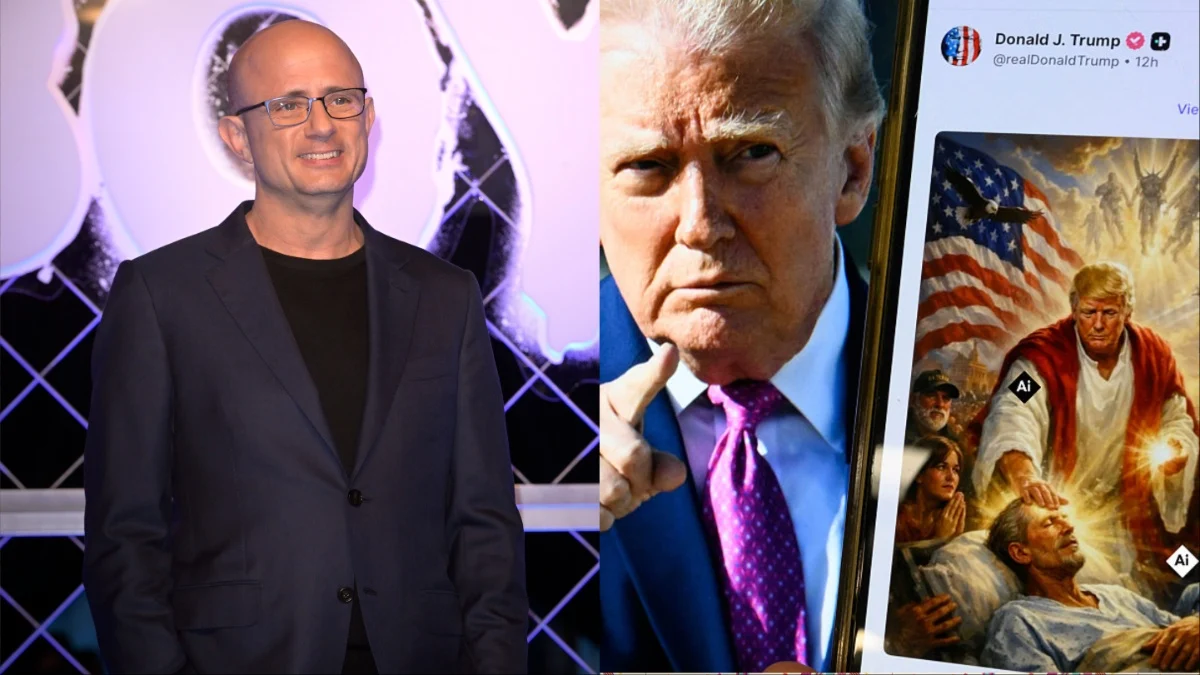
In a striking confluence of fiction and reality, the latest installment of the critically acclaimed series The Boys has presented a narrative arc for its antagonist, Homelander, that eerily mirrors a recent real-world event involving former President Donald Trump. Season 5’s third episode features Homelander experiencing a prophetic vision of himself ascending to the status of an immortal deity. This fictional depiction emerged shortly after a real-life incident where Donald Trump, amidst a public disagreement with the Vatican, shared an AI-generated image portraying himself in a Christ-like manner. The uncanny parallel has not gone unnoticed, prompting showrunner Eric Kripke to address the unsettling synchronicity in a recent interview.
A Pattern of Prescient Portrayals
This is not the first instance where The Boys has seemingly foreshadowed real-world events. In a particularly unnerving coincidence, the season 4 finale depicted an attempt on the life of a political leader. This episode was broadcast just two weeks after an actual assassination attempt was made on Donald Trump. The striking similarity of the fictional scenario to the real event even led to discussions about the potential need to pull the episode from broadcast, highlighting the sensitive nature of such coincidences in the public sphere.
Now, with the Homelander-as-divine imagery, the show finds itself once again grappling with the unsettling phenomenon of its fictional narratives appearing to anticipate current affairs. The episode, having been filmed and finalized long before its broadcast, presents a vision where Homelander embraces a godlike persona. This vision closely precedes the circulation of AI-generated artwork depicting Donald Trump in a messianic pose, a move that generated significant public attention and commentary.
Kripke’s Weary Perspective on Reality Mimicking Satire
Speaking to Polygon, Eric Kripke expressed a profound sense of exhaustion and bewilderment at the recurring phenomenon of the real world seeming to outpace and replicate the satirical elements of The Boys. "I am really tired and weary of the world reflecting the show before we get a chance to do it," Kripke stated. He further elaborated on this sentiment, saying, "I appreciate the marketing. I’m just like, can you just please give us a chance to put some absurd satire out there before you prove that it’s more realistic than we ever intended?"
Kripke’s comments underscore a creator’s struggle when the line between exaggerated fiction and observable reality becomes increasingly blurred. The show, known for its biting social commentary and often extreme portrayals of power and corruption, aims to critique contemporary society through hyperbole. However, when real-world events begin to mirror these extreme scenarios, it challenges the very foundation of satire, potentially diminishing its impact and raising questions about the state of contemporary society.
The "God" Complex: Homelander and Trump’s Divine Aspirations
The specific parallel involves Homelander’s burgeoning belief in his own divinity within the show and Donald Trump’s public presentation. In the latest episode of The Boys, Homelander grapples with his immense power and begins to entertain the idea of being an immortal god. This internal struggle culminates in him embracing a godlike identity. Concurrently, in the real world, Donald Trump, reportedly engaged in a dispute with the Pope, shared an AI-generated image on social media. This image depicted him in a manner that evoked religious iconography, specifically resembling Jesus Christ, complete with a halo. The timing of these events, with the fictional depiction appearing shortly after the real-world image went viral, has led to widespread discussion and a sense of déjà vu among fans and observers.
Kripke recalled his initial apprehension when developing the Homelander-as-god storyline. He admitted to being confident that such a plot development would be perceived as excessively outlandish, even for The Boys. "This is the episode where Homelander decides he’s going to be God and 48 hours before it, Trump releases an image of himself as God," Kripke remarked. He further explained the marketing considerations and his own internal debate: "A month ago when we were talking about marketing, I was like, Homelander saying he’s God is so out there. We have to be careful about how we even introduce the idea to the public because they’ll say he’s gone too far, and here we are." This sentiment reflects a creator’s dilemma when the intended satire is so potent that it risks being eclipsed by the very reality it seeks to critique.
The Broader Implications: Satire Under Pressure
The repeated instances of The Boys seemingly predicting real-world events raise fascinating questions about the nature of cultural commentary and the power of narrative. While Kripke expresses weariness, these coincidences also highlight the show’s keen observational acumen and its ability to tap into underlying societal anxieties and trends. The show’s exploration of power, narcissism, and the manipulation of public perception through media and technology resonates deeply in an era where such themes are increasingly prevalent.
The comparison between Homelander’s divine delusion and Donald Trump’s use of AI-generated imagery can be analyzed through the lens of contemporary political discourse and the blurring lines between celebrity, power, and religiosity. Both instances, in their own distinct ways, touch upon the human tendency to seek or project divine authority, particularly in figures who wield significant influence. Homelander, a product of corporate manipulation and unchecked power, embodies the dark side of this aspiration. Trump’s use of the AI image, regardless of intent, tapped into a similar vein of powerful figures leveraging imagery to enhance their public persona and potentially evoke a sense of reverence or divine mandate.
Analysis of the AI Image and its Context
The AI-generated image shared by Donald Trump was released during a period of heightened public discourse surrounding his legal challenges and his ongoing political campaign. The image, which depicted Trump with a halo and a seemingly serene expression, was widely interpreted as an attempt to associate him with divine protection or a higher calling. This occurred in the context of a broader trend of political figures and their supporters utilizing digital media and artificial intelligence to craft specific narratives and personas.
The technology behind such AI-generated images has become increasingly sophisticated, allowing for the creation of highly realistic and often persuasive visual content. This raises concerns about the proliferation of misinformation and the manipulation of public perception. The Trump incident, in particular, sparked debates about the ethics of using AI to create religious imagery for political purposes and the potential for such tactics to further polarize public opinion. The controversy surrounding the image was amplified by the fact that it was shared shortly after Pope Francis had criticized the use of AI to generate religious content.
The Boys’ Impact on Cultural Discourse
The Boys has consistently pushed boundaries with its unflinching critique of superhero tropes and its commentary on corporate influence, celebrity culture, and political machinations. The show’s ability to tap into the zeitgeist and provoke discussion has cemented its status as a significant cultural force. The Homelander-as-god storyline, juxtaposed with the Trump AI image incident, serves as a potent reminder of the show’s thematic relevance and its capacity to spark dialogue about the very nature of power and divinity in the modern age.
While Kripke’s frustration with reality mirroring fiction is understandable, these uncanny coincidences also underscore the power of art to reflect and, perhaps, even anticipate the anxieties of its time. As The Boys continues to explore these complex themes, audiences are left to ponder the unsettling parallels between the fictional world of Vought International and the increasingly surreal landscape of contemporary society. The episode, now streaming on Prime Video, offers viewers a compelling narrative that, for better or worse, seems to be speaking directly to the current moment. The ongoing dialogue between fiction and reality, particularly in the realm of powerful figures and their public presentations, promises to remain a fertile ground for both satire and serious consideration.



 Jia Lissa
 Yuyun Lusiyani
 Eva Lovia
 Pevita Pearce