
 Jia Lissa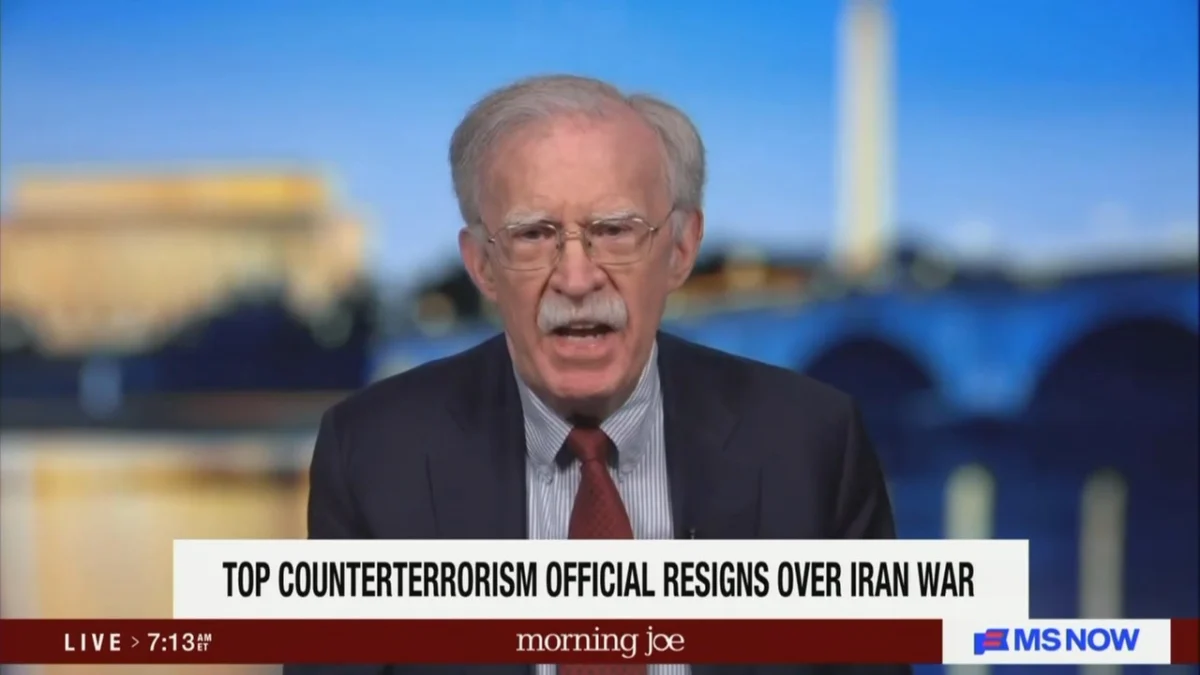
The internal stability of the current administration’s foreign policy apparatus faced a significant public challenge this week as high-ranking officials and former advisors clashed over the trajectory of military engagement with Iran. Former National Security Advisor and Ambassador John Bolton publicly celebrated the resignation of Joe Kent, the Director of the National Counterterrorism Center (NCTC), while simultaneously calling for the immediate departure of Director of National Intelligence (DNI) Tulsi Gabbard. The exchange, which played out across cable news and social media, highlights a deepening rift within the executive branch regarding the justification for ongoing hostilities in the Persian Gulf and the strategic necessity of regime change in Tehran.
The Resignation of Joe Kent and the Imminence Debate
Joe Kent, a retired U.S. Army Special Forces officer and a prominent figure within the "America First" movement, tendered his resignation on Tuesday. Kent, who had been a staunch ally of the president’s broader geopolitical vision, cited a fundamental moral and strategic disagreement with the administration’s escalation of the conflict with Iran. In a detailed letter shared via social media, Kent argued that the current military actions lack a foundational justification, asserting that Iran did not pose an "imminent threat" to the United States.
Kent’s departure is particularly notable given his background as a Gold Star husband and his long-standing advocacy for reducing American involvement in "forever wars." In his resignation statement, Kent alleged that the impetus for the conflict stemmed not from national security requirements, but from external political pressures. He specifically pointed toward influence from the Israeli government and its domestic lobbying entities, urging the president to "chart a new path" and avoid a protracted regional war.
The White House response was swift and dismissive. Official communications labeled Kent a "loser," a rhetorical move that signaled a total break between the administration and the former NCTC chief. Shortly thereafter, DNI Tulsi Gabbard—who built her political reputation on anti-interventionist principles—released a statement defending the administration’s stance. Gabbard argued that the president had "concluded" the Iranian regime represented an imminent threat, effectively providing the intelligence community’s seal of approval for the ongoing kinetic operations.
John Bolton’s Public Critique and the Demand for Alignment
Appearing on Wednesday morning’s broadcast of MS NOW’s Morning Joe, John Bolton offered a starkly different perspective, though one that equally favored Kent’s departure. Bolton, a veteran of several Republican administrations and a well-known proponent of a hawkish Middle East policy, stated that he was "glad" Kent had resigned. Bolton’s primary argument rested on the principle of administrative cohesion: that any official who cannot reconcile their personal beliefs with the president’s established policy has a professional obligation to exit the government.
"If you don’t believe in the administration’s policy, you should resign," Bolton told the program’s hosts. He extended this logic to Tulsi Gabbard, whose previous career in Congress was defined by her opposition to regime-change wars in the Middle East. Bolton suggested that if Gabbard harbors any of her former skepticism regarding intervention, she should follow Kent’s lead and "resign soon afterward."
Bolton’s commentary drew upon historical precedents of principled resignations. He cited Cyrus Vance, who resigned as Secretary of State under President Jimmy Carter following the failed "Desert One" mission to rescue American hostages in Iran in 1980. By invoking Vance, Bolton emphasized that high-level departures are a standard, albeit serious, mechanism for expressing dissent within the upper echelons of the U.S. government.
The Intelligence Conflict: What Defines an Imminent Threat?
A central point of contention in this unfolding drama is the definition of "imminence." Under international law and domestic war powers frameworks, the claim of an "imminent threat" is often the legal threshold used to justify preemptive military action without a formal declaration of war by Congress.
In his television appearance, Bolton offered a nuanced, if controversial, take on the intelligence surrounding Iran’s capabilities. He admitted that, based on his understanding of available data, he did not believe Iran was "within weeks of getting a nuclear weapon." However, Bolton argued that the legal standard of "imminence" is not strictly necessary to justify current U.S. actions. He characterized the ongoing conflict as an act of "self-defense," regardless of whether a specific, time-sensitive attack was being planned by the Islamic Revolutionary Guard Corps (IRGC).
This position stands in contrast to the traditional intelligence community’s standards, which typically require specific evidence of "capability" and "intent" to harm U.S. interests or personnel before a threat is labeled imminent. The discrepancy between Kent’s assessment (that no threat existed), Gabbard’s assessment (that the president concluded a threat was imminent), and Bolton’s assessment (that imminence is irrelevant to the justification of self-defense) suggests a lack of consensus on the very intelligence that underpins the war effort.
The Path to "Inexorable" Regime Change
Bolton’s media appearance coincided with the publication of an op-ed in the Wall Street Journal, in which he outlined a broader strategic vision for the region. In the piece, titled "Regime Change is Inexorable," Bolton argued that the United States cannot afford a stalemate or a partial victory. He posited that as long as the current government in Tehran remains in power, the security of the Persian Gulf and the stability of global energy markets will remain at risk.
"It would be untenable for the White House to declare victory while it remains unsafe to export Gulf oil," Bolton wrote. This economic argument links the military conflict directly to global trade. The Strait of Hormuz, a narrow waterway between Iran and Oman, serves as a transit point for approximately 20% of the world’s total oil consumption. Any disruption there has immediate and profound effects on global energy prices, inflation, and the domestic economy of the United States.
For Bolton, the logic of the conflict leads to only one conclusion: the removal of the current Iranian leadership. He views the current kinetic exchanges not as an isolated incident, but as the beginning of a process that must end with a new governing structure in Tehran. This stance places him at odds with the "America First" isolationists like Kent, who view such goals as an overextension of American power and a violation of the president’s original campaign promises to end Middle Eastern entanglements.
Chronology of Recent Escalations
To understand the weight of these resignations and public disputes, it is necessary to examine the timeline of events leading to the current crisis:
- Phase 1: Maximum Pressure Evolution: Following the withdrawal from the Joint Comprehensive Plan of Action (JCPOA), the U.S. moved from economic sanctions to more direct military posturing.
- Phase 2: Maritime Incidents: Increased reports of seized tankers and drone strikes on energy infrastructure in the Gulf of Oman heightened tensions.
- Phase 3: The Deployment: Significant naval and aerial assets were moved into the U.S. Central Command (CENTCOM) area of responsibility, citing intelligence of planned Iranian provocations.
- Phase 4: Kinetic Engagement: The transition from posturing to active conflict began with strikes on IRGC-linked facilities, leading to the current state of "ongoing war" referenced by Joe Kent.
- Phase 5: Internal Fracture: Joe Kent’s resignation on Tuesday marks the first major high-level departure specifically citing the Iran conflict as the cause.
Broader Implications for the Intelligence Community and National Security
The public spat between a former National Security Advisor, the DNI, and a former NCTC director raises serious questions about the politicization of intelligence. When the Director of National Intelligence justifies a war by stating the president "concluded" a threat was imminent—rather than stating the intelligence itself proved the threat—it suggests a top-down approach to policy-making that concerns many career analysts.
Furthermore, the departure of Joe Kent may signal a broader exodus of "restraint-oriented" officials from the administration. Kent was a key bridge between the president’s populist base and the national security establishment. His exit, combined with Bolton’s calls for Gabbard to follow suit, suggests that the administration’s foreign policy may be shifting back toward the neoconservative interventionism that the "America First" movement originally sought to replace.
The strategic implications are equally significant. If the U.S. is indeed committed to "inexorable" regime change, as Bolton suggests, the scope of the conflict is likely to expand far beyond localized strikes. This would require a massive mobilization of resources and could potentially draw in regional actors, including Israel, Saudi Arabia, and various proxy groups throughout the Levant and the Arabian Peninsula.
Official Reactions and Global Impact
While the White House has maintained a combative stance toward dissenters like Kent, the international community has reacted with caution. Allies in Europe and Asia have expressed concern over the potential for a total shutdown of Gulf oil exports. In the United Kingdom and France, diplomatic officials have reiterated calls for de-escalation, even as they acknowledge the security threats posed by Iranian regional activity.
In Tehran, the rhetoric has been predictably defiant. State-run media has characterized the internal U.S. disagreements as a sign of "imperial decline" and "strategic confusion." The Iranian leadership continues to maintain that its military actions are defensive responses to "economic terrorism" and foreign encroachment.
As the situation develops, the focus remains on the DNI’s office. Whether Tulsi Gabbard will heed Bolton’s call to resign—or if she will further entrench herself as a defender of the administration’s military strategy—will be a definitive indicator of the administration’s future direction. For now, the departure of Joe Kent stands as a stark reminder of the deep ideological divisions that persist at the highest levels of American power regarding the nation’s role in the Middle East and the justifications required to send U.S. forces into harm’s way.



 Yuyun Lusiyani
 Joko Widodo
 Eva Lovia
 Pevita Pearce