
 Eva Lovia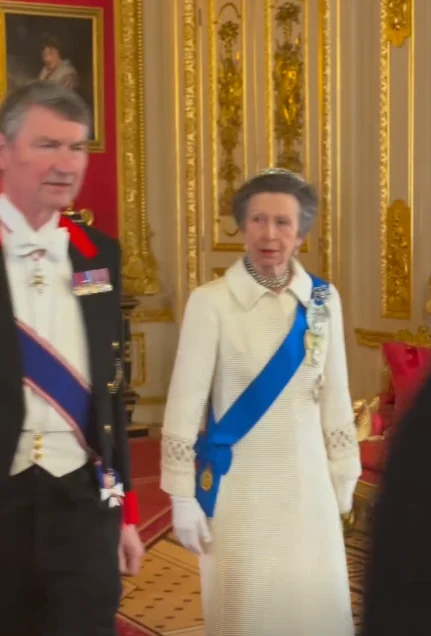
The Princess Royal demonstrated an exceptional commitment to sustainability and sartorial legacy by appearing at a recent State Banquet in a gown that is nearly six decades old. The striking ensemble, first worn by Princess Anne when she was 18 years old in 1969, was showcased at a grand State Banquet held in honour of the President of Nigeria during his official State Visit to the United Kingdom. This remarkable instance of wardrobe longevity underscores the Princess’s well-documented dedication to environmental consciousness and her personal style, which consistently embraces the principles of reuse and enduring elegance.
The gown itself is a testament to the fashion sensibilities of the late 1960s, featuring distinctive decorative elements on its wide cuffs. Princess Anne has retained these original flourishes, a detail that speaks volumes about her appreciation for the craftsmanship and sentimental value of the garment. While the core silhouette and print have been preserved, a subtle modification has been made: a new, discreet low collar has been introduced, replacing the original printed collar from 1969. This alteration reflects a considered update, harmonising the vintage piece with contemporary occasion wear while maintaining its inherent character.
The State Banquet, a formal occasion requiring white-tie attire, saw Princess Anne complement the historic gown with a cherished piece of jewellery. She selected the Meander diadem, a tiara that has become a signature of her collection. This exquisite piece was gifted to her by her parents, Queen Elizabeth II and Prince Philip, in 1972, several years after the initial debut of the dress. The pairing of the ancient gown with a treasured, yet later acquired, tiara creates a compelling narrative of personal history and evolving royal style. This choice, described as "sensible" yet "stunning," resonated particularly on a night filled with notable royal fashion moments.
A Night of Royal Fashion and Diplomatic Significance
The State Banquet, held at Buckingham Palace, was a highlight of the three-day State Visit by His Excellency Bola Ahmed Tinubu, President of the Federal Republic of Nigeria, and his wife, Mrs. Oluremi Tinubu. This visit marked a significant diplomatic engagement, representing the first State Visit by a Nigerian President to the UK in 37 years. Such occasions are steeped in tradition and serve as crucial opportunities for bilateral discussions and strengthening international ties. The sartorial choices of the senior royals often contribute to the visual narrative of these events, subtly conveying messages of respect, solidarity, and national identity.
Princess Anne’s decision to rewear the vintage gown was not the only fashion statement of the evening. The Princess of Wales, Catherine, opted for a contemporary gala gown by Andrew Gn, rendered in a vibrant bottle green. Her ensemble was accessorised with the iconic Lover’s Knot tiara, a piece famously associated with the late Queen Elizabeth II and Princess Diana. The Princess of Wales’s colour choice, a deep green, was widely interpreted as a thoughtful nod to the Nigerian flag, which features green and white stripes. This deliberate coordination was perceived by many as a sophisticated act of soft power, visually reinforcing the diplomatic bridge being built between the two nations.
Queen Camilla, the Queen Consort, presented a more classic and understated elegance. She wore a cream coat dress, a favoured design from her couturier Fiona Clare. Her choice of headwear was the sapphire and diamond tiara, a significant piece within the royal collection, created for the Crown Jewels during the early years of Queen Elizabeth II’s reign. This tiara has become a favoured accessory for Queen Camilla, having been worn at several key events, including the State Banquet for former US President Donald Trump during his 2025 State Visit. Her selection of this particular diadem further underscored the historical continuity and enduring traditions of the British monarchy.
The Duchess of Gloucester, Birgitte, also contributed to the evening’s regal display with an outfit that echoed the colour palette of Queen Camilla. She chose a navy evening gown and wore the all-diamond Iveagh tiara, adding another layer of opulence to the gathering.
The Nigerian State Visit: A Chronology of Key Events
The State Visit commenced with a formal welcome ceremony for President Tinubu and Mrs. Tinubu, led by King Charles III and Queen Camilla. This traditional ceremony, often held at Horse Guards Parade, sets the tone for the diplomatic engagement. Given President Tinubu’s observance of Ramadan, King Charles III made a notable adjustment to the usual schedule. Instead of the customary State Lunch, the visiting President and his wife were hosted for an afternoon audience. This thoughtful accommodation highlights the consideration given to the religious practices of visiting dignitaries.
Following the official welcome, a carriage procession transported the President and his delegation through Windsor. The journey culminated in a full military display at Windsor Castle, a display of pageantry and ceremonial honour that is a hallmark of State Visits. This part of the itinerary serves to showcase the military strength and ceremonial traditions of the host nation.
The State Banquet itself, held in the evening at Buckingham Palace, represented the pinnacle of the diplomatic and ceremonial events. The menu for the banquet was exclusively vegetarian, a decision that reflects evolving culinary trends and a potential consideration for broader dietary preferences. Prior to the banquet, a mocktail was served, offering a non-alcoholic option to guests. This attention to detail in the hospitality arrangements further contributes to the overall success and inclusivity of such high-profile events.
Analysis and Implications: Sustainability, Diplomacy, and Royal Legacy
Princess Anne’s sartorial choice to rewear a near 60-year-old gown transcends mere fashion; it is a potent statement on sustainability. In an era where fast fashion and disposable consumption are significant environmental concerns, the Princess Royal’s consistent practice of re-wearing and repurposing her wardrobe offers a powerful example. Her commitment is not a recent development but a long-standing ethos, positioning her as a consistent advocate for conscious consumption within the public eye. This instance, however, takes her advocacy to an unprecedented level, showcasing an item of clothing that has remained a part of her public life for almost her entire adult royal career. The economic and environmental benefits of such longevity are substantial, reducing the demand for new production and minimising textile waste.
The State Visit itself, occurring at a time of evolving global political landscapes and economic interdependence, carries significant diplomatic weight. Nigeria, as Africa’s most populous nation and a major economic power, holds substantial influence on the continent and beyond. Strengthening bilateral relations between the UK and Nigeria is therefore of strategic importance for both nations. The carefully orchestrated events, from the official welcome to the State Banquet, are designed to foster goodwill, facilitate dialogue on critical issues such as trade, security, and climate change, and underscore shared values.
The fashion choices of the royal family at such events are often scrutinised for their symbolic meaning. The Princess of Wales’s deliberate use of Nigerian flag colours can be interpreted as a modern approach to diplomatic dressing, signalling a proactive engagement with cultural representation. Queen Camilla’s choice of a classic tiara and elegant attire reinforces the enduring traditions and stability associated with the monarchy. Princess Anne’s vintage gown, in contrast, speaks to a different facet of royal legacy: a personal commitment to enduring values and a quiet, yet impactful, demonstration of principled living.
The longevity of Princess Anne’s gown, and indeed her commitment to re-wearing it, also speaks to the evolving narrative of royal public service. In an age where transparency and authenticity are increasingly valued, the visible demonstration of personal principles, such as sustainability, resonates with a wider audience. It humanises the royals, presenting them not just as figures of tradition and ceremony, but as individuals with personal convictions that inform their public actions. This particular instance, highlighting an 18-year-old’s choice of dress appearing on a woman approaching her 70s, is a remarkable visual representation of continuity, personal history, and the enduring power of well-made garments. It subtly challenges the notion of obsolescence in fashion, promoting a more mindful and sustainable approach to clothing consumption that is both personally meaningful and publicly influential. The enduring elegance of the gown, coupled with Princess Anne’s unwavering dedication to its repeated use, serves as a powerful reminder that true style is timeless and that conscious choices can leave a lasting, positive impact.



 Yuyun Lusiyani
 Joko Widodo
 Jia Lissa
 Pevita Pearce
 admin
admin
