
 Pevita Pearce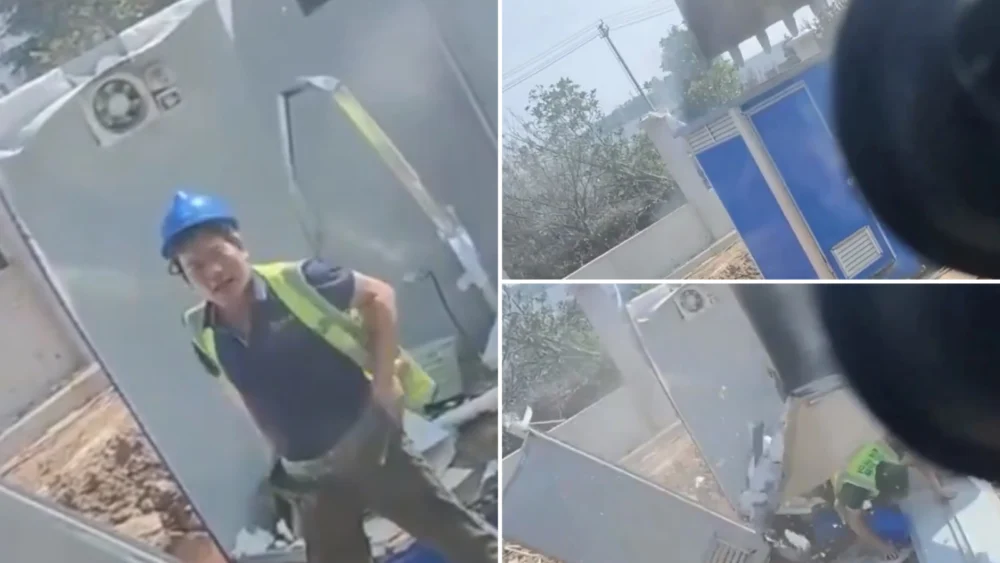
The intersection of high-risk industrial environments and the pervasive desire for viral social media content reached a harrowing peak recently as footage of a near-fatal incident at a construction site resurfaced across global platforms. The video, which depicts a heavy-duty excavator systematically dismantling a portable restroom while a worker was occupied inside, has ignited a fierce debate regarding workplace ethics, the legal boundaries of "pranking," and the efficacy of safety protocols in the modern construction industry. Originally gaining traction on Chinese social media networks in 2024, the clip has seen a massive resurgence in 2026, circulating widely on Reddit, X (formerly Twitter), and various international news aggregates, leaving millions of viewers in a state of collective disbelief.
The footage captures a sequence of events that transitions rapidly from what appears to be a misguided attempt at humor into a life-threatening emergency. In the video, the operator of a large-scale hydraulic excavator is seen maneuvering the machine’s bucket toward a standard polyethylene portable toilet. With a series of calculated, forceful movements, the operator strikes the top and sides of the unit. The structural integrity of the porta-potty, which is designed for portability rather than impact resistance, fails almost instantly. As the bucket crushes the roof and upper walls, the man inside is trapped within the collapsing debris. The sheer percussive force of the machinery, capable of moving tons of earth and concrete, is shown localized on a flimsy structure barely large enough to house a single human being.
Chronology of the Incident and Its Digital Resurgence
The origins of the footage can be traced back to mid-2024, when it first appeared on platforms like Douyin and Weibo. At the time, the incident was reported by several regional outlets, including The Sun, which highlighted the miraculous survival of the worker. However, the 2026 resurgence has brought the video to a much broader, more critical audience. On Reddit’s "r/Construction" and "r/WTF" communities, the clip has garnered tens of thousands of upvotes, with users analyzing the frame-by-frame mechanics of the destruction.
In the video’s climax, the excavator’s bucket tears through the door frame, at which point the worker—clutching his clothing and visibly disoriented—stumbles out of the wreckage. The victim appears to be in a state of profound shock, a physiological response to the sudden and violent intrusion into a private space. Despite the debris and the weight of the hydraulic arm, the man managed to stand and walk away, an outcome that many safety experts attribute to his adherence to basic safety gear.
The worker was notably wearing a standard-issue hard hat at the time of the incident. While these helmets are typically rated for falling objects or minor impacts, in this specific scenario, it may have provided the critical inches of clearance and skull protection necessary to prevent a fatal blow from the jagged plastic or the metal edge of the bucket. After exiting the remains of the unit, the worker is seen adjusting his clothing and walking away from the machine, though his gait suggests significant distress.
Statistical Context and Workplace Safety Standards
This incident serves as a grim reminder of the inherent dangers of the construction industry, which consistently ranks as one of the most hazardous sectors for employees worldwide. According to data from the International Labour Organization (ILO) and various national safety boards, heavy machinery accidents account for a significant percentage of site fatalities and permanent disabilities. Excavators, in particular, are involved in a high volume of "struck-by" and "caught-in-between" accidents.
In a standard professional environment, the operation of an excavator requires rigorous training, certification, and the strict following of "exclusion zones"—areas where ground personnel are prohibited while the machine is in motion. The intentional use of such a machine to interact with a structure known to be occupied represents a catastrophic breach of every established safety protocol. Industry analysts point out that the kinetic energy produced by an excavator’s hydraulic system can easily crush human bone and tissue with minimal resistance; the fact that the worker survived without visible catastrophic injury is being described by many online as a statistical anomaly.
Furthermore, the incident highlights a growing concern regarding "prank culture" in high-risk trades. While camaraderie and humor are often cited as essential for morale in grueling labor jobs, the escalation of these activities into "extreme pranking" has led to increased scrutiny from insurance providers and regulatory bodies like the Occupational Safety and Health Administration (OSHA) in the United States and similar agencies abroad.

Public Outcry and Legal Analysis
The reaction from the global online community has been overwhelmingly condemnatory. Unlike many viral videos that find a balance between humor and shock, the consensus regarding this footage is that the line of "pranking" was crossed into criminal territory. Comments across social media platforms reflect a shift in public tolerance for dangerous stunts. One widely circulated comment on X stated, "I didn’t know attempted murder was considered a prank," while another on Reddit argued that "the operator should be in jail for attempted murder; that wasn’t a joke, it was a death sentence that didn’t stick."
From a legal perspective, the actions of the excavator operator could potentially fall under several criminal and civil categories depending on the jurisdiction. These include:
- Reckless Endangerment: The conscious disregard of a substantial and unjustifiable risk to the safety of others.
- Assault with a Deadly Weapon: In many legal frameworks, a piece of heavy machinery can be classified as a deadly weapon if used in a manner intended to cause harm or fear of harm.
- Attempted Manslaughter or Murder: If it can be proven that the operator knew the worker was inside and that the actions taken were likely to result in death, the charges could escalate significantly.
Despite the intensity of the public reaction, there has been no official confirmation regarding disciplinary action or criminal charges against the operator or the construction firm involved. This lack of transparency has added to the frustration of viewers, who argue that the absence of visible consequences emboldens others to perform similar stunts for digital engagement.
The Viral Pattern: Porta-Potties as a Cultural Flashpoint
The fascination with the porta-potty incident is part of a larger, somewhat bizarre trend of portable restrooms becoming the center of viral internet content. The enclosed, private nature of the structures, contrasted with the public and often chaotic environments where they are placed, creates a unique stage for conflict and comedy.
In 2023, a massive brawl at a Morgan Wallen concert in Pittsburgh became a national news story after two women were filmed fighting inside and around a row of porta-potties. That incident was viewed millions of times and led to several interviews where the participants explained the breakdown in social order that led to the confrontation. Similarly, in 2024, a man at the Oklahoma State Fair was accused of a highly unusual and unsanitary form of fraud involving a porta-potty to win a car contest.
These incidents, while varied in their level of danger, point to a recurring theme in digital media: the subversion of private, vulnerable moments for public consumption. However, the excavator incident stands apart due to the sheer scale of the physical threat involved. Unlike a fistfight or a fraudulent contest entry, the destruction of a portable toilet with heavy machinery carries a high probability of a lethal outcome.
Broader Implications for the Construction Industry
For the construction industry, the viral nature of this video is a public relations and safety nightmare. It portrays a lack of professional oversight and a culture of negligence that many firms spend millions of dollars trying to eradicate. Modern site management increasingly relies on telematics and camera systems to monitor operator behavior, specifically to prevent unauthorized or dangerous use of equipment.
The incident is expected to be used as a "toolbox talk" case study for years to come—a cautionary tale of how quickly a lapse in judgment can lead to a potential fatality. Safety consultants suggest that the resurgence of this video in 2026 should prompt a re-evaluation of how "horseplay" is defined and punished on job sites. There is a growing call for "zero-tolerance" policies regarding the use of machinery for anything other than its intended engineering purpose.
Conclusion
The survival of the construction worker in this viral clip is a testament more to luck and the resilience of a hard hat than to any restraint shown by the excavator operator. As the video continues to circulate, it serves as a sobering reminder of the power of heavy machinery and the devastating consequences that occur when that power is treated with levity. While the internet may move on to the next viral sensation, the discussion regarding the ethics of workplace safety in the age of social media remains more relevant than ever. The incident stands as a definitive example of why the boundaries between humor and hazard must be strictly maintained, especially in environments where the margin for error is measured in inches and the cost of a mistake is a human life.




 Yuyun Lusiyani
 Joko Widodo
 Eva Lovia
 admin
admin
 Lina Irawan