
 Jia Lissa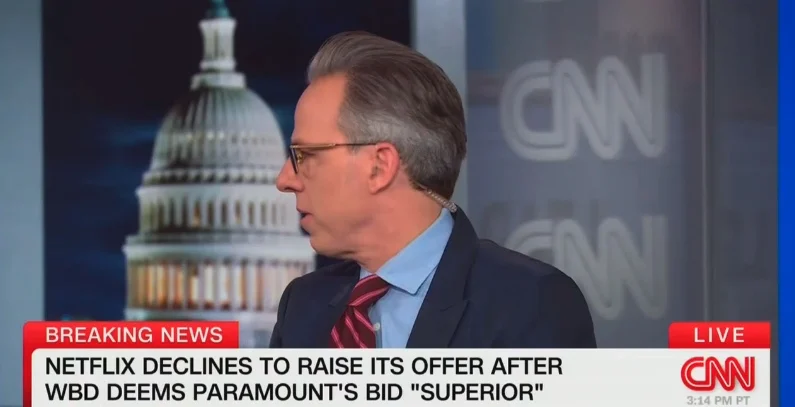
In a move that signals a seismic shift in the global media landscape, Paramount Skydance is positioned to acquire Warner Bros. Discovery (WBD) in a deal valued at approximately $111 billion. The development reached a critical turning point on Thursday when Netflix, previously considered a primary contender for the storied media conglomerate, officially declined to match Paramount’s counter-offer. The acquisition, if finalized and approved by regulators, would bring under one roof a massive portfolio of assets including the Warner Bros. movie studio, HBO, and the global news titan CNN.
The news was first confirmed to the public by CNN anchor Jake Tapper during a Thursday broadcast of The Lead. Tapper informed viewers that the Warner Bros. Discovery board had determined Paramount’s bid to be superior, largely because it encompassed the entirety of the company’s assets. While Netflix had been in tentative negotiations to acquire the prestige television and film arms of WBD, it reportedly balked at the inclusion of CNN, a move that allowed Paramount CEO David Ellison to secure the lead position by bidding for the "whole enchilada."
The Tapper Announcement and Internal Reactions
The announcement of the potential sale was a rare moment of meta-reporting for CNN, as the network’s own future hung in the balance of the negotiations. Shortly after returning from a commercial break, Jake Tapper addressed the situation directly, noting the personal and professional stakes for the staff within the studio.
"We have some breaking news in our national lead that affects everybody I’m looking at right now in the studio," Tapper told viewers. He explained that Netflix had declined to raise its offer following the WBD board’s assessment of the Paramount bid. Tapper emphasized that unlike previous iterations of the deal that saw the company being carved up, Paramount’s intent is to acquire Warner Bros. Discovery in its entirety, including the news division.
The atmosphere within CNN and the broader Warner Bros. Discovery offices has been described by insiders as one of "cautious apprehension." For years, the company has navigated the turbulent waters of corporate restructuring, following the 2022 merger of WarnerMedia and Discovery Inc. This latest development suggests that the era of David Zaslav’s leadership may be transitioning into a new chapter under David Ellison and the Skydance umbrella.
The Bidding War: Why Netflix Withdrew
The competition for Warner Bros. Discovery highlights the diverging strategies of the world’s leading media companies. Netflix, which has historically focused on entertainment and has only recently dipped its toes into live events and sports, was primarily interested in the intellectual property (IP) housed within HBO and the Warner Bros. film library. The addition of franchises like DC Comics, Game of Thrones, and Harry Potter would have solidified Netflix’s dominance in the streaming "arms race."
However, reports indicate that the sticking point for Netflix was the linear news and sports assets. Managing a 24-hour news cycle and the political complexities of a network like CNN was reportedly outside of Netflix’s current strategic roadmap. When Paramount countered with a $111 billion offer that included all divisions of WBD, Netflix executives chose to maintain their current capital structure rather than engage in a bidding war for assets they did not view as core to their subscription-based model.
Paramount’s aggressive move follows a period of rapid expansion for the company. After David Ellison’s Skydance successfully acquired Paramount Global and its subsidiary CBS in 2025, the company has shown a clear appetite for vertical integration, combining legacy broadcast media with modern production capabilities and news infrastructure.
A Chronology of the Consolidation
To understand the magnitude of this deal, one must look at the timeline of events that led to the February 2026 showdown:
- April 2022: Discovery Inc. completes its acquisition of WarnerMedia from AT&T, forming Warner Bros. Discovery under CEO David Zaslav. The company begins a period of intense cost-cutting to manage a debt load exceeding $40 billion.
- Late 2024: Rumors of further industry consolidation begin to swirl as streaming platforms struggle to reach consistent profitability.
- Early 2025: David Ellison’s Skydance Media reaches an agreement to merge with Paramount Global. The deal includes the acquisition of CBS and the hiring of Bari Weiss as editor-in-chief of CBS News following Paramount’s $150 million purchase of her media outlet, The Free Press.
- December 2025: Reports emerge that David Ellison has held preliminary discussions with figures in the political sphere regarding the future of CNN, signaling an interest in acquiring the network despite its recent ratings challenges.
- January 2026: Netflix enters formal talks to acquire the "prestige" assets of WBD, sparking a competitive bidding environment.
- February 26, 2026: Netflix officially withdraws from the process, leaving Paramount as the presumptive buyer.
Political Implications and Editorial Shifts
The potential acquisition of CNN by Paramount Skydance has already drawn significant attention from political figures, most notably President Donald Trump. Throughout his political career, Trump has maintained a contentious relationship with CNN, frequently labeling the network "fake news" and "unfair."
Publicly weighing in on the industry drama, President Trump stated that it is "imperative that CNN be sold." This sentiment aligns with reports that David Ellison has communicated to the Trump administration an intent to implement "sweeping changes" at the network. While the specifics of these changes have not been detailed, industry analysts point to Ellison’s recent track record with CBS News as a potential blueprint.
The 2025 acquisition of Bari Weiss’s The Free Press and her subsequent appointment to a leadership role at CBS News signaled a shift toward what some observers describe as an "anti-woke" or heterodox editorial approach. If Ellison applies a similar philosophy to CNN, it could represent the most significant transformation in the network’s history since its founding by Ted Turner in 1980. Such a shift would likely be aimed at reclaiming viewers who have migrated to more ideologically diverse platforms, though it remains a point of concern for those who value CNN’s traditional editorial independence.
Regulatory Hurdles and Economic Data
Despite the WBD board’s preference for the Paramount bid, the deal is far from a foregone conclusion. The acquisition will face intense scrutiny from regulatory bodies in both the United States and Europe. Antitrust regulators are expected to examine the concentration of media power, particularly the combination of two major film studios (Paramount and Warner Bros.) and two major broadcast/cable news organizations (CBS and CNN).
Key financial data points that regulators and investors will be monitoring include:
- Debt Management: Warner Bros. Discovery has been working to pay down a massive debt pile. The $111 billion valuation must account for the assumption of remaining liabilities.
- Market Share: A combined Paramount-WBD entity would control a significant percentage of the global box office and domestic cable viewership.
- Streaming Consolidation: The merger would likely result in the combination of Max and Paramount+, creating a streaming giant that could rival Disney+ and Netflix in terms of library depth.
Economists suggest that the deal reflects a "survival of the biggest" mentality in the media sector. As advertising revenue for linear television continues to decline, media companies are seeking scale to negotiate better terms with distributors and to fund the high costs of original content production.
Broader Impact on the Media Ecosystem
The implications of this deal extend beyond the corporate boardrooms of New York and Los Angeles. If Paramount successfully integrates WBD, it will create a media powerhouse with unparalleled influence over news, sports, and entertainment.
For the journalism industry, the merger raises questions about the diversity of voices in national news. The prospect of CNN and CBS News operating under the same corporate umbrella—and potentially under a unified editorial vision—could lead to significant layoffs and the consolidation of news bureaus. However, proponents of the deal argue that a well-capitalized owner like Ellison could provide the stability CNN needs to innovate in a digital-first world.
In the entertainment sector, the merger would consolidate some of the most iconic brands in cinema history. The union of Paramount Pictures and Warner Bros. Studios would create a production behemoth capable of dominating the theatrical release calendar for years to come.
As the legal and regulatory process begins, the media world remains focused on the next steps of David Ellison and the Warner Bros. Discovery board. While the $111 billion price tag has cleared the path for Paramount, the ultimate transformation of these storied institutions is only just beginning. The coming months will determine whether this merger creates a more resilient media giant or a monopolistic entity that draws the ire of government regulators on both sides of the Atlantic.



 Yuyun Lusiyani
 Joko Widodo
 Eva Lovia
 Pevita Pearce