
 Jia Lissa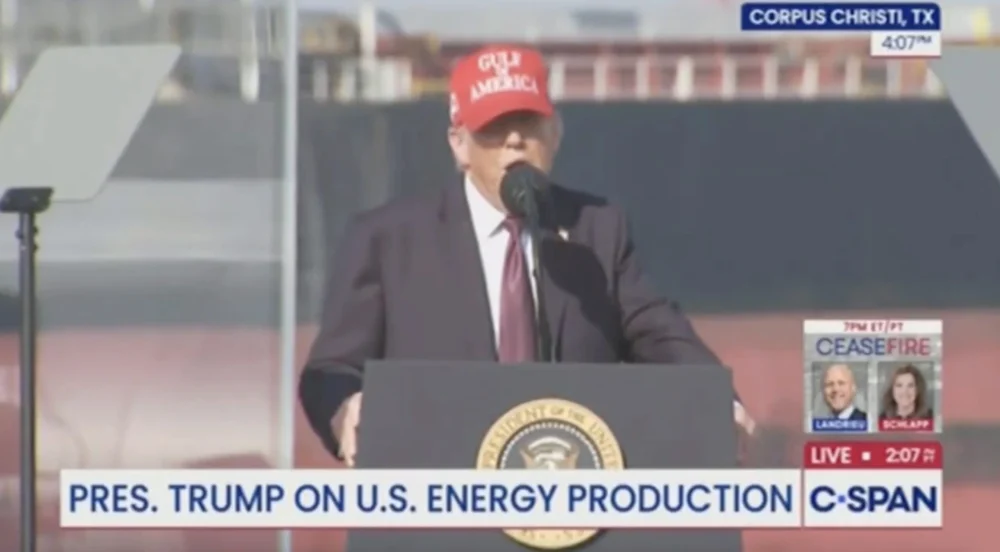
In a wide-ranging address focused on United States energy independence and domestic production, President Donald Trump delivered a speech in Corpus Christi, Texas, that has drawn significant attention for its inclusion of a detailed personal anecdote regarding the intersection of national economics and domestic life. During the event, which was intended to highlight the administration’s efforts to bolster the energy sector in the Gulf Coast region, the President deviated from prepared remarks to recount an interaction with a law enforcement officer. According to the President, the individual—described as a "big, tough cop" from New York—credited the administration’s economic policies, specifically the performance of the stock market and 401(k) retirement accounts, with a dramatic improvement in his marriage and personal life.
The President’s narrative centered on the officer’s purported financial transformation and the subsequent change in his spouse’s perception of his status. As recounted by the President, the officer stated that his wife had previously viewed him as a "loser" due to stagnant financial growth in his retirement savings over previous years. However, following a period of significant market gains, the officer allegedly claimed his wife now considers him a "financial genius." The President further quoted the officer as stating that these economic shifts had provided a "tremendous boost" to his life, explicitly mentioning an improvement in his marital intimacy and overall happiness.
Context and Setting of the Corpus Christi Address
The speech took place against the backdrop of Corpus Christi’s burgeoning role as a global hub for energy exports. As the leading port in the United States for crude oil exports, Corpus Christi represents a strategic pillar of the administration’s "energy dominance" policy. The President’s visit was designed to underscore the deregulation of the energy industry, the expansion of liquefied natural gas (LNG) facilities, and the infrastructure projects facilitating the transport of oil and gas from the Permian Basin to international markets.
While the primary objective of the visit was to discuss the Permian Basin’s output and the economic benefits of energy exports for the state of Texas, the President’s rhetorical style frequently involves the use of anecdotal evidence to illustrate the "real-world" impact of macro-economic indicators. By linking 401(k) performance to the personal dignity and domestic stability of a working-class archetype—in this case, a New York City police officer—the President sought to humanize the data points of the S&P 500 and the Dow Jones Industrial Average.
Detailed Chronology of the Anecdote and Media Response
The President’s story followed a familiar structure seen in many of his public addresses, where he identifies a specific individual who purportedly approached him to offer praise or gratitude. "I have a policeman, I tell this story—same guy," the President told the crowd in Texas. "This wonderful, tough policeman from New York. He’s taken good care of us, and he said, ‘Sir, it’s so good. My married life has gotten so much better.’"
The President continued the reenactment, suggesting the officer’s financial standing had been the primary friction point in his marriage. "My wife thought I was a loser, financially, I couldn’t make any money because my 401(k) was dying for years, and now she thinks I’m the smartest financial genius ever," Trump recounted to the audience, which responded with cheers and laughter. The narrative concluded with the officer allegedly stating, "It’s made my sex life good, it’s made my life good."
The reaction to the speech was immediate and polarized. On Friday evening, Fox News host Laura Ingraham featured the segment during the opening of The Ingraham Angle. The program utilized a chyron that read, "TRUMP’S ECONOMY: A BOOST IN YOUR BEDROOM?" to frame the discussion. The segment highlighted the President’s assertion that the "Trump Economy" was having a positive psychological and social impact on American households beyond simple balance sheets.
Conversely, the story faced scrutiny on social media platforms and from independent media outlets. The Tennessee Holler, a digital media company, expressed skepticism regarding the veracity of the account, categorizing it among the more improbable stories told by the President. On X (formerly Twitter), users pointed out the irony of the President’s timing, as some social media posts juxtaposed the President’s claims of a "skyrocketing" market with screenshots of intraday trading losses, suggesting that the "financial genius" status of 401(k) holders is subject to the inherent volatility of the markets.
Fact-Checking and Rhetorical Patterns: The "Sir" Analysis
The story has also reignited discussions among political analysts and fact-checkers regarding the President’s storytelling techniques. Daniel Dale, a prominent fact-checker who has tracked thousands of the President’s statements, previously published an analysis in 2019 regarding the use of the word "Sir" as a linguistic marker. According to Dale’s research for CNN, the President frequently uses the word "Sir" when recounting conversations with people—often described as "tough," "strong," or "crying"—who allegedly offer him unsolicited and effusive praise.
Dale’s analysis suggests that these "Sir" stories often lack verifiable details, such as names, dates, or locations, and frequently involve archetypal figures like construction workers, coal miners, or police officers. The Corpus Christi anecdote fits this pattern precisely: it involves a "big, tough" authority figure using the honorific "Sir" to credit the President with a life-changing personal outcome that aligns with the administration’s policy goals. Fact-checkers argue that these narratives serve as a rhetorical device to bypass traditional data-driven arguments in favor of emotional, relatable testimonials that are difficult to disprove but also impossible to verify.
Economic Data and the 401(k) as a Political Metric
Central to the President’s anecdote is the performance of the 401(k) plan, a defined-contribution retirement account that has become the primary vehicle for retirement savings for millions of Americans. Throughout his term, the President has frequently cited the growth of the stock market as a direct proxy for the health of the American middle class.
Data from the period surrounding the speech indicates that the U.S. stock market had indeed experienced significant growth since 2016. The S&P 500, a broad index of large-cap stocks, saw substantial returns during the first three years of the administration, driven in part by the Tax Cuts and Jobs Act of 2017 and a general environment of deregulation. For many Americans with consistent contributions to their retirement accounts, the "wealth effect" of a rising market was a tangible reality.
However, economists note that the benefits of stock market growth are not evenly distributed. According to Federal Reserve data, the wealthiest 10% of American households own approximately 84% of all stocks, including those held in 401(k)s and IRAs. While a "tough cop" from New York might indeed see a significant boost in a retirement account, a large segment of the population—particularly those in lower-income brackets—has little to no exposure to the equity markets. By framing the economy through the lens of a 401(k), the President’s rhetoric targets a specific demographic: the suburban and working-class voters who have enough discretionary income to participate in the market and whose perception of the economy is closely tied to their quarterly investment statements.
Broader Implications for Political Communication
The President’s speech in Corpus Christi exemplifies a shift in political communication where the personal and the political are inextricably linked. By suggesting that economic policy can directly influence the most intimate aspects of a citizen’s life—including their marriage and self-esteem—the President moves beyond traditional policy debate into the realm of cultural and psychological messaging.
This approach has several implications for the political landscape:
- The Personalization of Policy: Complex economic theories and trade policies are distilled into stories of personal redemption. This makes the administration’s successes feel personal to the supporter and its failures feel like personal attacks.
- Validation of Archetypes: By repeatedly using figures like the "tough policeman," the President reinforces a specific vision of American identity. These figures serve as proxies for a segment of the electorate that feels seen and valued by the administration’s rhetoric.
- The Erosion of Objective Fact-Checking: When a political leader uses unverifiable anecdotes to support their platform, it creates a "he-said, she-said" dynamic that fact-checkers struggle to penetrate. Supporters often view the story as "spiritually true" even if the specific details are questioned by the media.
Conclusion
The President’s address in Corpus Christi served as a microcosm of his broader campaign and governing strategy: a blend of hard-line policy focus—in this case, energy production—and highly personalized, often hyperbolic storytelling. While the anecdote of the "tough cop" and his rejuvenated marriage may be viewed by critics as an improbable fabrication, it resonates with a base that views the stock market not just as a financial index, but as a measure of national and personal strength.
As the political cycle continues, the use of such narratives is likely to remain a central feature of the administration’s communication strategy. Whether the "Trump Economy" truly provides a "boost in the bedroom" remains a matter of individual experience and anecdotal claim, but its utility as a rhetorical tool in the battle for public opinion is undeniable. The event in Texas underscores the degree to which the modern presidency utilizes every platform—from energy ports to national television—to weave a narrative of national prosperity tied directly to the persona and policies of the executive.



 Yuyun Lusiyani
 Joko Widodo
 Eva Lovia
 Pevita Pearce