
 Yuyun Lusiyani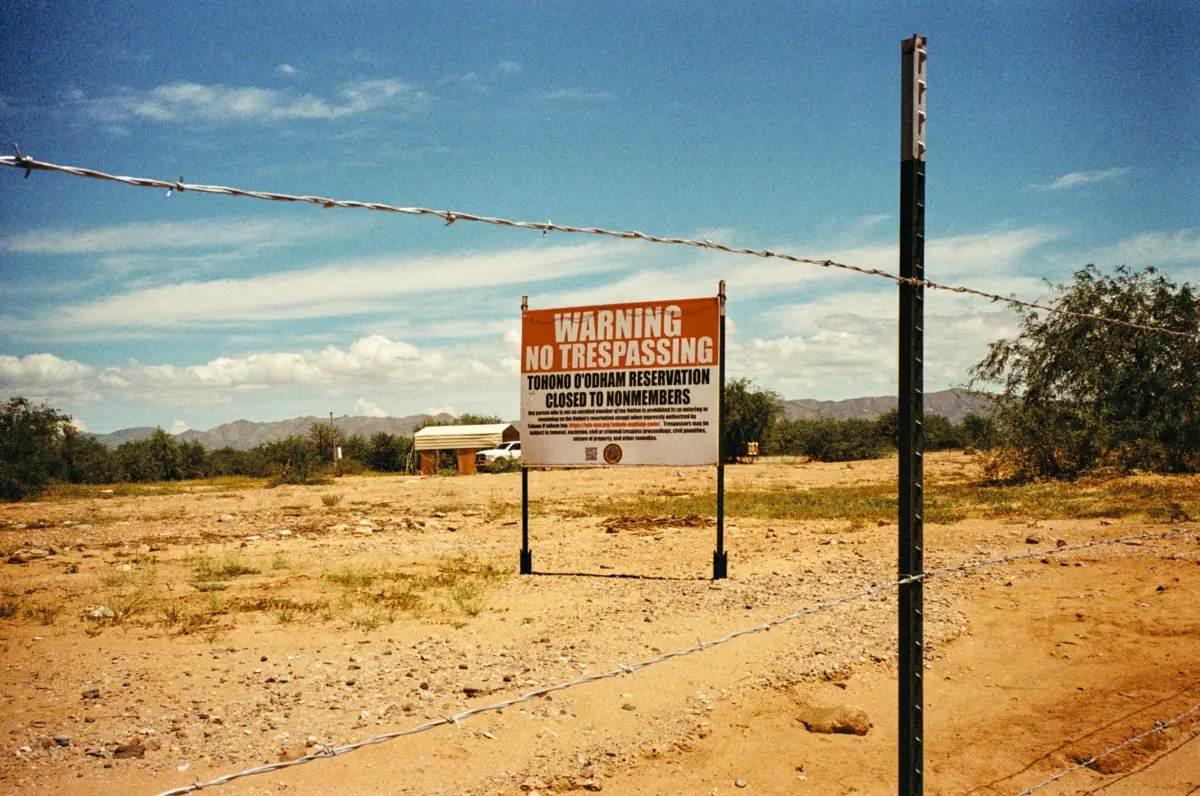
The early morning hours of August 25 saw the U.S. Department of Homeland Security (DHS) launch a controversial push to construct a 62-mile border wall across the Tohono O’odham Nation in Southern Arizona, triggering a fierce dispute over tribal sovereignty, cultural preservation, and federal authority. Chairman Verlon Jose received a curt email at 4:59 a.m. from acting chief patrol agent Henry N. Laxdal of the U.S. Border Patrol’s Tucson Sector, announcing that government contractors were set to begin soil tests for the wall in precisely one minute. The message, which offered the tribe the option to provide cultural monitors without impeding operations, underscored a perceived pattern of disregard for the Nation’s self-governance and ancestral ties to the land.
An Unannounced Incursion and Immediate Outcry

Chairman Jose, 59, was already aware of the impending arrival. An hour prior, tribal members had reported a convoy of work trucks, drilling rigs, and Border Patrol vehicles heading south through the reservation, with social media channels quickly corroborating the accounts. This swift deployment, following a mere 60-second notification, immediately drew strong condemnation from the Tohono O’odham leadership. Jose subsequently issued a public statement on the Nation’s website, labeling the incursion illegal. He further revealed that DHS had deployed a surveillance blimp and enlisted Mexican security forces to safeguard the construction crews, painting a picture of a coordinated, militarized operation.
As daylight broke, the scale of the federal presence became clearer. Contractors were guarded by federal agents in tactical gear and masks, reportedly drawn from a special operations cadre previously involved in citywide sweeps in Minneapolis and Chicago, which had resulted in fatalities. The Nation’s chief of police was blocked at a roadblock set up by these agents when attempting to reach the worksite, highlighting the confrontational nature of the federal operation. Deshane Gregg, a tribal member, recounted being forced off the road by a convoy of contractors and federal agents, describing the experience as a "government siege." She expressed the community’s helplessness against the aggressive posture of the agents, lamenting the constant surveillance by drones and the palpable tension.
A History of Cooperation and Mounting Tensions

For a quarter-century, the Tohono O’odham Nation, whose ancestral lands span the Sonoran Desert from Southern Arizona into Mexico, has navigated a complex relationship with U.S. border security. Comprising approximately 37,000 enrolled members, with thousands residing in Mexico, the Nation’s 2.8 million-acre reservation represents the largest unwalled section on the southern border. Historically, tribal leaders had staved off extensive wall construction by cooperating with DHS, allowing their reservation to serve as a testing ground for various homeland security measures. These included vehicle barriers, state-of-the-art surveillance towers, and partnerships with the Border Patrol and Immigration and Customs Enforcement (ICE).
Despite these long-standing collaborations, the Trump administration signaled a significant shift. In February, U.S. Customs and Border Protection (CBP) informed the tribe of its intent to completely seal off the 62-mile southern boundary, allocating nearly $52 billion from the "One Big Beautiful Bill Act" for the project. This announcement directly challenged the existing framework of cooperation and threatened to sever vital cultural and familial ties across the border.
The Legal Battle for Sovereignty

In response to the federal government’s plans, the Tohono O’odham Nation initiated legal action. Their homeland straddles the international border, and thousands of tribal members live in Mexico, necessitating routine border crossings for ceremonies, family visits, and traditional practices. A wall, tribal members and leaders argued, would not only disrupt these essential crossings but also destroy landscapes considered sacred and vital to their cultural identity. The lawsuit contended that the Trump administration’s unilateral efforts constituted an "historic attack on tribal sovereignty."
Meetings between tribal leaders and DHS officials yielded little common ground. Chairman Jose recalled hoping for a more collaborative approach from DHS Secretary Markwayne Mullin, the first Native American to lead the department. However, Mullin’s message was unequivocal: the wall would be built, and Justice Department attorneys were prepared to defend the project to the Supreme Court. Council member Vivian Juan-Saunders further recalled Mullin stating, "Don’t mess with me." The message grew even more direct during a subsequent meeting with CBP Commissioner Rodney Scott, who, according to Jose, Juan-Saunders, and council member Jesse Navarro, threatened to close the three border gates used by tribal members for cross-border travel if the Nation pursued its lawsuit. CBP declined to comment on these alleged threats.
On June 16, the Tohono O’odham Nation filed a lawsuit in the U.S. District Court for the District of Columbia, asserting that the wall would illegally reduce the size of its reservation, which only Congress has the authority to do. The tribe highlighted the contradiction between the administration’s claims of a safer border—with CBP reporting significantly lower apprehensions and Border Patrol "encounters" at a 50-year low—and the perceived necessity of a wall. The Nation’s interim chief of police, James Cook, stated in a sworn declaration that reports of illegal entry and border-related crimes had "almost disappeared," further questioning the rationale for such a drastic measure.

Federal Waivers and Judicial Scrutiny
The Nation sought a preliminary injunction to halt border wall activities while the litigation proceeded. However, on the eve of a July 22 hearing, DHS filed a notice affirming its intent to waive over 30 federal laws, including those mandating tribal consultation, to expedite the project. This move underscored the sweeping powers granted to DHS to bypass environmental and cultural preservation statutes, powers that the Trump administration had utilized on 60 occasions across its two terms.
In court, government attorneys acknowledged their "cooperative" history with the tribe but maintained that the Nation "does not hold veto power over the United States’ sovereign duty to secure its borders." They argued that an injunction was premature, as planning was ongoing, and issues could still be addressed. The government insisted construction would be limited to the Roosevelt Reservation, a 60-foot-wide zone where CBP was authorized to build barriers. Riyaz Kanji, the tribe’s lead attorney, countered that this zone did not extend onto tribal land, and the rugged terrain would inevitably force construction beyond this narrow boundary. Kanji argued that DHS, despite its extensive powers, could not override a sovereign government, calling the plans a "blatant and unprecedented disregard for the tribe’s rights." Justice Department attorney Adam R.F. Gustafson, however, asserted that the tribe had previously approved a barrier and that the current debate was merely over its type, which was for DHS to decide. He assured the court of the department’s "commitment" to consultation and its serious consideration of the tribe’s views.

Ultimately, on August 14, Judge Richard J. Leon denied the Nation’s injunction request, stating he "fully expect[ed] the government in the months ahead to follow through on its guarantees of consultation and cooperation with the Nation." This decision paved the way for the federal government to proceed, a development swiftly celebrated by DHS General Counsel James Percival, who posted a meme depicting a Star Trek "Borg" character with the caption "RESISTANCE IS FUTILE" on social media. He added, "We respect tribal sovereignty but not to the detriment of border security. This wall is getting built. Our authority is beyond dispute."
The Tadai Me:i Prayer Camp: A Spiritual Stand
The O’odham’s skepticism about the government’s assurances proved well-founded. Days after the meeting with Secretary Mullin, a border wall contractor "inadvertently disturbed a cultural site" west of the reservation, bulldozing a 70-foot swath through the Las Playas Intaglio, a 6,500-year-old earthen etching. This destruction, despite the site being well-marked and known to archaeologists, fueled tribal fears.

In anticipation of the imminent federal incursions, tribal leaders erected dozens of "no trespassing" signs along main access roads. Concurrently, tribal elder and Marine Corps veteran Wynona P. Larson Yazzie, alongside longtime activist Amy Juan, initiated a traditional prayer fire ceremony. The chosen site was symbolic: the border gate at Ko:li Ki:jig, a traditional crossing on the U.S.-Mexico line that had become a flashpoint for increased border security post-9/11. The camp, named Tadai Me:i (roadrunner on fire), became a spiritual bastion against the federal advance.
The prayer fire, lit on August 9, was maintained 24/7, with participants focusing on morning prayers and nightly cleanses amidst an atmosphere of communal solidarity. This was not a protest designed for confrontation, but a ceremony. Yet, the camp was immediately met with intensified federal surveillance. Activity logs, meticulously kept by tribal members, documented nearly 665 observations in the first seven days alone, mostly involving federal agents "buzzing around their location." Drones, helicopters (including marked CBP and suspected military Black Hawks), and various federal vehicles became constant fixtures. Agents were observed photographing campers, and Mexican security forces were seen conversing with Border Patrol across the international boundary.
Escalation and Disparate Treatment

The surveillance extended beyond the camp. On the fourth night, an elder couple returning from the prayer gathering was stopped at a rarely staffed checkpoint a half-mile outside the reservation. Agents, conducting an "immigration check," asked for tribal IDs and inquired about the ceremony, an unusual interaction according to Amy Juan. This incident prompted many gathering participants to leave, fearing late-night encounters with Border Patrol.
The August 25 incursion, following the judge’s denial of the injunction, marked a dramatic escalation. Larson Yazzie, racing to document the events, was stopped by an agent who had laid a spike strip ahead. The tribal police chief was also blocked by a Border Patrol roadblock manned by BORTAC agents in tactical gear, a unit known for its heavy-handed tactics. He observed drilling rigs operating beyond the 60-foot "Roosevelt Reservation" that government attorneys had assured the judge would be the construction limit. Bureau of Indian Affairs agents were also present, claiming to be there to "preserve the peace and monitor activities."
The prayer camp participants, undeterred, relit their ceremonial fire. Davy Cross, a camp participant, described being awakened at 4:33 a.m. by the sound of a weapon being chambered, followed by drones flying dark and low, and then an airplane and helicopter. Soon after, a caravan of over 30 Border Patrol and construction vehicles encircled the camp, with Mexican state police completing the encirclement on the other side of the border. "We got surround[ed] by over 30 vehicles," Cross noted in the activity log, a moment captured in a widely shared video.

The Tohono O’odham Nation’s attorneys filed an appeal, arguing that the Trump administration was making "a mockery" of the court’s expectation of "consultation and cooperation." The disparity in treatment became particularly stark when compared to developments in Texas. Around the same time, Republican Governor Greg Abbott secured a pause on border wall construction plans in Big Bend National Park after discussions with the DHS secretary. Abbott advocated for "technology tools that don’t include barriers," such as drones and fiber optics – precisely the measures the Tohono O’odham Nation had long endured and suggested as alternatives. A judge subsequently granted a preliminary injunction halting construction in the Big Bend area. Amy Juan observed the bitter irony, attributing the difference to "good old boy conversations" between politicians and federal officials, implying a lack of similar respect for tribal leadership.
Ongoing Struggle and Dystopian Realities
The relentless surveillance and intimidation continue. Nate Sosa, a young Pascua Yaqui member, described agents chambering weapons near sleeping campers and constant aerial monitoring. Liz Quiroga, a 28-year-old tribal member, meticulously documented 379 observations over five days, with nearly two-thirds involving Border Patrol units near the fire. She lamented the situation as "true dystopia."

While its legal challenge continues, the Tohono O’odham Nation has ceased attempts to physically remove border wall contractors from its lands, a pragmatic decision in the face of overwhelming federal force. Yet, the Tadai Me:i prayer camp remains, a steadfast symbol of resistance and cultural resilience. The constant surveillance, the militarized presence, and the looming threat to their ancestral lands underscore a profound crisis of sovereignty and human rights, leaving the Tohono O’odham Nation in a precarious and intensely monitored struggle against a determined federal agenda. The outcome of this battle will have lasting implications not only for the Tohono O’odham people but for the broader landscape of tribal sovereignty and border policy in the United States.


 Joko Widodo
 Eva Lovia
 Jia Lissa
 Pevita Pearce
 admin
admin