
 Jia Lissa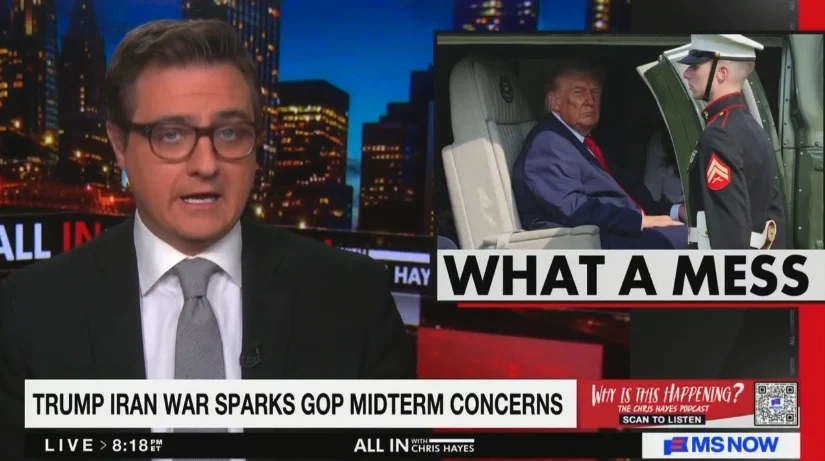
MS NOW’s Chris Hayes recently dedicated a significant portion of his program, All In, to analyzing a notable rhetorical shift among prominent Fox News personalities regarding President Donald Trump’s military campaign against Iran. As the conflict enters a critical phase, voices within the traditionally supportive network have begun expressing urgent concerns over the war’s trajectory, its mounting human and financial costs, and its potential to derail Republican prospects in the upcoming midterm elections. The shift comes as the United States military continues a sustained bombing campaign, marking ten consecutive days of strikes against Iranian targets following a deadly escalation in the region.
The current hostilities reached a tipping point over a recent weekend when Iranian-linked strikes in Jordan resulted in the deaths of two active-duty U.S. Army soldiers. A third service member was killed in Iraq during the hazardous process of disposing of an Iranian-manufactured drone. These fatalities have brought the total number of American service members killed since the conflict’s inception in February to at least 17. The war, launched jointly by President Trump and Israeli Prime Minister Benjamin Netanyahu, has faced significant scrutiny from its onset, but the recent surge in casualties and the prospect of an "endless" engagement have catalyzed a new wave of domestic political pressure.
Chronology of Escalation and Military Engagement
The path to the current conflict began in early 2026, following a breakdown in regional security agreements and a series of maritime provocations in the Persian Gulf. In February, the Trump administration, citing intelligence of imminent threats to U.S. assets and in coordination with the Israeli government, initiated a series of "preventative" strikes that rapidly evolved into a full-scale kinetic conflict.
By March, the U.S. had deployed additional carrier strike groups to the Eastern Mediterranean and the Gulf of Oman. However, rather than a swift capitulation by Tehran, the conflict devolved into a war of attrition involving drone technology, proxy militias, and targeted assassinations. The recent ten-day bombing campaign represents one of the most intense periods of aerial bombardment since the war began, aimed at degrading Iran’s command and control centers and its drone manufacturing capabilities.
The geography of the conflict has also expanded. While initial strikes were focused on Iranian soil, the theater of war now encompasses much of the Levant and Mesopotamia. The deaths of soldiers in Jordan and Iraq highlight the vulnerability of U.S. personnel stationed across the Middle East, even in nations not directly party to the primary conflict. This expansion has led to increased logistical strain and a heightened risk of a broader regional conflagration that could draw in other neighboring powers.
Financial Costs and Legislative Demands
As the military engagement intensifies, so does the financial burden on the American taxpayer. On Tuesday, Secretary of Defense Pete Hegseth appeared before the Senate Armed Services Committee to provide testimony on the administration’s requirements for the remainder of the fiscal year. Hegseth formally requested a $95 billion supplemental funding package specifically earmarked for operations related to the Iran war.
This request comes on top of the existing $1.15 trillion Pentagon budget currently moving through the legislative process in Congress. The sheer scale of these figures has sparked debate on Capitol Hill, with some fiscal hawks questioning the sustainability of such spending in a high-inflation environment. Critics argue that the $95 billion "emergency" request is a symptom of a lack of a clear exit strategy, while proponents maintain that failing to fund the effort now would jeopardize the safety of the troops already deployed.
The economic ramifications extend beyond the federal budget. Chris Hayes noted during his broadcast that oil prices have begun to "shoot up once again," a direct consequence of instability in the Middle East and threats to vital shipping lanes like the Strait of Hormuz. For the Trump administration, rising energy costs represent a dual threat: they fuel domestic inflation and provide a tangible grievance for voters who are already skeptical of the war’s objectives.
Public Opinion and the 2026 Midterm Landscape
The most significant hurdle for the administration may be the rapidly eroding public support for the war. According to a recent Washington Post/Ipsos poll, a staggering 69% of Americans now disapprove of President Trump’s handling of the conflict with Iran. This figure represents a broad cross-section of the electorate, including a growing number of independent and moderate Republican voters.
With the 2026 midterm elections just over a hundred days away, the political stakes are at an all-time high. Historically, incumbent parties struggle during midterm cycles, and an unpopular foreign war often exacerbates those losses. Hayes argued that the "panic" among Republican stakeholders is palpable, as they fear the war will become the defining issue at the ballot box.
"You could literally hear the panic among anyone who is invested in a Republican majority," Hayes told his viewers. "And they’re not being subtle about it." This sentiment was echoed in the clips Hayes aired from Fox News, where hosts who typically align with the president’s "America First" agenda are now signaling that the political cost of the war may soon outweigh its perceived strategic benefits.
Analysis of Media Sentiment: The Fox News Pivot
The shift in tone on Fox News is particularly noteworthy given the network’s influence over the Republican base. Hayes highlighted comments from three key figures: Laura Ingraham, Brit Hume, and David Asman.
Laura Ingraham, host of The Ingraham Angle, was explicit in her warning to the White House. "The clock is ticking for President Trump to get out of this war before voters head to the polls," she stated. Ingraham emphasized that the conflict has become an "unpopular" and "endless distraction" that could jeopardize the GOP’s chances in November. Her focus on the "clock" suggests a belief that the administration has a very narrow window to achieve a diplomatic or military breakthrough before the political damage becomes irreversible.
Brit Hume, Fox News Chief Political Analyst, pointed to a perceived breach of the president’s foundational campaign promises. Hume noted that Trump had built his political identity on the promise of keeping the United States out of "endless" or "unsatisfactory" wars. "And now he’s in one," Hume remarked. "And it’s not at all clear how it’s gonna end. So he’s vulnerable on this point." Hume’s analysis touches on a deeper ideological tension within the Republican party between interventionist neoconservatives and the isolationist "MAGA" wing.
On Fox Business, host David Asman focused on the practicalities of the conflict’s economic fallout. He questioned whether there were ways to "work around" the Iranian influence on global energy, such as developing new pipelines or increasing domestic pumping to mitigate the "Iranian hump." This line of questioning reflects a desperate search for solutions that would allow the U.S. to maintain its aggressive stance without suffering the domestic economic consequences that typically follow Middle Eastern instability.
Geopolitical Implications and the Netanyahu Factor
The war’s inception is inextricably linked to the alliance between President Trump and Prime Minister Benjamin Netanyahu. The two leaders have long shared a hardline stance toward the Islamic Republic, viewing its nuclear ambitions and regional proxy networks as an existential threat. However, the current conflict has tested the limits of this partnership.
While Israel has provided intelligence and tactical support, the bulk of the kinetic operations and the resulting casualties have been American. This disparity has led to murmurs of discontent within the U.S. military establishment. Analysts suggest that the "palpable relief" mentioned by Hayes regarding the earlier Memorandum of Understanding (MOU) was due to the hope that a formal framework would prevent the very escalation currently taking place. The failure of that MOU to maintain peace is now seen by many as a strategic blunder.
Furthermore, the conflict has complicated U.S. relations with other regional players. Allies like Saudi Arabia and the United Arab Emirates find themselves in a precarious position, balancing their desire to see Iranian influence curtailed with the need to avoid a total collapse of regional stability that would devastate their own economies.
Broader Impact and Future Outlook
As the midterms approach, the Trump administration faces a formidable challenge: how to de-escalate a high-stakes war without appearing to retreat or concede to Tehran. The "no endless wars" mantra that helped propel Trump to the presidency in 2016 and 2024 is now being used against him by both political opponents and erstwhile media allies.
The $1.15 trillion Pentagon budget and the additional $95 billion request represent a massive investment of national resources at a time when domestic infrastructure, healthcare, and education remain underfunded in the eyes of many voters. If the administration cannot demonstrate a clear path to victory or a face-saving diplomatic exit, the 69% disapproval rating may translate into significant seat losses for Republicans in both the House and the Senate.
The commentary from Fox News suggests that the conservative media apparatus is preparing for the possibility of a political "midterm correction." By urging the president to "get this over with," figures like Ingraham and Hume are attempting to provide the White House with the political cover needed to pivot toward de-escalation. Whether the administration will heed these warnings or continue the current course remains the central question of the 2026 political landscape.
In the coming weeks, the focus will likely remain on the Senate Armed Services Committee and the progress of the supplemental funding bill. However, the true barometer of the war’s success or failure will not be found in military briefings, but in the fluctuating prices at gas stations and the shifting sentiments of the American electorate as they prepare to head to the polls. The "palpable relief" of the past has been replaced by a "palpable anxiety" that now spans the political spectrum, from the studios of MSNBC to the prime-time slots of Fox News.

 Yuyun Lusiyani
 Joko Widodo
 Pevita Pearce
 admin
admin
