
 Jia Lissa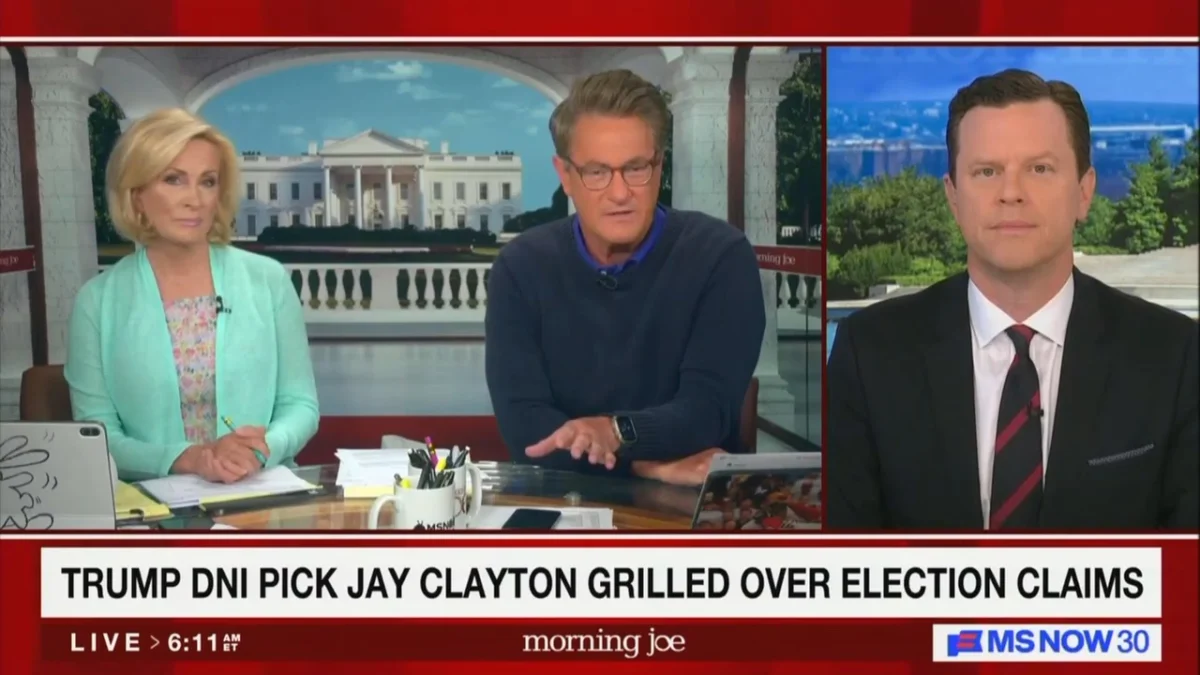
The confirmation process for Jay Clayton, President Donald Trump’s nominee for Director of National Intelligence (DNI), reached a critical flashpoint on Wednesday as the former Securities and Exchange Commission (SEC) Chairman faced intense questioning regarding the legitimacy of the 2020 presidential election. The hearing, conducted before the Senate Intelligence Committee, became a focal point of national discourse after Clayton repeatedly declined to explicitly state that President Joe Biden won the 2020 election, opting instead to use the term "certified" to describe the result. This rhetorical choice prompted a sharp rebuke from MSNBC’s Morning Joe host Joe Scarborough, who characterized the exchange as a troubling sign of authoritarian influence within the incoming administration’s intelligence apparatus.
During the hearing, Clayton was pressed by several Democratic senators to provide a definitive acknowledgement of the 2020 election results. When asked directly if Joe Biden had won fairly, Clayton maintained a pivot to legal terminology, stating that the election had been "certified" and that Biden had served his term as the recognized president. This refusal to use the word "won" or to disavow claims of widespread fraud—claims that have been consistently debunked by federal agencies, state election officials, and the judiciary—drew immediate parallels to the broader political movement questioning the foundations of American democratic transitions.
The Morning Joe Critique: Orwellian Warnings and Totalitarian Theory
On Thursday morning, Joe Scarborough used his platform to provide a blistering critique of Clayton’s testimony, framing the nominee’s performance as a submission to "presidential delusions." Scarborough, a former Republican congressman, argued that the refusal to acknowledge a settled historical and legal fact was not merely a political maneuver but a fundamental assault on the concept of objective truth.
Scarborough invoked George Orwell’s dystopian novel 1984, specifically citing the passage: "The party told you to reject the evidence of your eyes and your ears. It was their final, most essential command." By referencing Orwell, Scarborough suggested that the requirement for high-level officials to mirror the President’s rhetoric regarding 2020 constitutes a form of psychological and institutional control that prioritizes loyalty to a leader over fealty to factual reality.
The host further enriched his analysis by citing Hannah Arendt’s seminal work, The Origins of Totalitarianism. Scarborough noted that Arendt identified the erosion of institutional competence in favor of "blind loyalty" as a precursor to the collapse of democratic structures. He argued that the DNI role, which oversees 18 different intelligence agencies, requires a leader capable of delivering unvarnished, objective truth to the Commander-in-Chief. By failing to state a basic fact about the 2020 election, Scarborough contended that Clayton was signaling a willingness to prioritize political alignment over the analytical integrity required for national security.
Legal and Factual Context of the 2020 Election Results
The controversy surrounding Clayton’s testimony stands in stark contrast to the extensive legal record of the 2020 election. Following the November 2020 vote, the Trump campaign and its allies filed over 60 lawsuits in state and federal courts, including the Supreme Court, challenging the results in key swing states such as Pennsylvania, Georgia, Michigan, and Arizona.
Of these cases, 63 were dismissed or ruled against due to a lack of evidence or legal merit. Notably, many of these rulings came from judges appointed by President Trump himself. In Pennsylvania, federal judges noted that the campaign failed to provide even a "scintilla" of evidence regarding widespread voter fraud. Furthermore, the Cybersecurity and Infrastructure Security Agency (CISA), then led by Chris Krebs, issued a statement in November 2020 declaring the election "the most secure in American history."
The U.S. Supreme Court also declined to hear several high-profile challenges, including a lawsuit filed by the state of Texas that sought to invalidate the results in four other states. This judicial consensus forms the "judicial notice" that Scarborough referenced during his broadcast, suggesting that for a "learned man" like Clayton—a prominent attorney and former regulator—to hedge on these facts is a deliberate choice rather than a lack of information.
The Role of the Director of National Intelligence
The significance of Clayton’s testimony is amplified by the specific nature of the office he has been nominated to lead. The Director of National Intelligence was a position created in the wake of the September 11 terrorist attacks as part of the Intelligence Reform and Terrorism Prevention Act of 2004. The primary goal of the DNI is to integrate the nation’s intelligence efforts and ensure that the President receives a unified, objective assessment of global threats.
The DNI serves as the head of the Intelligence Community (IC) and the principal advisor to the President, the National Security Council, and the Homeland Security Council for intelligence matters related to national security. Key responsibilities include:
- The President’s Daily Brief (PDB): Overseeing the production of the most sensitive intelligence document in the U.S. government.
- Budgetary Oversight: Managing the National Intelligence Program budget.
- Analytical Integrity: Ensuring that intelligence analysis is timely, objective, and independent of political considerations.
Critics of Clayton’s testimony argue that if a DNI nominee cannot acknowledge a domestic political fact verified by the very agencies he seeks to lead (such as the FBI and CISA), his ability to provide objective analysis on foreign threats may be compromised by a desire to conform to the executive’s political preferences.
Timeline of the Nomination and Hearing
The path to Clayton’s confirmation hearing has been marked by a series of shifts in the Trump administration’s national security team.
- Nomination Announcement: President Trump announced Jay Clayton as his pick for DNI earlier this year, surprising some observers given Clayton’s background in financial regulation rather than traditional intelligence or espionage.
- The Pre-Hearing Climate: In the weeks leading up to the hearing, Republican senators largely signaled support for Clayton, citing his successful tenure at the SEC. However, Democratic members of the Senate Intelligence Committee signaled that they would focus heavily on his commitment to the independence of the intelligence community.
- Wednesday’s Hearing: The hearing lasted several hours, with Senator Jon Ossoff (D-GA) leading much of the questioning regarding the 2020 election. Clayton’s refusal to deviate from the "certified" terminology became the viral takeaway from the session.
- Trump’s Impending Address: The hearing occurred just 24 hours before a scheduled televised address by President Trump, which reports suggest will focus heavily on continued allegations of 2020 election interference. This timing added a layer of political pressure to Clayton’s testimony, as any admission of Biden’s victory could have been seen as a direct contradiction of the President’s upcoming remarks.
Reactions from Lawmakers and Policy Experts
The reaction to the hearing has been split along predictable partisan lines, though some national security experts have expressed non-partisan concern. Senator Mark Warner (D-VA), the Chairman of the Senate Intelligence Committee, emphasized that the DNI must be "willing to speak truth to power, even when that truth is uncomfortable for the President."
Conversely, Republican supporters of Clayton, such as Senator Marco Rubio (R-FL), have defended the nominee, arguing that his focus on the "certification" of the election is a factual statement that respects the legal process without becoming embroiled in political theater. Supporters argue that Clayton’s experience managing a complex federal agency like the SEC makes him qualified to handle the bureaucratic challenges of the IC.
However, former intelligence officials have raised alarms. Retired senior analysts have noted that the "politicization of intelligence" is one of the greatest risks to national security. If the workforce within agencies like the CIA or NSA perceives that their leader is filtering information to satisfy a political narrative, it could lead to a "chilling effect" on reporting and a decline in the quality of intelligence reaching the President’s desk.
Broader Implications for the Intelligence Community
The debate over Clayton’s testimony reflects a larger struggle over the future of the American civil service and the "deep state" narrative promoted by the Trump administration. By emphasizing "loyalty" in his personnel choices, President Trump has signaled a desire to exercise greater control over agencies that have historically operated with a degree of autonomy.
For the Intelligence Community, the stakes are particularly high. The DNI must coordinate between 18 disparate elements, including the Department of Defense, the Department of Energy, and the Treasury. A lack of trust in the DNI’s objectivity could hamper information sharing and lead to intelligence failures similar to those seen prior to the Iraq War, where political pressure was cited as a factor in the assessment of weapons of mass destruction.
Furthermore, the international implications are significant. U.S. intelligence relies heavily on partnerships with foreign allies, such as the "Five Eyes" (UK, Canada, Australia, New Zealand). These partners share sensitive data based on the assumption that U.S. intelligence is professional, objective, and stable. A perceived shift toward a politically motivated intelligence leadership could strain these vital relationships.
As the Senate moves toward a vote on Clayton’s confirmation, the focus remains on whether his performance was a necessary political compromise to secure the job or a preview of a new era where the Director of National Intelligence serves as a defender of the President’s personal narratives. For Joe Scarborough and other critics, the hearing was a "frightening" glimpse into a future where the distinction between political loyalty and factual reality is increasingly blurred.


 Yuyun Lusiyani
 Joko Widodo
 Pevita Pearce
 admin
admin
