
 Pevita Pearce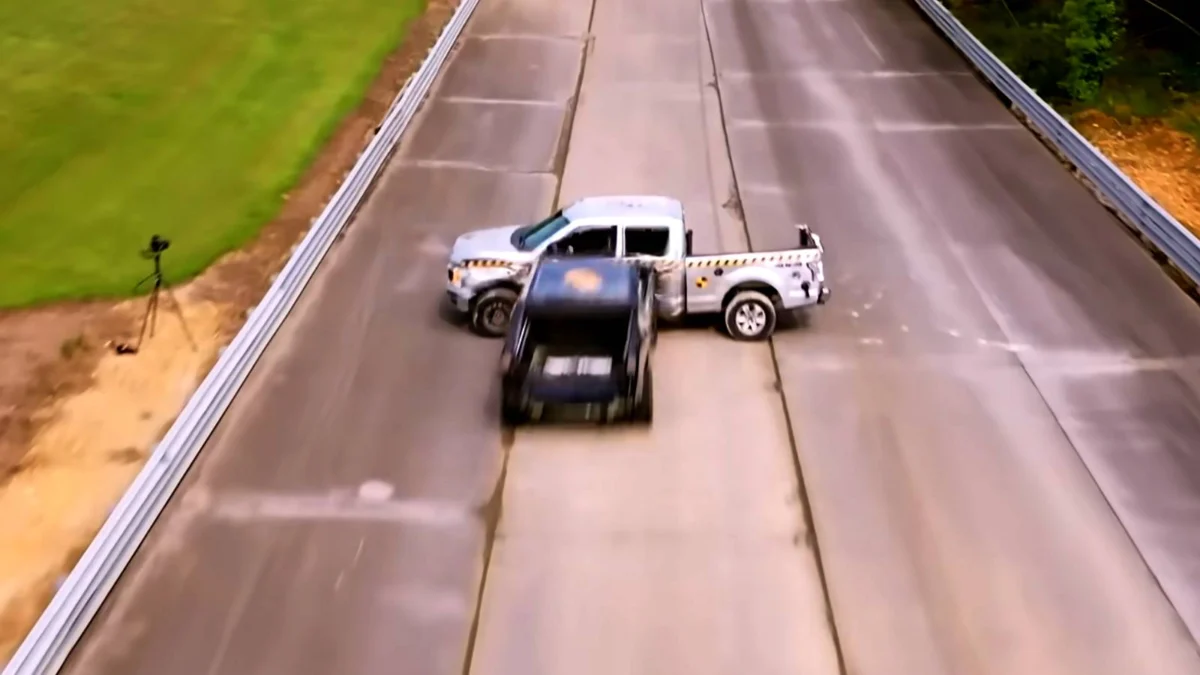
The multi-year automotive durability saga conducted by prominent YouTuber Cody Detwiler, known professionally as WhistlinDiesel, has reached a destructive conclusion following a high-speed remote-controlled collision and a comprehensive evaluation of long-term maintenance requirements. In a final assessment that weighed structural resilience against mechanical reliability, Detwiler officially declared the Ford F-150 the superior vehicle over the Tesla Cybertruck. This conclusion follows a series of grueling tests designed to push both pickups to their absolute mechanical limits, culminating in a 111-mph impact that resulted in the total loss of both vehicles.
The final chapter of the series focused on a head-to-head collision on a closed drag strip, where the Tesla Cybertruck was outfitted with sophisticated mechanical actuators and controlled remotely via First-Person View (FPV) goggles. This setup allowed for a high-speed impact without risking human life. The Cybertruck, traveling at a recorded speed of 111 mph, struck a stationary Ford F-150. The resulting impact provided a stark visual contrast in automotive engineering philosophies. While the Ford F-150 suffered a catastrophic failure—its passenger cabin completely separating from the chassis amid a momentary fireball—the Cybertruck’s stainless-steel exoskeleton remained largely intact in terms of its overall silhouette, despite the total destruction of its internal components.
The Verdict: Reliability Over Resilience
Despite the Cybertruck’s apparent victory in the final high-speed crash test, Detwiler’s final judgment was based on a more practical metric: consistent operational uptime. Over the course of the two-year testing period, the Tesla Cybertruck reportedly required between six and seven visits to authorized service centers, accumulating an estimated $53,000 in repair costs. In contrast, the Ford F-150, despite being subjected to the same environmental stressors and physical abuse, reportedly required zero dealership visits for repairs during the same period.
This disparity in maintenance highlights a critical divide between legacy automotive manufacturing and the Silicon Valley approach to vehicle production. The Ford F-150 utilized a traditional body-on-frame construction that has been refined over decades, whereas the Cybertruck utilized a novel "exoskeleton" design using cold-rolled stainless steel. While the Cybertruck’s body panels proved nearly impervious to minor impacts and even small-arms fire in previous segments of the series, the underlying mechanical systems and the integration of those systems into the frame proved to be significant points of failure.
Chronology of the Durability Series
The comparison began in 2024, shortly after the widespread release of the Tesla Cybertruck. Detwiler’s objective was to move beyond standard consumer reviews and subject the vehicles to "extreme-case" scenarios. The testing timeline can be broken down into several key phases:
- Initial Structural Testing (Early 2024): The vehicles were subjected to off-road "torture tracks" and blunt-force impacts. It was during this phase that the Cybertruck first showed signs of structural vulnerability. While attempting to pull the Ford F-150 from a ditch, the Cybertruck’s rear aluminum casting—the section of the frame where the tow hitch is mounted—snapped entirely. This incident sparked widespread debate regarding the use of "gigacast" parts in heavy-duty applications.
- Explosive and Ballistic Trials: In a later segment, Detwiler tested the "bulletproof" claims made by Tesla CEO Elon Musk. The Cybertruck’s stainless steel successfully deflected several rounds that would have easily penetrated the Ford’s aluminum skin. However, subsequent tests involving C4 explosives demonstrated that while the exterior was tough, the shockwaves caused significant internal electronic failures in the Tesla.
- The Moab Expedition: Both trucks were taken to the rugged terrain of Moab, Utah. The Cybertruck initially impressed with its air suspension and instant torque, but it was soon sidelined by a failure in its towing and steering modules. The Ford F-150 continued to navigate the trails, at one point operating on only three wheels after a suspension failure, until damaged wiring finally rendered it immobile.
- The 111-MPH Finale: The series concluded with the high-speed collision and the subsequent recycling of both vehicles.
Technical Analysis of the Collision
The final crash provided significant data regarding the Cybertruck’s safety and structural integrity. One of the primary concerns regarding the Tesla pickup has been its lack of traditional "crumple zones." In a standard vehicle like the Ford F-150, the frame is designed to deform in a controlled manner to absorb the energy of an impact, thereby protecting the occupants.
In the 111-mph collision, the Cybertruck’s rigid stainless-steel body did not deform significantly. While this kept the vehicle’s shape recognizable, such rigidity can be a double-edged sword; in a manned collision, the kinetic energy not absorbed by the vehicle’s body is instead transferred to the passengers. Detwiler noted, however, that the Tesla’s high-voltage battery pack remained intact and did not suffer a thermal runaway event (fire), which is a common concern in high-impact EV accidents.
The Ford F-150’s failure—the separation of the cab from the frame—was expected given the extreme speed of the impact, which far exceeds the parameters of standard NHTSA (National Highway Traffic Safety Administration) or IIHS (Insurance Institute for Highway Safety) testing. These organizations typically conduct offset frontal crashes at 40 mph. At 111 mph, the kinetic energy is nearly eight times greater than at 40 mph.
Financial and Industry Implications
The $53,000 repair bill for the Cybertruck is a point of concern for potential fleet buyers and long-term owners. Tesla’s service model, which relies heavily on proprietary parts and authorized service centers, contributed to both the cost and the downtime of the vehicle. The Ford F-150 benefits from a massive secondary market for parts and a century-old infrastructure of independent mechanics and dealerships, making it the more "serviceable" vehicle in the eyes of the tester.
Industry analysts suggest that the results of such "viral" durability tests, while unscientific, have a measurable impact on brand perception. Tesla has marketed the Cybertruck as "apocalypse-proof," a claim that Detwiler’s series both supported (in terms of body strength) and undermined (in terms of mechanical longevity). The failure of the rear frame in earlier tests prompted a wave of scrutiny regarding Tesla’s engineering choices for a vehicle marketed for towing and heavy labor.
Final Disposal and Conclusion
The series ended with a symbolic gesture of finality. Both the mangled remains of the Ford F-150 and the structurally compromised Tesla Cybertruck were transported to a recycling facility. Footage showed the vehicles being torn apart by heavy hydraulic machinery and fed into an industrial shredder. This finality was intended to emphasize that neither vehicle is truly "indestructible," regardless of marketing claims.
In his concluding remarks, Detwiler praised Tesla for its innovation, stating that the company was "onto something" with the Cybertruck’s performance and comfort. However, he emphasized that for a truck to be truly useful, it must be reliable. The Ford F-150’s ability to withstand two years of extreme abuse without requiring professional repair earned it the title of the winner.
The series also highlighted the power of social media in automotive journalism. Prior to the full video release, leaked footage of the wrecked Cybertruck led to viral rumors that Detwiler had been killed in the accident. The subsequent reveal of the remote-control setup served as a commentary on the dangers of such high-speed stunts and the importance of safety protocols in content creation. As the automotive world continues to transition toward electrification, the "WhistlinDiesel" series remains a controversial but influential data point in the ongoing debate between traditional engineering and the new frontier of electric utility vehicles.



 Yuyun Lusiyani
 Joko Widodo
 Eva Lovia
 admin
admin
 Lina Irawan