
 Pevita Pearce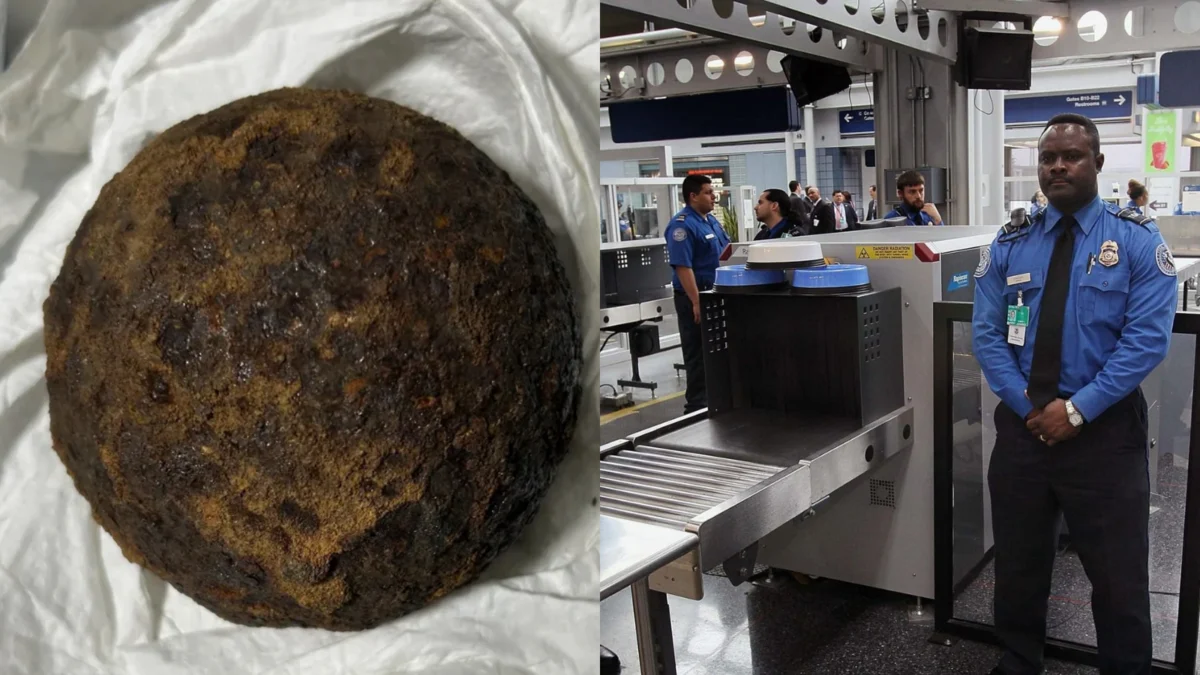
The discovery of five Civil War-era cannonballs inside a traveler’s checked luggage at Gulf Shores International Airport has sparked a multi-agency investigation and highlighted the ongoing challenges of securing historic artifacts. On July 18, during a routine screening of checked baggage, Lead Transportation Security Administration (TSA) Officer Justin Dupree identified a series of dense, opaque objects that initially defied immediate identification. What appeared at first glance to be heavy fitness equipment was soon revealed to be a collection of nineteenth-century artillery munitions, triggering an emergency response protocol that briefly transformed a standard security checkpoint into a potential bomb disposal scene.
The incident began when the X-ray monitor displayed several large, circular masses inside a passenger’s suitcase. Officer Dupree, a four-year veteran of the TSA, noted that the density of the objects was consistent with items like medicine balls or heavy metal spheres. However, the lack of uniformity and the texture suggested something more specialized. Upon opening the bag for a manual inspection, officers discovered five metal cannonballs, ranging in size from approximately one inch in diameter to the size of a large grapefruit, carefully wrapped in paper towels.
The immediate concern for airport security was the potential for the munitions to be "live." Civil War-era shells were frequently filled with black powder and equipped with fuses that, while aged, can remain volatile and highly explosive for over a century. Officer Dupree reported that his primary focus was the absence of a visible fuse, which necessitated the immediate involvement of explosives specialists. The Baldwin County Sheriff’s Office and TSA explosives experts were summoned to the scene to conduct a diagnostic assessment of the items. Following a tense period of evaluation, the team determined that the cannonballs were inert and did not contain active explosive charges.
A Trail Leading to Fort Morgan
The resolution of the immediate safety threat shifted the focus to the provenance of the artifacts. Law enforcement officers from the Baldwin County Sheriff’s Office traced the cannonballs to Fort Morgan, a National Historic Landmark located approximately 20 miles from the airport at the tip of Mobile Point. Fort Morgan is one of the most significant military sites in Alabama, having played a pivotal role in the defense of Mobile Bay during the American Civil War.
Investigations revealed that the artifacts had been illicitly removed from the fort. According to Captain Nathan Lusk of the Baldwin County Sheriff’s Office, the theft was attributed to an out-of-state juvenile who had managed to extract the items from the historic site. The passenger in possession of the bag at the airport, however, was not the individual who stole them. TSA officials clarified that the traveler had reportedly purchased the cannonballs from a roadside stand, unaware that they were stolen property or that they constituted prohibited items under federal aviation security guidelines.
The director of Fort Morgan has since declined to pursue criminal charges against the passenger, citing her apparent lack of knowledge regarding the items’ origin. Despite this, the Alabama Historical Commission has maintained an active investigation into the circumstances of the theft, seeking to understand how a juvenile was able to remove significant archaeological material from a protected state museum and how those items ended up in the secondary market.

Historical Context: The Siege of Fort Morgan
To understand the significance of the recovered cannonballs, one must look to the history of Fort Morgan and the Battle of Mobile Bay. Completed in 1834, the masonry star fort was designed to guard the entrance to one of the Confederacy’s last major open ports. During the summer of 1864, the fort became the site of an intense naval and land siege.
The Battle of Mobile Bay is perhaps best remembered for Admiral David Farragut’s famous command, "Damn the torpedoes, full speed ahead!" as he led the Union fleet past the fort’s heavy guns and through a field of naval mines (then called torpedoes). Following the naval victory, Union forces landed on the peninsula and began a two-week siege of Fort Morgan. The fort was subjected to a relentless bombardment from both land-based batteries and the Union fleet.
The cannonballs found in the luggage at Gulf Shores International Airport are tangible remnants of this conflict. Projectiles used during the siege included solid shot, designed to batter masonry walls, and spherical shells, which were intended to explode over enemy positions. The recovery of these items is of high archaeological value, as each artifact provides data regarding the types of weaponry used and the positioning of forces during the 1864 engagement.
Security Protocols and the Prohibition of Munitions
While the cannonballs were confirmed to be inert, their presence in checked luggage represented a significant breach of TSA regulations. Under current federal guidelines, all forms of ammunition and artillery—including replicas and antique munitions—are strictly prohibited from being transported in the cabin or the cargo hold of commercial aircraft unless specific, rigorous criteria are met, and even then, heavy artillery is generally barred.
TSA Alabama Federal Security Director Tara Corse emphasized that the "inert" status of a weapon does not grant it an exemption from security rules. "Even if inert and not active, travelers should avoid bringing weapons of any kind, including replicas, to the airport," Corse stated. "They can cause security alerts, flight delays, and safety concerns."
The primary issue with inert munitions is that they are indistinguishable from live explosives on an X-ray screen. When such an item is detected, the TSA must follow a protocol that includes evacuating the immediate area, halting the screening process, and calling in bomb disposal units. This process results in significant operational delays and consumes law enforcement resources. In this instance, the discovery of the cannonballs required the coordination of federal and local authorities, potentially delaying other passengers and diverting officers from other security duties.
Trends in Unusual Airport Discoveries
The "Indiana Jones-esque" discovery, as Officer Dupree described it, adds to a growing list of bizarre and hazardous items intercepted by the TSA in recent years. While the agency frequently reports the interception of firearms—a number that reached a record 6,737 in 2023—it also encounters more eccentric attempts to bypass security.

Recent reports from the TSA include the discovery of a live smoke grenade concealed inside a jar of peanut butter and a woman attempting to smuggle live turtles hidden within her clothing. These incidents, while occasionally humorous in retrospect, highlight a persistent lack of awareness among the traveling public regarding what constitutes a security threat. The TSA continues to leverage these high-profile stories as educational tools, urging passengers to use the "Can I Bring?" tool on the agency’s website before arriving at the terminal.
The Preservation of Alabama’s Cultural Heritage
The return of the five cannonballs to Fort Morgan marks a victory for preservationists, but it also raises concerns about the vulnerability of historic sites. Alabama law, specifically the Alabama Antiquities Act, protects artifacts located on state-owned lands. The unauthorized removal of such items is a violation of state law, intended to prevent the "pot-hunting" and looting that strips historical sites of their context and educational value.
Artifacts like Civil War cannonballs are not merely "souvenirs"; they are property of the state and part of the public trust. When items are removed from their original location, historians lose the ability to study the "provenience"—the exact spot where an item was found—which is often more important than the object itself. The Alabama Historical Commission’s ongoing investigation serves as a reminder that the protection of these sites requires constant vigilance, both from site staff and the general public.
Conclusion and Implications
The five recovered artifacts have been safely returned to the museum at Fort Morgan, where they will likely be integrated into the site’s collection or used for educational purposes. The passenger, after having the items confiscated and being questioned by law enforcement, was permitted to continue her travel.
Lead Officer Justin Dupree reflected on the uniqueness of the event, noting that in his career, he had encountered training munitions and inert grenades, but never stolen artifacts of such historical pedigree. The incident serves as a multifaceted case study in modern security: it is a story of vigilant screening, a reminder of the volatility of historical munitions, and a cautionary tale about the illicit trade of cultural property.
As the TSA and local law enforcement conclude their review of the July 18 event, the message to the public remains clear: historical artifacts belong in museums, and munitions of any age or condition belong far away from commercial aviation. The "Indiana Jones" moment at Gulf Shores International Airport ended without injury or damage, but it serves as a stark illustration of the unexpected complexities that define the front lines of transportation security.




 Yuyun Lusiyani
 Joko Widodo
 Eva Lovia
 admin
admin
 Lina Irawan