
 Lina Irawan
The automotive world has witnessed the emergence of the Bugatti Destrier, a singular commission that represents the absolute zenith of Molsheim’s bespoke coachbuilding capabilities. Developed under the hyper-exclusive Programme Solitaire, the Destrier is a radical reimagining of the Bugatti Bolide, the marque’s most extreme, track-focused vehicle. By stripping away the aggressive aerodynamic appendages, wings, and splitters that define the Bolide’s downforce-heavy profile, Bugatti has created a vehicle that prioritizes aesthetic purity and historical homage without compromising the raw mechanical violence of its 1,600 PS powertrain. This one-of-one creation is not merely a car but a sculptural tribute to the dual-purpose legacy of the Type 57 chassis, bridging the gap between the circuit and the Concours lawn.
Standing a mere 1,000 millimeters tall, the Destrier’s silhouette is a direct architectural parallel to the legendary Type 57 platform of the 1930s. In that era, a single chassis served as the foundation for both the Le Mans-winning Type 57G "Tank" and the ethereal Type 57SC Atlantic road car. The Destrier and the Bolide continue this philosophy into the 21st century, utilizing a shared Dallara-developed carbon fiber monocoque to deliver two diametrically opposed expressions of engineering. While the Bolide was engineered to shatter lap records through aerodynamic grip, the Destrier has been sculpted to dominate the world’s most prestigious automotive exhibitions, beginning with its global public debut at the Pebble Beach Concours d’Elegance on August 16, 2026.

The Evolution of the W16 Legacy
At the heart of the Destrier lies Bugatti’s iconic 8.0-liter quad-turbocharged W16 engine. In this configuration, the powerplant produces 1,600 PS, a figure that ensures the vehicle’s performance remains as breathtaking as its visual design. Despite its orientation toward aesthetic refinement, the Destrier retains the full mechanical vitals of its track-focused donor. The integration of such a massive powertrain into a body standing only one meter high required extraordinary thermal management and packaging ingenuity.
The transition from the Bolide to the Destrier involved more than a simple removal of body parts; it required a fundamental recalibration of the car’s visual weight. By freeing the monocoque from the functional requirements of extreme downforce, Bugatti’s design team, led by Director of Design Frank Heyl, was able to reveal a "waistline" that draws inward behind the forward-hinged doors. This narrowing creates a dramatic visual tension before the bodywork expands into muscular haunches over the rear wheels. This posture—low-slung and poised—is a deliberate nod to the "destrier," the highly prized warhorse of the medieval knight, known for its strength and agility.
Aesthetic Refinement and Historical Cues
The exterior of the Destrier is finished in "Sapphire Celeste," a bespoke, multi-layered paint shade developed exclusively for this commission. The paint features diamond-inspired particles that allow the color to shift and shimmer under different lighting conditions, a modern interpretation of the blue hue found on the famous "Pope" Atlantic (Type 57SC chassis 57591).

Several key design modifications distinguish the Destrier from its predecessors:
- The Horseshoe Grille: The signature Bugatti element has been widened and lowered, providing a more planted appearance.
- The C-Line: The iconic Bugatti C-line has been reinterpreted; it "breathes" by pausing briefly before the front wheel arch to reveal tinted carbon fiber bodywork before resuming its sweep along the flank.
- Wheel Configuration: The Destrier sits on 20-inch front and 21-inch rear wheels, an increase from the 18-inch wheels found on the Bolide, enhancing its road-going presence.
- The Rear Profile: In place of the Bolide’s massive rear wing, the Destrier features a smooth, blended tail reminiscent of the Chiron Profilée, emphasizing fluid lines over aggressive downforce.
In a display of artisanal craftsmanship, the engine bay components and various interior touchpoints feature a hand-hammered aluminum finish. This technique creates a textured surface that mimics the appearance of medieval plate armor, further reinforcing the "Destrier" nomenclature and providing a tactile link to the past.
Interior Craftsmanship: The Tailor’s Atelier
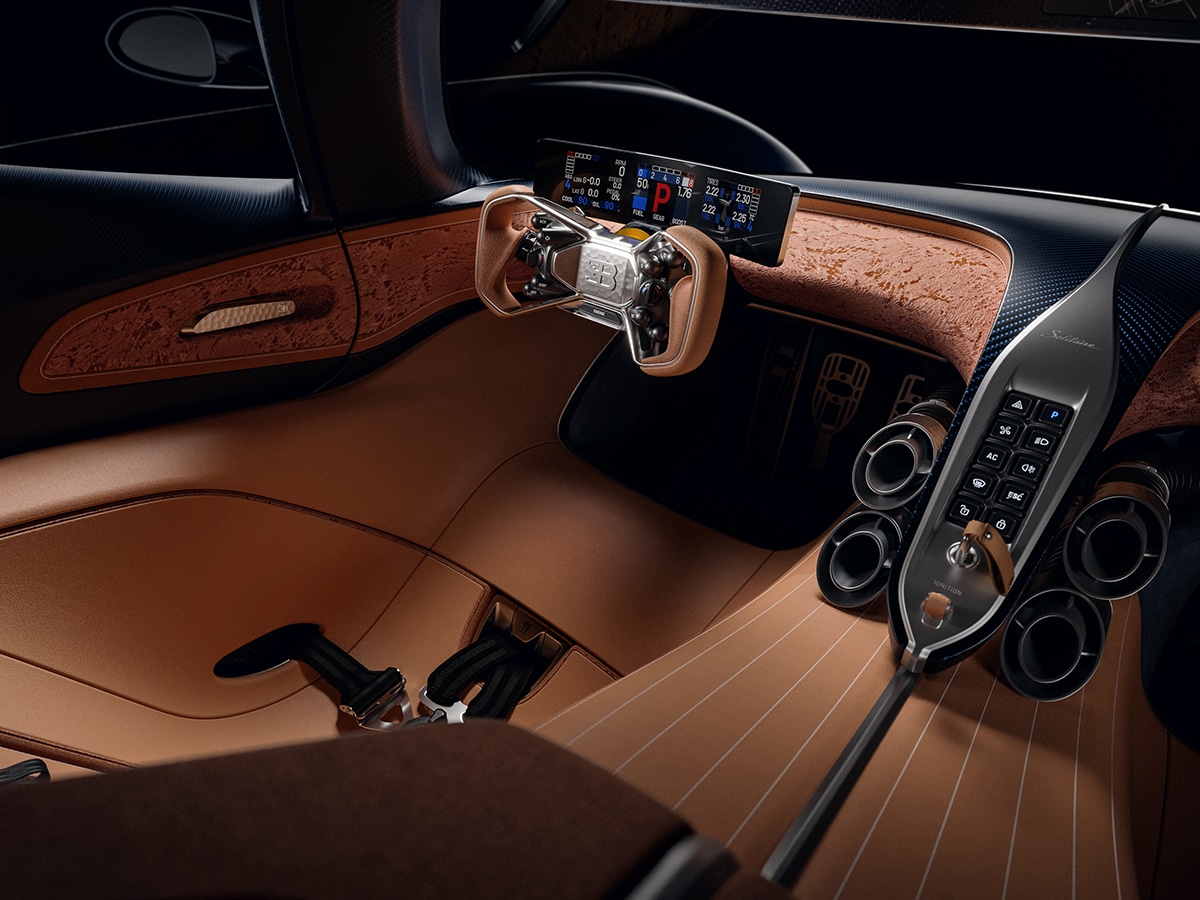
If the exterior of the Destrier is a study in sculptural aerodynamics, the interior is an exercise in haute couture. Moving away from the spartan, carbon-heavy cockpit of a racing car, the Destrier’s cabin is designed to evoke the warmth and intimacy of a high-fashion tailor’s atelier. The interior is anchored by three primary textures: smooth leather, velvety nubuck, and an innovative 3D-knitted technical fabric.

The primary color palette is "Ambre Voyageur," a rich, warm brown that provides a sophisticated contrast to the cool "Sapphire Celeste" exterior. A defining feature of the cabin is the "halo-line," a continuous sweep of 3D-knitted textile that wraps around the cockpit. This fabric is woven with genuine copper yarns, a technique borrowed from the highest levels of garment construction, allowing the surfaces to catch the light with a subtle metallic shimmer.
The hand-hammered aluminum finish seen in the engine bay is mirrored inside the car across four primary touchpoints: the steering wheel spokes, the center console inserts, the door handle surrounds, and the gear selector. To honor the brand’s roots, a subtle French tricolour flag is integrated into the dashboard, while a custom oil filler cap, laser-engraved with the Destrier emblem and a "1/1" designation, marks the vehicle’s unique status in the Bugatti lineage.
Programme Solitaire and the Market for One-of-Ones
The Destrier is the latest product of Bugatti’s Programme Solitaire, a division operating out of the historic Chateau Saint-Jean in Molsheim. Named after the French term for a single, rare diamond, the program allows the world’s most prolific collectors to collaborate directly with Bugatti’s design and engineering teams. Unlike standard production models or even limited-run "few-off" series, Solitaire cars are fully certified, one-of-one vehicles that represent the absolute peak of the brand’s portfolio.
This commission follows the success of the F.K.P. Hommage, which famously integrated a $400,000 Audemars Piguet timepiece into the dashboard. However, where previous commissions were often narrative-driven, the Destrier is a design-led exercise. By building two fundamentally different vehicles on a single carbon chassis, Bugatti is reaffirming its commitment to the coachbuilding traditions of the 1920s and 30s. To cement this connection, a hand-laser-engraved dedication plate is situated above the windscreen, displaying technical drawings of both the Type 57G Tank and the Type 57SC Atlantic.
While Bugatti does not publicly disclose the final transaction prices for Solitaire commissions, industry analysts suggest that such projects command figures well in excess of $20 million USD. These vehicles are viewed not just as automobiles, but as blue-chip investments and multi-generational artworks.
Debut, Delivery, and Long-Term Impact
The Destrier’s journey to the public eye is meticulously timed. Its reveal ahead of the 2026 Pebble Beach Concours d’Elegance serves as a centerpiece for Bugatti’s presence at Monterey Car Week. Following its California unveiling, the car will transition from a public spectacle to a private treasure, delivered directly to the anonymous collector who commissioned it.

"Destrier is not a car you understand with your head; it is a car you feel with your heart," stated Frank Heyl during the vehicle’s internal unveiling. "The Bolide gave us the most extreme proportions we have ever created, and by freeing them from the relentless pursuit of downforce, we let them speak as pure sculpture. I believe Destrier will be gracing Concours lawns 50 years from now."
The long-term implications of the Destrier are significant. As the automotive industry shifts toward electrification and hybridization—exemplified by Bugatti’s own transition to the V16 hybrid Tourbillon—the Destrier stands as one of the final, purest celebrations of the quad-turbo W16 era. It represents a closing chapter in a story that began with the Veyron, characterized by internal combustion at its most complex and powerful.
By bypassing the standard road-use cycle, the Destrier is expected to maintain a "museum-grade" existence. Its appearances will likely be limited to elite international events, ensuring that each sighting remains a significant occasion for the global automotive community. In the broader context of Bugatti Rimac’s strategy, the Destrier proves that even as the company looks toward a high-tech future, it remains deeply tethered to the artistic and historical values established by Ettore and Jean Bugatti nearly a century ago.




 Yuyun Lusiyani
 Joko Widodo
 Eva Lovia
 Pevita Pearce
 admin
admin