
 Jia Lissa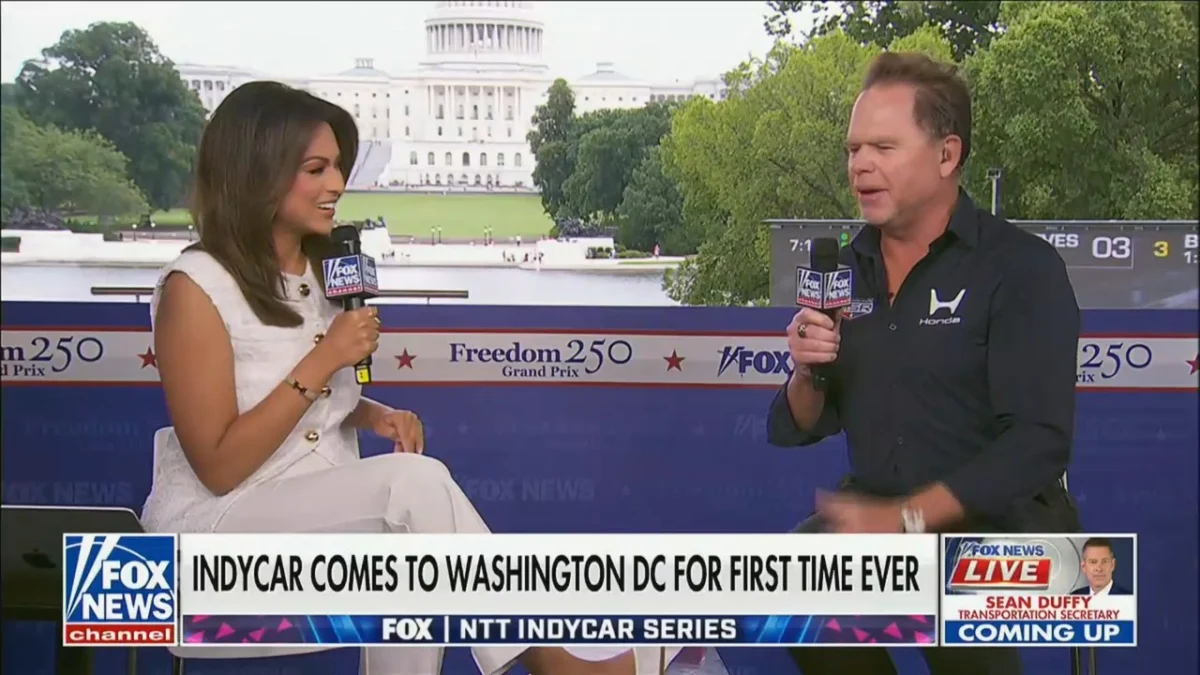
The intersection of high-stakes sports broadcasting and live news reporting reached a literal and figurative crescendo this past Saturday as Fox News anchor Aishah Hasnie attempted to navigate the sonic challenges of the inaugural IndyCar Freedom 250 Grand Prix qualifying sessions in Washington, D.C. Positioned against the iconic backdrop of the United States Capitol, the broadcast served as a testament to the logistical complexities of hosting a premier open-wheel racing event in the heart of the nation’s capital. As IndyCars roared along a makeshift street circuit that included portions of Pennsylvania Avenue, the sheer volume of the 2.2-liter twin-turbocharged V6 engines frequently overwhelmed the audio equipment, illustrating the raw power of the machinery and the difficulties of field reporting in a high-decibel environment.
The broadcast occurred during a period of significant domestic news, creating a jarring juxtaposition between the celebratory atmosphere of the racetrack and the sobering reality of events elsewhere in the country. Hasnie’s reporting was intermittently drowned out as she attempted to provide updates on the tens of thousands of residents in Indiana who remained without electricity following a series of devastating severe storms. The technical struggle was palpable; at one point, the anchor appeared to gesture for off-camera assistance to manage the encroaching noise and logistical flow before transitioning to a Fox Weather Alert regarding meteorological developments in the Pacific.
Live Reporting Under Extreme Conditions
Field reporting from a live sporting event requires a delicate balance of situational awareness and technical coordination. For Hasnie, the challenge was twofold: maintaining a professional delivery of hard news while being physically situated just yards away from vehicles capable of reaching speeds in excess of 180 miles per hour on straightaways. The acoustic environment of a street circuit, where sound reflects off government buildings and asphalt, creates a unique "canyon effect" that can render standard microphone setups inadequate.
During the broadcast, Senior Fox News correspondent Robert Ray joined the segment from a separate location to provide updates on Tropical Storm Moke. Ray noted the intensity of the environment surrounding Hasnie, remarking on the "beautiful and loud" atmosphere in the District. Ray’s report focused on the impending threat to the Hawaiian Islands, specifically near Hilo, where the tropical system was projected to deposit up to a foot of rain. The handoff between the two journalists highlighted the diverse range of the network’s coverage, swinging from the mechanical roar of a D.C. street race to the life-safety concerns of a Pacific weather system.
The Inaugural Freedom 250 Grand Prix: A Historical Context
The Freedom 250 Grand Prix represents a significant milestone for IndyCar and the city of Washington, D.C. Historically, street races in the United States have been staples in cities like Long Beach, Detroit, and St. Petersburg, but securing a permit for a race through the federal core of the capital has long been considered a "holy grail" for racing promoters. The event was made possible through a complex coordination between the District government, the National Park Service, and various federal security agencies.
The presence of Meyer Shank Racing (MSR) team owner Mike Shank during the broadcast added a layer of sporting prestige to the segment. Shank, whose team achieved a historic victory at the 105th Running of the Indianapolis 500 earlier in the year, spoke to the significance of the D.C. event. He emphasized the "spectacular" nature of the backdrop, noting that the race was being held on a stage unlike any other in the world. Despite the noise levels that made the interview difficult to conduct, Shank’s enthusiasm for the venue was clear. He credited the realization of the event to the persistence of industry leaders, specifically citing Roger Penske, the owner of the IndyCar Series and the Indianapolis Motor Speedway, for his role in navigating the political and logistical hurdles required to bring racing to Pennsylvania Avenue.
Political and Economic Implications of Urban Racing
The decision to host an IndyCar event in Washington, D.C., carries weight beyond the realm of sports. According to the dialogue captured during the broadcast, the event received high-level political endorsement, with Hasnie noting that the President of the United States had expressed a specific preference for IndyCar over other racing leagues such as NASCAR or Formula 1. This preference underscores the "All-American" branding that IndyCar has cultivated, particularly with its ties to the Midwest and the historic Indianapolis 500.
From an economic perspective, the Freedom 250 Grand Prix aims to boost local tourism and showcase the District as a versatile venue for international events. Shank noted that the event featured a "full house," with many spectators attending for free, thereby increasing the sport’s visibility to a demographic that might not typically travel to traditional permanent road courses. The "eyeballs" on the sport, as Shank phrased it, represent a crucial metric for sponsors who are looking for high-impact visual placements in major media markets.
Technical Analysis of the Broadcast Challenges
The difficulty Hasnie experienced in being heard is a common issue in "run-and-gun" field reporting at motor racing events. An IndyCar engine at full throttle can produce sound levels exceeding 100 decibels. For context, the Occupational Safety and Health Administration (OSHA) notes that exposure to 100 decibels can cause hearing damage after just 15 minutes. While broadcast microphones often use "noise-canceling" or "cardioid" patterns to prioritize the speaker’s voice, the sheer atmospheric pressure of several cars passing simultaneously can "clip" the audio signal, leading to the unintelligible segments noted during Shank’s interview.
Hasnie’s lighthearted suggestion for Shank to "hold the mic a little bit closer" was a pragmatic response to a situation where the ambient noise floor was nearly equal to the volume of the human voice. This moment of levity served to acknowledge the absurdity of the situation—trying to conduct a professional interview while the equivalent of a jet engine thunders past in the background.
Chronology of the Coverage
The sequence of the Saturday broadcast provided a snapshot of the day’s priorities:
- Opening Sequence: Hasnie attempts to report on the Indiana power outages (affecting roughly 50,000 residents) as the qualifying sessions begin.
- Weather Transition: A brief struggle with the live feed and background coordination leads to a transition to Robert Ray.
- Meteorological Update: Ray provides data on Tropical Storm Moke, emphasizing the flood risk for Hawaii.
- The Shank Interview: Mike Shank joins the set to discuss the Meyer Shank Racing team’s strategy and the significance of the D.C. venue.
- The Audio Climax: As cars pass the Capitol, the audio becomes increasingly difficult to parse, leading to the conclusion of the segment.
The Role of Roger Penske and the Future of IndyCar
The mention of Roger Penske is vital to understanding the current trajectory of the IndyCar Series. Since acquiring the series in 2020, Penske has focused on elevating the brand’s prestige and expanding its footprint into major metropolitan areas. The Freedom 250 Grand Prix is a direct result of this "Penske Era" strategy, which seeks to compete with the rising popularity of Formula 1 in the United States by offering a more accessible, domestic alternative that still carries the glamour of urban racing.
Shank’s comment that "it took a guy like him to make it happen" refers to Penske’s reputation for meticulous planning and his deep connections within both the corporate and political spheres. The success of the D.C. event—measured by attendance and the ability to operate a safe race in a high-security zone—will likely determine if the Freedom 250 becomes a permanent fixture on the IndyCar calendar.
Conclusion and Broader Impact
The Fox News segment, while hampered by the realities of live sound, successfully captured the energy of an event that blends American political symbolism with high-velocity sport. The challenges faced by Aishah Hasnie are indicative of the broader hurdles inherent in bringing "the greatest spectacle in racing" to the streets of a major city. While the noise may have drowned out some of the specific dialogue, the visual of IndyCars racing past the Capitol dome sent a clear message about the sport’s ambitions.
As the Meyer Shank Racing team and others look toward the final race results, the media coverage of the qualifying sessions serves as a reminder of the logistical "heavy lifting" required to merge the worlds of news, weather, and professional sports. The Freedom 250 Grand Prix has set a precedent for urban racing in the U.S., proving that even in the most regulated and quiet-conscious city in the country, the roar of the engines can still find a home—even if it makes the local news a little harder to hear.

 Yuyun Lusiyani
 Joko Widodo
 Pevita Pearce
 admin
admin
