
 Jia Lissa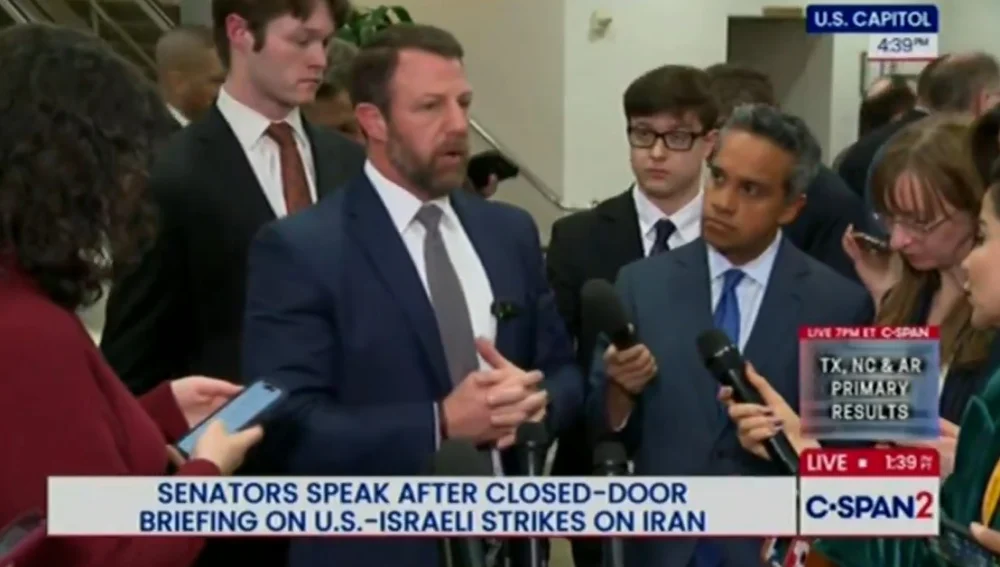
The semantic boundaries of American foreign policy were thrust into the spotlight on Tuesday as Senator Markwayne Mullin (R-OK) engaged in a pointed exchange with reporters on Capitol Hill regarding the Trump administration’s intensifying military operations against Iran. During a press availability, Mullin initially characterized the ongoing hostilities as a "war," only to quickly pivot and walk back the statement when pressed on the legal and constitutional implications of such a designation. The exchange highlights a growing tension within the federal government between the rhetorical description of high-intensity conflict and the formal, legal declarations required by the United States Constitution and the War Powers Resolution of 1973.
The interaction began when reporters questioned the Senator about the long-term objectives of the current military campaign and whether the United States was actively seeking to preserve alternative leadership structures within the Islamic Republic. Mullin’s response was blunt: "This is war, and we’re taking out the threat. And if you’re part of the threat, then you’re a target. What we call not all the arrows, but going after the archers." This characterization—specifically the use of the word "war"—immediately drew scrutiny from the press corps, led by CNN’s Chief Congressional Correspondent Manu Raju.
The Semantic Pivot and the Definition of Hostilities
As the exchange continued, Raju pressed Mullin on whether his statement constituted a formal concession that the United States is currently at war. Mullin attempted to distance his remarks from a legal declaration, stating, "We haven’t declared war. They declared war on us, but we haven’t." When reminded that both President Trump and Secretary of Defense Pete Hegseth had utilized similar terminology in recent days, Mullin maintained a defensive posture, repeatedly asserting that no formal declaration had been issued by Congress.
The confrontation reached a climax when a second reporter pointed out that Mullin had explicitly said "This is war" just moments prior. Mullin responded by calling the remark a "misspoke," though he immediately followed up by reiterating the severity of the situation. "But I was saying that they’ve declared war on us. But war is ugly. It always has been ugly. But we’re, you know, we’ve taken out a regime that’s been trying to attack us for quite some time," Mullin stated.
The Senator’s insistence that the U.S. is "simply fighting the threat that’s been at our door for 47 years" reflects the administration’s broader narrative: that current military actions are a delayed but necessary defensive response rather than an unprovoked offensive war. This distinction is critical for the executive branch, as it allows the administration to bypass certain congressional oversight mechanisms that would be triggered by a formal declaration of war.
Constitutional and Legal Frameworks of Modern Conflict
The debate over Mullin’s terminology is rooted in Article I, Section 8 of the U.S. Constitution, which grants Congress the sole power to declare war. However, Article II identifies the President as the Commander in Chief of the armed forces, a role that has historically been interpreted by various administrations to allow for limited military engagements without a formal declaration.
Since the end of World War II, the United States has not officially "declared war" on any nation. Instead, conflicts ranging from the Vietnam War to the Global War on Terror have been conducted under "Authorizations for Use of Military Force" (AUMF) or by citing the President’s inherent constitutional authority to defend the nation from imminent threats.
The War Powers Resolution of 1973 was designed to check the President’s power to commit the U.S. to an armed conflict without the consent of Congress. Under the resolution, the President must notify Congress within 48 hours of committing armed forces to military action and forbids armed forces from remaining for more than 60 days, with a further 30-day withdrawal period, without a congressional authorization or a declaration of war. By avoiding the word "war," officials like Mullin seek to maintain the administration’s flexibility to conduct operations under the umbrella of "counter-terrorism" or "national defense" rather than full-scale state-to-state warfare.
The "Archers vs. Arrows" Strategy: A Tactical Shift
Mullin’s metaphor of "going after the archers" rather than the "arrows" provides insight into the Trump administration’s current military doctrine regarding Iran. In military parlance, "arrows" represent the proxy groups, such as Hezbollah in Lebanon, the Houthis in Yemen, or various militias in Iraq and Syria, that Iran has historically used to exert influence and conduct asymmetric warfare. The "archers" represent the Iranian leadership, the Islamic Revolutionary Guard Corps (IRGC), and the command-and-control infrastructure within Iran itself.
This strategy suggests a move away from the "maximum pressure" campaign of the first Trump term, which relied heavily on economic sanctions, toward a more kinetic approach targeting high-value assets within Iranian territory. Data from recent months indicates a significant uptick in precision strikes against Iranian drone manufacturing sites, ballistic missile facilities, and naval assets in the Persian Gulf.
According to analysts at the Center for Strategic and International Studies (CSIS), the shift to targeting the "archers" carries significant risks of escalation. While it may degrade Iran’s ability to project power in the short term, it also removes the "plausible deniability" that previously allowed both nations to avoid a direct, total conflict.
Timeline of Escalation: 1979 to the Present
To understand the context of Senator Mullin’s "47 years" comment, one must look at the timeline of U.S.-Iran relations, which have been characterized by cycles of hostility and brief periods of diplomatic outreach:
- 1979: The Iranian Revolution and the subsequent storming of the U.S. Embassy in Tehran, leading to a 444-day hostage crisis.
- 1980s: The "Tanker War" in the Persian Gulf during the Iran-Iraq War, where the U.S. Navy and Iranian forces engaged in direct skirmishes.
- 2015: The signing of the Joint Comprehensive Plan of Action (JCPOA), which temporarily limited Iran’s nuclear program in exchange for sanctions relief.
- 2018: The U.S. withdrawal from the JCPOA under the first Trump administration, initiating the "maximum pressure" campaign.
- 2020: The assassination of IRGC General Qasem Soleimani in a U.S. drone strike, which brought the two nations to the brink of war.
- 2024-2026: A series of regional escalations involving Iranian-backed proxies and direct Iranian missile strikes on U.S.-aligned interests, culminating in the current administration’s intensified military response.
Mullin’s reference to a 47-year threat frames the current operations as the culmination of nearly five decades of unresolved grievances, positioning the U.S. actions as a final resolution to a long-standing security dilemma.
Broader Political and Economic Implications
The rhetoric used by Senator Mullin and other administration officials has profound implications for both domestic politics and global markets. Domestically, the classification of the conflict impacts public opinion. Polling data from the Pew Research Center suggests that while a majority of Americans support "strong measures" to prevent Iran from obtaining a nuclear weapon, support for a "ground war" remains low, hovering around 25-30%. By framing the conflict as something other than "war," the administration may be attempting to sustain public support for high-intensity air and sea operations without triggering the domestic backlash associated with traditional warfare.
Economically, the uncertainty surrounding the definition of the conflict has led to volatility in global energy markets. Iran’s proximity to the Strait of Hormuz—a vital transit point through which approximately 20% of the world’s oil supply passes—means that any sustained military engagement could lead to a significant spike in crude oil prices. Market analysts note that the term "war" often triggers specific insurance clauses in shipping and maritime contracts, potentially raising the cost of global trade even if the conflict remains localized.
Congressional Reactions and Foreign Policy Dissent
The reactions to Mullin’s comments on Capitol Hill were divided along predictable partisan lines. Democratic leaders expressed concern that the administration’s rhetoric is outpacing its legal authority. Senator Chris Murphy (D-CT), a frequent critic of executive overreach in foreign policy, argued that the administration is "playing with fire" by using the language of war while avoiding the constitutional responsibility to consult Congress.
"You cannot have it both ways," Murphy said in a separate statement. "You cannot tell the American people we are ‘at war’ to justify unilateral military action and then tell Congress it isn’t a ‘war’ to avoid following the law. If this is a war, the President needs to come to Congress for an authorization."
Conversely, many of Mullin’s Republican colleagues defended the administration’s posture. Senator Marco Rubio (R-FL) suggested that the media’s focus on the word "war" was a distraction from the reality of Iranian aggression. Rubio emphasized that the U.S. is engaged in "legitimate self-defense" against a regime that has "consistently targeted American service members and allies."
Conclusion: The Semantic Battleground
The exchange between Senator Markwayne Mullin and the press corps serves as a microcosm of the larger debate over the future of American military engagement. As the lines between "counter-terrorism," "limited strikes," and "total war" continue to blur in the 21st century, the language used by policymakers becomes a critical tool for shaping both legal reality and public perception.
While Mullin may have characterized his initial comments as a "misspeak," the incident underscores the difficulty of maintaining a nuanced political narrative in the face of escalating military violence. As the Trump administration continues its operations against the "archers" in Iran, the pressure on both the executive branch and Congress to define the true nature of this conflict will only increase. Whether characterized as a "war," a "military operation," or a "47-year defense," the reality on the ground remains one of significant risk, with the potential to reshape the geopolitical landscape of the Middle East for decades to come.



 Yuyun Lusiyani
 Joko Widodo
 Eva Lovia
 Pevita Pearce
 admin
admin
 Lina Irawan