
 Jia Lissa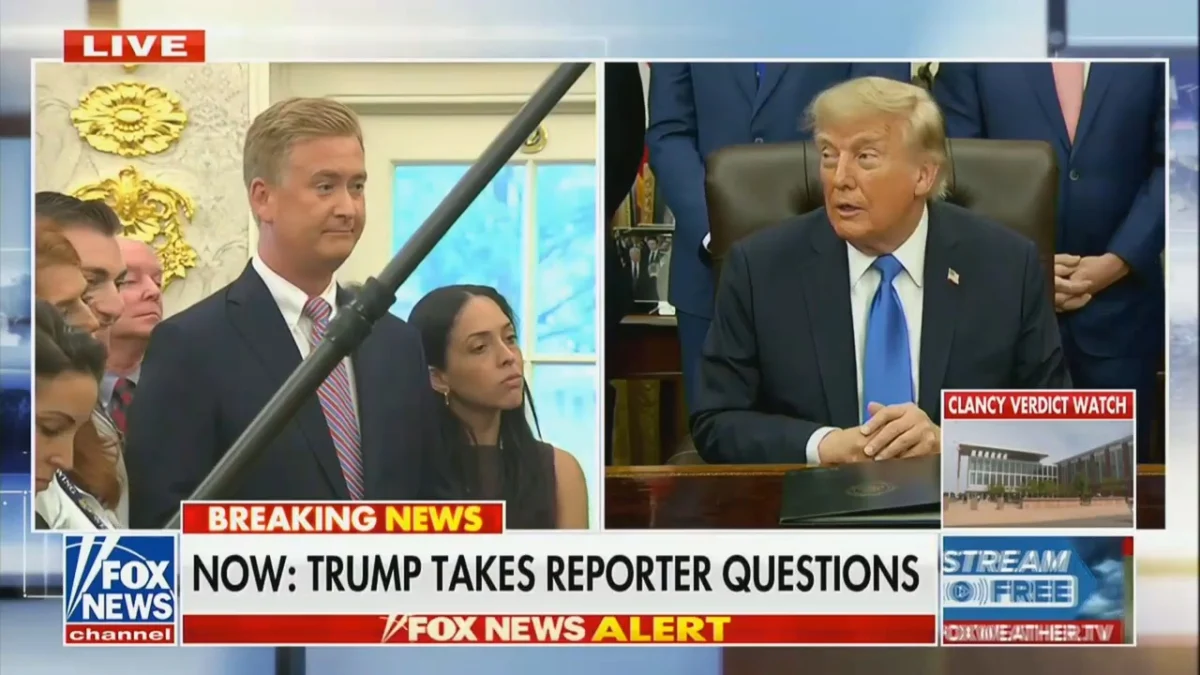
During a formal gathering in the Oval Office on Wednesday, President Donald Trump engaged in a high-stakes dialogue regarding the United States’ posture toward the Islamic Republic of Iran, specifically addressing whether his administration would consider direct intelligence intervention to support domestic uprisings. The exchange was prompted by a social media post authored by the President on Tuesday, in which he questioned the timing of a potential popular revolt against the current Iranian leadership. Fox News’s senior White House correspondent, Peter Doocy, pressed the President on the practical implications of his rhetoric, asking specifically if the administration was prepared to authorize the Central Intelligence Agency (CIA) to arm Iranian citizens.
The President’s response, while stop short of a definitive policy announcement, provided a window into his administration’s assessment of the internal stability of the Iranian regime. Refusing to confirm or deny specific intelligence directives, Trump characterized the situation in Iran as a humanitarian crisis marked by extreme state-sponsored violence. He highlighted the brutal tactics allegedly employed by Iranian security forces to suppress dissent, suggesting that the regime’s reliance on lethal force is a sign of its waning control over the population.
The Oval Office Exchange and the Rhetoric of Intervention
The confrontation began when Peter Doocy cited a post from Trump’s Truth Social platform. In that post, the President had asked, “When are the Iranian people going to rise up and fight?” This query, interpreted by many as an endorsement of regime change or at least a call for internal revolution, led Doocy to ask: “If that’s what you want, will you send the CIA in to arm Iran?”
President Trump’s reply was measured yet descriptive. “Well, I wouldn’t want to say that to you, Peter,” the President remarked, noting that discussing specific covert or intelligence strategies would be inappropriate in a public setting. However, he immediately pivoted to the plight of the Iranian protesters, contrasting their conditions with the "luxury" experienced by observers in the West. Trump claimed that the Iranian government has escalated its use of lethal force, citing figures that suggest a massive loss of life among the civilian population.
The President asserted that as of three months ago, approximately 52,000 protesters had been killed, a number he claimed has since risen to nearly 65,000. He described a tactical environment where the regime utilizes snipers and machine guns to dismantle crowds, specifically noting that snipers are used to target individuals with precision to instill fear and break the momentum of large gatherings.
Contextual Background: The Evolution of U.S.-Iran Tensions
To understand the weight of the President’s comments, one must look at the trajectory of U.S.-Iran relations over the last several years. The Trump administration has consistently pursued a policy of "Maximum Pressure," which began with the 2018 withdrawal from the Joint Comprehensive Plan of Action (JCPOA), also known as the Iran Nuclear Deal. This policy shift was designed to cripple the Iranian economy through a series of escalating sanctions, thereby limiting the regime’s ability to fund regional proxies and its ballistic missile program.
Internal unrest in Iran has become a recurring theme during this period. The most significant wave of protests in recent history followed the death of Mahsa Amini in September 2022, which sparked the "Woman, Life, Freedom" movement. These protests were met with a severe crackdown by the Islamic Revolutionary Guard Corps (IRGC) and the Basij militia. While international human rights organizations have documented hundreds of deaths and thousands of arrests, the figures cited by President Trump in the Oval Office represent a significant escalation over previously reported estimates by non-governmental organizations (NGOs).
Analysis of Reported Casualty Figures and Human Rights Data
The discrepancy between the President’s figures and those provided by international monitors is a point of significant interest. Organizations such as Amnesty International and Iran Human Rights (IHRNGO) have traditionally reported death tolls in the hundreds or low thousands during periods of intense unrest. For example, during the 2019 "Bloody November" protests, Reuters reported that approximately 1,500 people were killed.
President Trump’s citation of 65,000 deaths suggests either access to classified intelligence that significantly exceeds public estimates or a rhetorical emphasis intended to highlight the extreme brutality of the regime. Regardless of the specific numbers, the President’s focus on the use of snipers aligns with various reports from activists on the ground who have documented security forces firing from rooftops into crowds. Trump’s description of the regime "getting weaker and weaker by the day" reflects a long-standing belief within certain wings of the U.S. foreign policy establishment that the Islamic Republic is facing an existential crisis of legitimacy.
A Timeline of Key Events in U.S.-Iran Relations (2018–Present)
The current tension is the result of a multi-year timeline of diplomatic and military maneuvers:
- May 2018: The United States officially withdraws from the JCPOA, re-imposing heavy economic sanctions on Iran’s oil and banking sectors.
- April 2019: The U.S. designates the Islamic Revolutionary Guard Corps (IRGC) as a Foreign Terrorist Organization (FTO), the first time a part of another government was so designated.
- November 2019: Widespread protests erupt in Iran over fuel price hikes; the regime responds with a near-total internet blackout and lethal force.
- January 2020: A U.S. drone strike kills General Qasem Soleimani, head of the IRGC’s Quds Force, in Baghdad, bringing the two nations to the brink of direct conflict.
- September 2022: The death of Mahsa Amini in police custody triggers months of nationwide protests focusing on civil liberties and the mandatory hijab law.
- 2023–2024: Iran increases its regional influence through the "Axis of Resistance," involving conflicts in Gaza, Lebanon, and Yemen, while domestic economic pressure continues to mount.
Strategic Implications of Potential CIA Involvement
The question of whether the United States would arm Iranian dissidents is one of the most sensitive topics in modern geopolitics. History weighs heavily on this discussion, particularly the 1953 coup (Operation Ajax), where the CIA and British intelligence orchestrated the overthrow of Prime Minister Mohammad Mosaddegh. That event remains a cornerstone of the Iranian regime’s anti-American narrative.
If the U.S. were to move toward arming protesters, it would represent a fundamental shift from "Maximum Pressure" to "Regime Change." Such a move carries immense risks:
- Civil War: Arming factions within a country can lead to a prolonged and bloody civil conflict, as seen in Syria or Libya.
- Regime Retaliation: The Iranian government might respond by accelerating its nuclear program or launching asymmetric attacks against U.S. assets and allies in the Middle East.
- Loss of International Support: Many European and Asian allies prefer a diplomatic solution and might view direct military or intelligence support for an insurgency as a violation of international law.
However, proponents of a more aggressive stance argue that the Iranian people are the only force capable of fundamentally changing the regional security architecture. They contend that without external support, the regime’s superior firepower—described by Trump as snipers and machine guns—will always prevail over unarmed civilians.
Inferred Official Responses and Global Reaction
While the Iranian government has not yet issued a formal rebuttal to this specific Oval Office exchange, its historical pattern suggests it will label the President’s comments as "blatant interference" in its internal affairs. Tehran frequently accuses Washington of orchestrating domestic unrest to destabilize the nation.
Domestically, the President’s comments are likely to draw a divided reaction. Critics may argue that discussing CIA involvement in the Oval Office is reckless and provides the Iranian regime with a propaganda victory, allowing them to paint all protesters as foreign agents. Conversely, supporters of the President may view his statements as a necessary moral stand against a tyrannical regime, signaling to the Iranian people that the United States recognizes their struggle and the violence they face.
The intelligence community typically maintains a policy of "neither confirming nor denying" such operations. However, the President’s refusal to rule out arming protesters, combined with his vivid descriptions of regime brutality, suggests that all options remain on the table as the administration navigates the complex landscape of Middle Eastern diplomacy.
The Path Forward for U.S. Policy
As the regime in Tehran continues to grapple with economic stagnation and social dissent, the role of the United States remains a pivotal factor. President Trump’s assertion that the regime is "getting weaker by the day" suggests a policy based on the expectation of eventual collapse or forced reform. Whether that transition is sparked by internal pressure alone or aided by external intelligence support remains the central question of U.S. strategy in the region.
The President concluded his remarks by expressing a grim understanding of why the Iranian people have not yet succeeded in an overthrow, citing the sheer lethality of the opposition they face. "And who can blame them?" Trump asked, acknowledging the fear instilled by state snipers. This acknowledgment of the protesters’ "plight" serves to frame the U.S. position not just as a geopolitical rivalry, but as a struggle between a population seeking change and a government willing to use any means necessary to maintain its grip on power.
As the situation evolves, the international community will be watching closely to see if the President’s rhetorical support for the "rising up" of the Iranian people translates into a more tangible—and potentially covert—form of assistance.

 admin
admin
 Nila Kartika Wati
 Lina Irawan
 Yuyun Lusiyani