Jia Lissa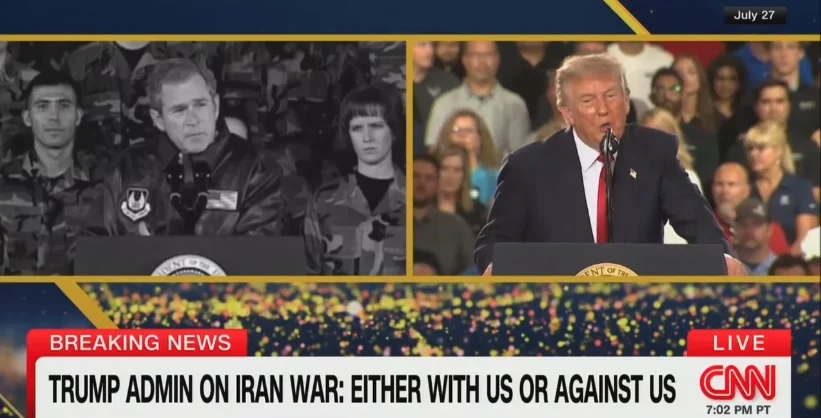
The geopolitical landscape of 2026 has been increasingly defined by the escalating conflict between the United States and the Islamic Republic of Iran, a confrontation that critics and historians are now beginning to compare to the early stages of the Iraq War. On a recent broadcast of CNN NewsNight, host Abby Phillip presented a detailed split-screen montage illustrating what she described as a "brutal" alignment in rhetoric between the administration of President Donald Trump and that of former President George W. Bush. The segment highlighted a series of nearly identical justifications, warnings, and slogans used by both administrations to frame their respective military interventions in the Middle East, raising significant questions about the cyclical nature of American foreign policy and the strategic objectives currently being pursued in the Persian Gulf.
The comparison comes at a precarious moment for the Trump administration. Despite the President’s recent assertions that the primary objectives of the conflict have been met, the reality on the ground suggests a protracted engagement. The CNN report emphasized that the language of "regime change" and "preemptive security" has returned to the forefront of the American political lexicon, mirroring the atmosphere of 2002 and 2003. As the U.S. military continues to exchange fire with Iranian forces, the domestic debate over the necessity and the endgame of the war has intensified, fueled by the striking similarities in how these conflicts were sold to the American public.
The Chronology of Escalation: From Intelligence Briefings to Active Combat
The current conflict did not emerge in a vacuum but followed a specific timeline of diplomatic pressure and intelligence assertions. According to reports cited by the New York Times and discussed on CNN, the catalyst for the military campaign was a high-level presentation delivered by Israeli Prime Minister Benjamin Netanyahu on February 12, 2026. During this meeting in the White House Situation Room, Netanyahu reportedly provided U.S. officials with intelligence dossiers claiming that the Iranian government was "ripe for regime change" and that the civilian population was prepared to support a transition of power if given external military backing.
Following this intelligence briefing and subsequent lobbying from the Israeli government, President Trump officially launched military operations on February 28, 2026. The initial phase of the war was characterized by rapid surgical strikes and a declaration of overwhelming superiority. However, by late August, the conflict had transitioned into a series of escalatory exchanges. On August 30, 2026, reports surfaced of direct fire between U.S. and Iranian assets in the Strait of Hormuz, a critical maritime chokepoint for global oil supplies. While the U.S. targeted Iranian military infrastructure, Iranian-backed forces responded by targeting U.S. assets in the region, leading to a volatile stalemate that contradicts earlier administration claims of a swift conclusion.
Rhetorical Mirroring: The Bush and Trump Doctrines
The core of the CNN NewsNight analysis was the linguistic bridge between the 43rd and 45/47th presidents. Host Abby Phillip noted that the escalation in the Middle East runs directly counter to President Trump’s public declarations of victory. Specifically, Trump’s use of the phrase "mission accomplished" has drawn immediate and unfavorable comparisons to George W. Bush’s infamous May 2003 speech aboard the USS Abraham Lincoln. While Bush used the phrase to signal the end of major combat operations in Iraq—only for the country to descend into a years-long insurgency—Trump’s use of the term comes amidst ongoing strikes and counter-strikes.
The CNN montage provided several specific examples of this rhetorical overlap:
1. The Proliferation of Weapons of Mass Destruction
In 2002, President Bush famously stated, "The United States of America will not permit the world’s most dangerous regimes to threaten us with the world’s most destructive weapons." This was the foundational argument for the invasion of Iraq, predicated on the belief that Saddam Hussein possessed WMDs—a claim later proven to be incorrect. In 2026, President Trump used a nearly identical justification for the Iran campaign, stating, "When somebody comes up and says, ‘Why are we doing this?’ Just say, ‘Because we cannot let them have a nuclear weapon.’ It’s very simple."
2. Characterizing the Regime as an Aggressor
Both presidents framed their targets not just as threats to the U.S., but as regional bullies. Bush spoke of the "treacherous history" of the Iraqi regime and its wars against its neighbors. Similarly, Trump remarked in 2026, "They did something which was very foolish, very stupid, I would say. They attacked their neighbors." This framing serves to moralize the conflict, positioning the U.S. as a necessary stabilizer in a volatile region.
3. State Sponsorship of Terrorism
The designation of "state sponsor of terror" has been a consistent pillar of U.S. Middle East policy. Bush’s 2002 goals included preventing "regimes that sponsor terror from threatening America, or our friends and allies." Trump’s 2026 rhetoric echoed this precisely: "Iran, number one state sponsor of terror. They send their money all over the world to create problems."
4. The "With Us or Against Us" Ultimatum
Perhaps the most striking parallel is the return of the binary foreign policy ultimatum. In 2001, Bush declared, "You’re either with us or you’re against us in the fight against terror." In 2026, this doctrine was revived by top Trump administration officials. Treasury Secretary Scott Bessent stated, "And we are telling people either you are with us or against us." This sentiment was reinforced by UN Ambassador Mike Waltz, who warned, "You’re either against us or you’re with us, and you don’t want to be siding with Iran right now."
The Role of Benjamin Netanyahu and Intelligence Claims
A recurring figure in both the 2003 and 2026 narratives is Israeli Prime Minister Benjamin Netanyahu. The CNN report reminded viewers that in 2002, Netanyahu testified before the U.S. Congress, strongly urging an invasion of Iraq and claiming it would have "enormous positive reverberations" for the region. History has viewed that testimony with scrutiny, as the post-invasion reality in Iraq led to significant regional instability and the rise of extremist groups like ISIS.
In 2026, Netanyahu’s role has been equally central. His February presentation to the White House was the tipping point for the Trump administration’s decision to move toward active conflict. The "regime change" narrative—the idea that the Iranian people are waiting for a spark to overthrow the Ayatollahs—has been a cornerstone of the Prime Minister’s lobbying efforts. However, this assessment has faced internal pushback from some sectors of the U.S. intelligence community, who warn that external military intervention often galvanizes nationalistic support for existing regimes rather than triggering their collapse.
Domestic Frustration and the "Rise Up" Narrative
The disconnect between administration expectations and the reality of the conflict was highlighted by a recent social media post from President Trump. On Tuesday, a visibly frustrated President took to Truth Social to question why Iranian civilians have not yet revolted against their government. He asked why the population was not "rising up" to help him win the war, a sentiment that suggests the administration may have overestimated the immediate internal appetite for a Western-led revolution.
This frustration mirrors the difficulties faced by the Bush administration in 2003, where the expectation of being "greeted as liberators" was quickly replaced by the reality of a complex sectarian and nationalist resistance. Analysts suggest that the "regime change" model often fails to account for the deep-seated complexities of Iranian civil society and the historical memory of previous foreign interventions in the country’s internal affairs.
Economic and Strategic Implications
The ongoing conflict in 2026 carries heavy economic stakes, particularly concerning the Strait of Hormuz. As one of the world’s most vital energy transit points, any disruption in the Strait has immediate effects on global oil prices and supply chains. The exchange of fire reported by CNBC and highlighted by Abby Phillip indicates that the "Mission Accomplished" phase of the war has not yet secured these critical waterways.
Supporting data suggests that global markets have reacted with volatility to the news of U.S. and Iranian strikes. Economists warn that a prolonged conflict could lead to a significant increase in energy costs, potentially impacting the domestic U.S. economy and complicating the administration’s broader economic agenda. Furthermore, the "with us or against us" stance adopted by Secretary Bessent and Ambassador Waltz has put significant diplomatic pressure on U.S. allies in Europe and Asia, many of whom are wary of being drawn into another protracted Middle Eastern conflict.
Analysis of Global and Official Responses
While the administration maintains a unified front, the international response has been mixed. Traditional allies have expressed concern over the "preemptive" nature of the strikes, while regional adversaries have used the "Mission Accomplished" rhetoric to paint the U.S. as an unreliable actor. In Washington, the split-screen comparison aired by CNN has provided fuel for congressional critics who argue that the lessons of the Iraq War have been ignored.
Official responses from the White House have dismissed the CNN montage as "media bias," asserting that the threats posed by Iran in 2026 are distinct from those posed by Iraq in 2003. Administration officials argue that Iran’s nuclear program and its network of regional proxies constitute an existential threat that requires a different, more aggressive posture than the diplomacy-first approach of previous years.
Conclusion: The Weight of Historical Precedent
The 2026 Iran conflict serves as a case study in the power of political rhetoric and the enduring influence of established foreign policy doctrines. By aligning the language of the current administration with that of the Bush era, media outlets like CNN are highlighting a perceived pattern of interventionism that has historically led to unforeseen consequences.
As the war enters its next phase, the question remains whether the Trump administration can avoid the pitfalls that characterized the Iraq War. The "Mission Accomplished" declaration, the reliance on third-party intelligence for regime change, and the binary "with us or against us" ultimatums are all elements that have been seen before. Whether they will yield a different result in the 2020s than they did in the 2000s is a matter of intense debate among policymakers, military strategists, and the American public. For now, the echoes of 2003 continue to resonate through the corridors of power in 2026, serving as both a template for action and a cautionary tale of the complexities inherent in Middle Eastern intervention.


 admin
admin
 Lina Irawan
 Yuyun Lusiyani
 Nana Wu
 Joko Widodo