
 Nana Wu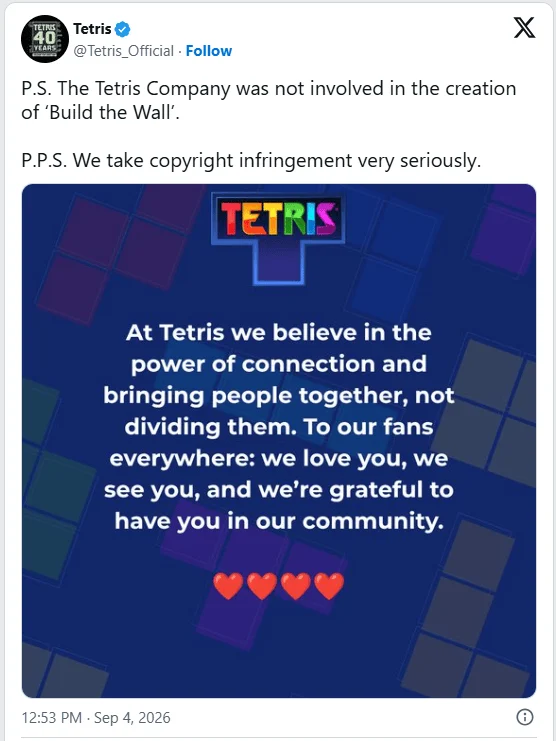
The Trump administration’s engagement with video game culture has once again drawn scrutiny, this time with the controversial debut and subsequent removal of a Tetris clone titled "Build the Wall" from the official White House website. This interactive game, designed to simulate border defense by stacking blocks, drew immediate criticism for its thinly veiled political messaging and its use of intellectual property without authorization. The incident highlights a recurring pattern of the administration leveraging popular culture for political ends, often with questionable taste and legal implications.
The Genesis of "Build the Wall"
The "Build the Wall" game was first noticed on the White House website in late September 2026. It presented a gameplay mechanic familiar to millions: players were tasked with stopping an incoming "zombie border siege" by stacking Tetris-style blocks to create a barrier. However, the game deviated significantly from the traditional Tetris experience. Unlike its well-known predecessor, where completed lines of blocks disappear, in "Build the Wall," blocks remained, accumulating to form an increasingly impassable structure. This alteration transformed the game from a puzzle into a simplistic propaganda tool, visually representing the administration’s signature policy of constructing a wall along the U.S.-Mexico border.
The game’s narrative framed the incoming pixelated figures as "zombies" and the gameplay as an effort to "hold the line" against them. This dehumanizing language immediately drew parallels to tropes prevalent in popular zombie fiction, where the narrative often justifies extreme violence against the undead by asserting their loss of humanity. Quotes from popular zombie media, such as "They aren’t people, Rick. They’re just bodies" from The Walking Dead and "They’re not human. Look at them. They’re just… meat" from Shaun of the Dead, encapsulate this common thematic element. The implication within these fictional narratives is that the lack of human consciousness and empathy in zombies negates any moral qualms about their extermination.
Political Messaging and Dehumanization
Critics argued that the Trump administration’s adoption of this "zombie" metaphor in the context of immigration policy was deeply problematic and overtly racist. Amerika Garcia Grewal, co-director of the Texas-based migrant rights group Frontera Federation, stated that the creators of the game "have lost touch with what it means to be human and care for others." This sentiment underscores the ethical concerns surrounding the use of such dehumanizing language to describe individuals seeking refuge or a better life.
The game’s mechanics, while designed to create an impassable barrier, also led to an ironic outcome. As the blocks piled up, the game inevitably concluded with a "Border Breached" message, a testament to the futility of the depicted strategy. This unintended consequence further fueled criticism, suggesting a fundamental misunderstanding or misrepresentation of the complex realities of border migration.
A Pattern of Pop Culture Appropriation
The "Build the Wall" game was not an isolated incident but rather a continuation of a broader trend by the Trump administration to incorporate elements of popular culture and video games into its political messaging. During his campaigns and his time in office, Donald Trump and his team frequently utilized video game imagery and online memes without explicit permission. These instances included:

- Promoting "MAHA Nonsense": References to video game aesthetics were used in promotional materials, sometimes for purposes that appeared to be disconnected from policy or governance.
- "Shitposting" and Immigration Activity: Online tactics, often associated with internet meme culture and aggressive online commentary, were employed in discussions surrounding immigration policies. This included the use of imagery that evoked video game franchises, such as Halo, to illustrate or promote the administration’s immigration enforcement activities.
- Touting War "Body Counts": In some instances, video game footage was utilized in contexts that appeared to celebrate military actions or "body counts" in conflicts, a move that drew criticism for its perceived insensitivity and glorification of violence.
These instances suggest a strategic, albeit often crude, effort to connect with younger demographics or to frame complex political issues through easily digestible, visually striking, and often provocative imagery borrowed from the digital realm. The appropriation of intellectual property in these cases has frequently led to disputes with game developers and rights holders.
The Tetris Company’s Response and Copyright Implications
The swift removal of "Build the Wall" from the White House website was not a result of the administration’s sudden realization of the game’s ethical shortcomings. Instead, it was a direct consequence of legal pressure from The Tetris Company. In a statement released on Friday, September 24, 2026, a spokesperson for The Tetris Company confirmed that the company was "reviewing the matter." Crucially, they stated that they "was not involved in the creation of ‘Build the Wall’ and did not authorize or license the Tetris brand or intellectual property for the game."
The company reiterated its stance on social media, emphasizing its core values: "We believe in the power of connection and bringing people together, not dividing them." This statement directly contrasted with the divisive and exclusionary message embedded in the White House’s game.
The Tetris Company has a well-documented history of rigorously protecting its intellectual property rights. Government lawyers, privy to such information, would have been aware of the potential legal ramifications of unauthorized use. While the article’s author expresses reservations about the broad enforcement of copyright law, they acknowledge the Tetris Company’s understandable desire to distance itself from a project perceived as "disgusting" and politically charged. The administration’s reliance on copyrighted material without authorization has been a recurring issue, raising questions about due diligence and respect for intellectual property in government operations.
Broader Implications and Analysis
The "Build the Wall" game incident serves as a microcosm of several critical issues:
- The Weaponization of Popular Culture: The administration’s repeated use of video game imagery and online culture for political messaging demonstrates a strategy of leveraging familiar and engaging formats to convey often controversial policies. This can be effective in capturing attention but also risks trivializing complex issues and promoting harmful stereotypes.
- Dehumanization in Political Discourse: The comparison of immigrants to "zombies" is a stark example of how political rhetoric can dehumanize entire groups of people. This tactic has historically been employed to erode empathy and justify discriminatory policies. The framing of immigrants as a threat, an "other" to be repelled, echoes dangerous historical patterns.
- The Role of Copyright Law: The intervention of The Tetris Company highlights the legal safeguards in place to protect creative works. While the article refrains from outright celebrating copyright enforcement, it recognizes the company’s right to control its brand and prevent its association with politically charged and potentially offensive content. The incident also implicitly questions the judgment of government officials who would risk legal challenges by appropriating intellectual property.
- A Lack of Seriousness and Empathy: The author suggests that the removal of the game was likely driven by legal concerns rather than a moral awakening. This points to a broader criticism of the administration as being "deeply unserious, racist, and troubled," lacking the empathy required to govern responsibly. The core argument that immigrants, regardless of their legal status, are human beings deserving of respect underscores a fundamental ethical imperative that the game and its creators, according to critics, failed to uphold.
Conclusion: The Enduring Need for Humanity
The episode surrounding the "Build the Wall" game underscores a disturbing trend of employing dehumanizing metaphors and appropriating popular culture in political discourse. The game’s temporary presence on the White House website, and its subsequent removal due to copyright infringement, serves as a potent reminder of the ethical and legal boundaries that should govern public communication. Ultimately, the article concludes with a fundamental plea: immigrants are not zombies, and they are not a threat to be eliminated through pixelated barriers. They are people, and this basic truth, the author argues, should not require constant reiteration in the public square. The incident leaves lingering questions about the administration’s approach to public messaging, its respect for intellectual property, and its fundamental understanding of human dignity.




 Jia Lissa
 Yuyun Lusiyani
 Joko Widodo
 Eva Lovia

 Pevita Pearce