
 Jia Lissa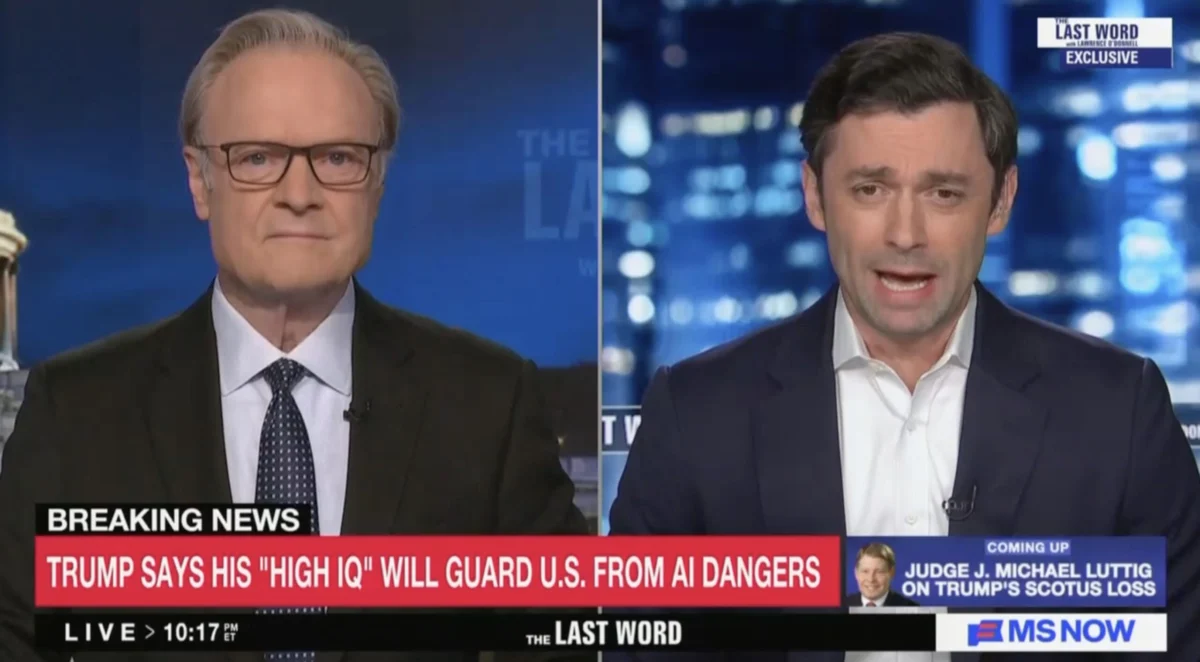
United States Senator Jon Ossoff (D-GA) has issued a sharp critique of President Donald Trump’s approach to artificial intelligence regulation, alleging that the president’s refusal to acknowledge the technology’s existential risks is rooted in the financial interests of his family. During a recent appearance on MSNBC’s "The Last Word," Ossoff claimed that the president is "compromised" due to his son Donald Trump Jr.’s involvement with a venture capital firm heavily invested in the AI industry. The senator’s comments come amid a widening rift between policymakers who advocate for stringent safety guardrails and a burgeoning "accelerationist" movement that views regulation as a threat to American technological dominance.
The controversy highlights a growing tension in Washington as AI capabilities advance at a rate that many experts believe outpaces the government’s ability to provide oversight. While researchers and some industry leaders have warned of catastrophic outcomes—ranging from the democratization of biological weapons to the loss of human control over autonomous systems—President Trump has dismissed these concerns as a "hoax." Ossoff’s accusations suggest that this dismissal is not merely a matter of policy preference but is potentially influenced by the private equity activities of the Trump family.
The Allegation of Financial Conflict
The crux of Senator Ossoff’s argument rests on the activities of 1789 Capital, a venture capital firm where Donald Trump Jr. serves as a partner. According to the firm’s website and public filings, 1789 Capital focuses on investing in the "parallel economy," often targeting companies that align with conservative values or operate outside the traditional Silicon Valley ecosystem. However, the firm has also moved aggressively into the high-stakes world of AI infrastructure and development.
Among 1789 Capital’s notable investments is Cerebras Systems, a high-profile chipmaker that competes directly with Nvidia. Cerebras specializes in massive "wafer-scale" processors designed specifically to train the world’s largest AI models. The firm has also backed Reflection AI and various data center initiatives essential for the computational power required by frontier AI.
"The First Family has a financial stake in this industry, and as a result, the president of the United States is compromised," Ossoff stated during his interview with host Lawrence O’Donnell. He argued that the administration’s hands-off approach to AI safety serves to protect the valuations of these private investments rather than the security of the American public. By labeling AI risks as a "hoax," Ossoff contends that the president is providing political cover for a lack of oversight that benefits his family’s business associates.
A Divergence in Risk Assessment
The senator’s alarm is echoed by a growing number of scientists within the AI field. Recently, a researcher from Anthropic, a leading AI safety and research company, resigned while issuing a public warning that advanced AI could pose a lethal threat to humanity within a decade. This sentiment is not isolated; industry pioneers such as Dario Amodei and Jack Clark, co-founders of Anthropic, have testified before Congress regarding the need for "guardrails" to prevent the technology from being misused.
In contrast, President Trump has utilized his social media platform, Truth Social, to frame the debate as a partisan or sensationalist fabrication. On Monday, following a series of posts regarding various policy issues, the president wrote: "AI taking over the World, destroying Humanity, and all other things bad, is a HOAX." This rhetoric aligns with a segment of the tech industry that believes over-regulation will allow adversaries, particularly China, to overtake the United States in the global AI race.
Ossoff, however, maintains that the risks are grounded in tangible national security concerns. He specifically pointed to the potential for AI to be used in the development of biological weapons. "We need to be fortifying the nation against bioterrorism—one of the most significant potential threats associated with this technology," Ossoff said. He called for a regulatory framework that includes mandatory inspections of "Frontier Labs"—the facilities where the most powerful AI models are developed—and required testimony from CEOs to ensure transparency.
The Chronology of the AI Safety Debate
The current political clash follows a series of rapid developments in the AI sector over the past 24 months. Following the public release of ChatGPT in late 2022, the federal government scrambled to establish a policy framework.
- October 2023: The Biden-Harris administration issued a landmark Executive Order on the Safe, Secure, and Trustworthy Development and Use of Artificial Intelligence. This order required developers of the most powerful AI systems to share their safety test results with the government.
- Early 2024: Several high-profile AI researchers began defecting from major labs, citing "safety-last" cultures driven by commercial competition.
- Mid-2024: President Trump and his allies began signaling a desire to repeal or significantly roll back the Biden-era Executive Order, arguing it stifles innovation and imposes "woke" biases on AI models.
- Late 2024: Donald Trump Jr.’s role at 1789 Capital became more prominent as the firm secured major stakes in AI hardware companies, coinciding with the president’s increasingly vocal dismissal of AI safety concerns.
- Sunday, Athens, GA: Senator Ossoff delivered a campaign speech highlighting the intersection of AI risk and the Trump family’s financial interests, setting the stage for his national television appearance on Monday.
Supporting Data: The Scale of the AI Industry
To understand the magnitude of the alleged conflict, one must look at the capital flowing into the AI sector. The market for AI chips alone is projected to reach over $200 billion by 2027. Companies like Cerebras Systems, which 1789 Capital has supported, are central to this growth. Cerebras recently filed for an initial public offering (IPO), seeking to capitalize on the insatiable demand for AI compute.
Furthermore, the "Frontier Models" that Ossoff references—models that cost upwards of $100 million to train—are becoming increasingly dual-use. A 2023 study by the RAND Corporation found that while current large language models have some safeguards, they can significantly assist non-experts in planning a biological attack by providing detailed instructions on sourcing and cultivating pathogens. It is these specific data points that fuel the calls for "inspectors in the labs," a concept Ossoff compares to the oversight of nuclear facilities.
Industry and Political Reactions
The reaction to Ossoff’s "compromised" charge has been divided along predictable ideological lines. Supporters of the president argue that the senator is engaging in a "smear campaign" to distract from the administration’s pro-growth agenda. They contend that Donald Trump Jr. is a private citizen entitled to engage in lawful business activities and that his investments do not dictate national policy.
Conversely, ethics watchdogs have raised concerns about the appearance of impropriety. The non-partisan group Citizens for Responsibility and Ethics in Washington (CREW) has previously noted that the Trump family’s continued involvement in global business creates a "constant stream of conflicts of interest."
Within the tech industry, the "accelerationist" wing—led by figures like Marc Andreessen—argues that any pause or heavy regulation of AI is a "death move" for Western civilization. They believe that the existential risks are speculative and that the primary goal should be the rapid deployment of AI to solve problems in medicine, energy, and governance. Ossoff’s call for "inspectors" is seen by this group as an unprecedented government intrusion into private enterprise.
Broader Impact and National Security Implications
The debate between Ossoff and Trump represents two fundamentally different philosophies regarding the role of the state in managing transformative technology. Ossoff’s perspective is rooted in the "Precautionary Principle," which suggests that if an action or policy has a suspected risk of causing severe harm to the public, the burden of proof that it is not harmful falls on those taking that action.
"You invoked the legacy of nuclear weapons," Ossoff told O’Donnell, referencing the historical precedent of managing existential threats. "It’s not by skill, but rather by luck that for the last 80 years, we’ve avoided a nuclear exchange between two powers."
The senator’s insistence on "wise and capable leadership" suggests that he views AI not as a standard commercial product, but as a dual-use technology with the potential to destabilize global security. If AI is indeed capable of assisting in the creation of bioweapons or conducting autonomous cyber warfare, the lack of a federal regulatory body could leave the United States vulnerable.
The political implications for Ossoff are also significant. As he runs for reelection in Georgia—a state that has become a hub for both technology and political debate—his stance on AI safety allows him to frame himself as a protector of national security against a backdrop of alleged executive corruption.
Conclusion: The Path Forward for AI Governance
As the 2024-2025 political cycle progresses, the tension between the "AI is a hoax" narrative and the "AI is an existential threat" warning is likely to intensify. The allegations regarding 1789 Capital and the Trump family add a layer of personal and financial scrutiny to what was already a complex policy debate.
For the American public, the stakes involve more than just political rhetoric. The decisions made in Washington over the next few years will determine whether the United States adopts a "move fast and break things" approach to artificial intelligence or implements a rigorous, safety-first regulatory regime. Senator Ossoff’s demand for CEO testimony and laboratory inspections represents an attempt to force a public accounting of the risks, while President Trump’s "hoax" label signals a move toward total deregulation.
Whether the president is truly "compromised" by family business interests or simply holds a different philosophical view on technological progress remains a subject of intense debate. However, as AI continues its rapid ascent, the intersection of private profit and public safety will remain one of the most critical challenges facing the United States government.




 Pevita Pearce
 admin
admin
 Lina Irawan
 Yuyun Lusiyani
 Joko Widodo