
 Pevita Pearce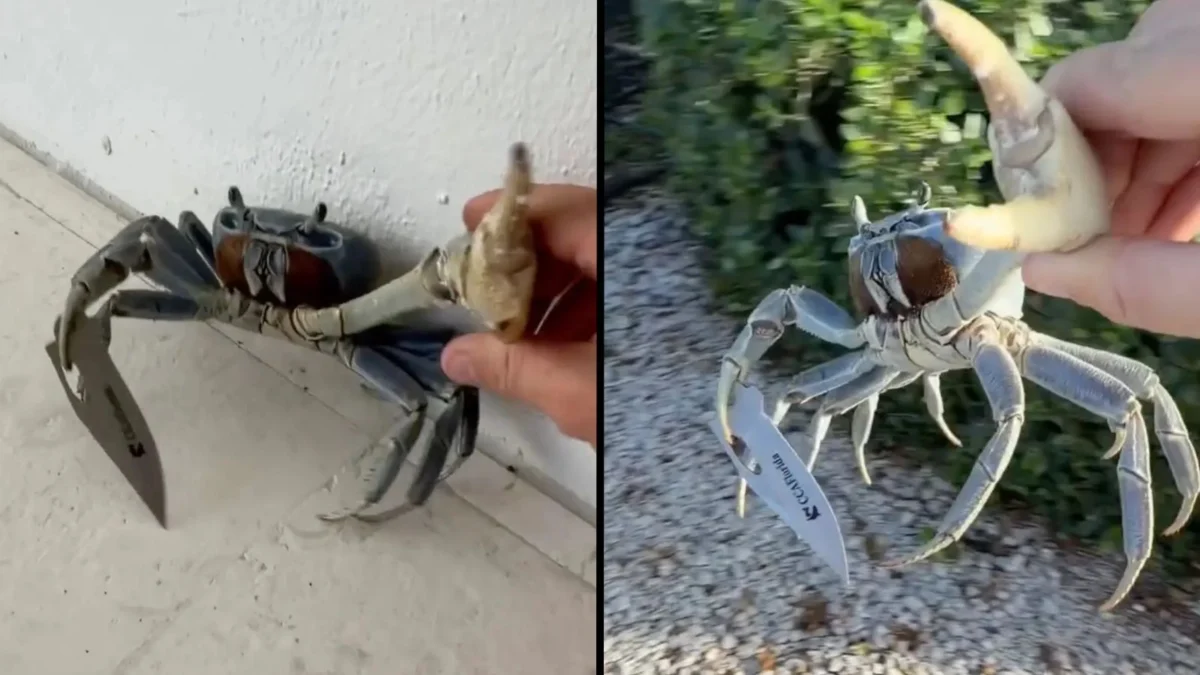
A resident of Florida has captured international attention after documenting a highly unusual encounter with a crustacean that appeared to be armed with a sharp metal blade. The individual, identified as Eduardo Alvarez, shared footage of the incident on social media, sparking a massive wave of engagement and renewed discussions regarding the often-unpredictable nature of wildlife within the Florida peninsula. The video, which features Alvarez and his dog, Summer, showcases a small crab wielding what appears to be a "shank" or a small knife, leading to a tense but ultimately non-injurious standoff in a residential setting.
The incident has quickly ascended to viral status, amassing millions of views and highlighting the intersection of urban development and natural habitats in the Sunshine State. While Florida is historically known for encounters with large apex predators such as alligators and invasive Burmese pythons, the sight of a defensive crab utilizing a human-made tool has provided a unique addition to the state’s long history of bizarre animal interactions.
Detailed Chronology of the Incident
The encounter took place on or shortly before September 16, when Alvarez was walking his dog, Summer, near his home. According to the footage and accompanying captions, the dog was the first to notice the crustacean, which was seeking shelter beneath a door frame or similar architectural crevice. Upon investigating what his pet had discovered, Alvarez realized that the animal was not merely a standard crab but was actively grasping a metal object resembling a small blade or a discarded piece of cutlery.
In the recorded video, Alvarez expresses immediate disbelief, questioning how the animal came to possess such an object. The crab, appearing to be in a defensive posture, brandished the blade toward both the dog and the camera. Alvarez can be heard in the recording advising his dog to remain at a distance, referring to the animal as a "gangster-ass crab" and remarking on the absurdity of the situation.
As the confrontation progressed, Alvarez attempted to dislodge the blade from the crab’s pincers to prevent injury to his pet or the animal itself. The crab resisted, taking several swipes with the weapon before Alvarez was eventually able to move the creature from its hiding spot. The video concludes with the crab still in a defensive stance, though the immediate threat to the household was mitigated.
Viral Reception and Social Media Metrics
Since its upload to Instagram on September 16, the video has achieved staggering reach across multiple digital platforms. As of current reporting, the post is nearing 20 million views and has garnered approximately 1 million likes. The comment sections have become a hub for humor, skepticism, and cultural commentary.
The phrase "Mess with crabby, you get stabby" became a recurring theme among viewers, reflecting a common internet meme structure used for defensive animals. Other users pointed to the event as a quintessential "Florida Man" story—a cultural trope that characterizes the state as a location for eccentric and often dangerous occurrences involving local residents and wildlife.
However, the viral nature of the post also invited scrutiny. A segment of the audience questioned the authenticity of the encounter, suggesting that the blade may have been intentionally placed in the crab’s claw to generate social media engagement. Alvarez has not officially commented on these allegations of staging, though the biological mechanics of the crab’s grip suggest that such a scenario is physically possible, whether the interaction was accidental or orchestrated.
Biological and Behavioral Analysis of the Encounter
From a zoological perspective, the behavior exhibited by the crab, while appearing "human-like" in its use of a tool, is rooted in the natural defensive instincts of decapod crustaceans. Crabs, particularly species found in Florida such as the Blue Crab (Callinectes sapidus) or various species of land crabs, possess powerful chelae (pincers) designed for crushing prey and defending against predators.
The anatomy of a crab’s pincer involves a fixed finger and a movable dactyl, operated by strong adductor muscles. These muscles are capable of exerting significant pressure and, more importantly, can maintain a "lock" on an object for extended periods. If a crab encounters an object that fits within its grasp while in a state of agitation or fear, its reflex is to clamp down firmly. In a residential environment where litter or small tools may be present, it is entirely plausible for a crab to seize a discarded blade. Once the object is held, the crab’s natural movement—raising its claws to ward off threats—creates the appearance of a deliberate "stabbing" motion.
While crabs are not known for tool use in the same manner as primates or certain bird species, they are highly reactive to their environment. The presence of a dog, which the crab would perceive as a large predator, would trigger a maximum defensive response. The added weight and reach of the metal object, while likely accidental in its acquisition, served to enhance the crab’s defensive radius during the encounter with Alvarez and Summer.
Florida’s Unique Wildlife Landscape
The incident serves as a reminder of the complex ecosystem within Florida, where human infrastructure frequently overlaps with wild habitats. The Florida Fish and Wildlife Conservation Commission (FWC) manages thousands of species, many of which have adapted to suburban living.
To provide context to the "strangeness" of the crab incident, one must look at the broader data regarding animal encounters in the state:
- Alligator Interactions: Florida is home to an estimated 1.3 million alligators. The FWC’s Statewide Nuisance Alligator Program (SNAP) handles thousands of calls annually regarding alligators in pools, garages, and backyards.
- Invasive Species: The state spends millions of dollars annually to manage invasive species like the Burmese python and the Green Iguana. The annual "Python Challenge" is a high-profile event designed to incentivize the removal of these snakes from the Everglades.
- Crab Populations: Florida’s coastline and inland waterways support a massive population of crabs. The commercial blue crab industry alone is a significant economic driver, but the proximity of these animals to residential zones often leads to interactions with pets and humans.
The prevalence of such encounters has fostered a specific cultural identity for the state, where residents are often seen as being desensitized to wildlife that would cause alarm in other regions. This sentiment was echoed by social media commenters who noted that Alvarez’s reaction—laughing while attempting to disarm the crab—was a "signature Florida" response.
Implications for Public Safety and Animal Welfare
While the video was largely received as entertainment, it raises pertinent questions regarding public safety and the ethics of wildlife interaction for social media content. Experts in animal behavior generally advise against engaging with wildlife that appears agitated. In this instance, the risk of injury to the dog, Summer, was elevated due to the presence of the blade.
Furthermore, the "viral video" economy has created incentives for individuals to capture increasingly dramatic footage of animals. If the incident was indeed staged, it would represent a violation of ethical guidelines regarding the treatment of wildlife, as forcing an animal into a high-stress confrontation for entertainment can have physiological repercussions for the creature. If the encounter was genuine, it serves as a cautionary tale about the disposal of sharp objects in areas where wildlife may scavenge.
Institutional Responses and Broader Impact
Local authorities and wildlife experts have used similar viral moments in the past to educate the public on "living with wildlife." The FWC frequently issues guidelines urging residents to secure trash, keep pets on leashes in wildlife-prone areas, and avoid feeding or harassing wild animals.
The broader impact of the "knife-wielding crab" story lies in its ability to captivate a global audience through the absurdity of its premise. In an era of digital media saturated with complex news cycles, stories involving anomalous animal behavior often serve as a form of "digital folklore." This specific event contributes to the ongoing narrative of Florida as a frontier where the boundaries between the civilized world and the wild are perpetually blurred.
As the video continues to circulate, it remains a testament to the power of social media to turn a brief, backyard encounter into a global conversation. Whether viewed as a humorous anomaly, a biological curiosity, or a staged performance, the "gangster-ass crab" of Florida has secured its place in the annals of internet history, reminding viewers that in the Florida wilderness, even the smallest inhabitants can put up a formidable fight.




 Yuyun Lusiyani
 Joko Widodo
 Jia Lissa
 admin
admin
