
 Yuyun Lusiyani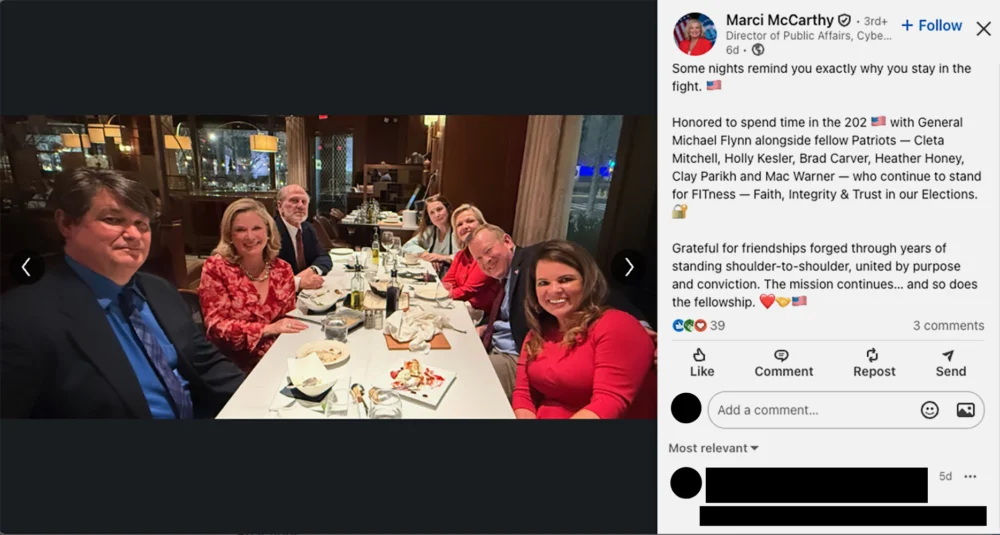
A recent summit in Washington D.C. brought together several high-ranking federal election officials and prominent figures associated with efforts to challenge the 2020 presidential election results, where discussions centered on urging the president to declare a national emergency to assert federal control over the upcoming midterm elections. The gathering, held last week, has drawn significant scrutiny from election experts and pro-democracy organizations, who warn of an escalating campaign to fundamentally alter the administration and oversight of American elections.
Summit Reveals Coordinated Push for Federal Election Takeover
The February 19 roundtable discussion, hosted at a downtown Washington, D.C. office building and sponsored by the conservative Gold Institute for International Strategy, served as a nexus for both government insiders and outside activists. Key participants, identified through videos, photos, and social media posts reviewed by ProPublica, included Kurt Olsen, a White House lawyer tasked with reinvestigating the 2020 election, and Heather Honey, a Department of Homeland Security official responsible for election integrity initiatives. The event was convened by Michael Flynn, former national security adviser to President Trump, and featured Cleta Mitchell, director of the Election Integrity Network, a group known for propagating unsubstantiated claims of widespread election fraud and noncitizen voting.
The central theme emerging from the summit was a concerted push to persuade the president to take unprecedented actions, specifically declaring a national emergency, to influence the November midterms. This strategy, proponents argue, would circumvent the traditional state-level administration of elections, allowing for federal mandates that could include banning mail-in ballots and eliminating voting machines—measures that courts have largely blocked when attempted through executive orders in the past. Legislation mandating strict national voter ID requirements, also favored by this faction, has similarly stalled in Congress.
Key Figures and Their Roles
The roster of attendees underscores the blend of administration personnel and long-standing election integrity activists.
- Michael Flynn: The summit convener, Flynn has been a vocal proponent of declaring a national emergency to address what he describes as election vulnerabilities. Following the event, he posted on social media, directly addressing the president, stating, "We The People want fair elections and we know there is only one office in the land that can make that happen given the current political environment in the United States." His role highlights a continued effort to operationalize strategies rooted in the "Stop the Steal" movement.
- Kurt Olsen: As a White House lawyer charged with revisiting the 2020 election, Olsen’s presence indicates an internal administration conduit for these proposals. His involvement, alongside others, suggests a formal or informal channel for activists’ ideas to reach the highest levels of government.
- Heather Honey: A Department of Homeland Security official leading election integrity efforts, Honey’s attendance is particularly notable given DHS’s critical role in securing election infrastructure. Prior to her government appointment, Honey was a leader in Mitchell’s Election Integrity Network, raising questions about potential conflicts of interest and the blurring lines between partisan advocacy and governmental roles.
- Cleta Mitchell: A veteran conservative attorney, Mitchell’s Election Integrity Network has been at the forefront of post-2020 election challenges and continues to advocate for stringent voting restrictions based on unproven fraud allegations. Her presence signifies the deep integration of outside activist groups with administration figures.
- Clay Parikh: A special government employee at the Office of the Director of National Intelligence, Parikh is assisting Olsen with the 2020 inquiry. The ODNI stated Parikh attended in his "personal capacity," a common defense that nonetheless raises eyebrows given the nature of the discussions.
- Mac Warner: Formerly handling election litigation at the Justice Department, Warner resigned the day after the event. A Justice Department spokesperson confirmed he had not received the required ethics approval to participate, underscoring potential ethical breaches within the administration.
- Marci McCarthy: Director of communications for the nation’s cyber defense agency, which oversees election infrastructure security. McCarthy’s prior association with the Election Integrity Network, similar to Honey, points to a pattern of individuals with strong partisan ties holding critical government roles related to election oversight.
- Kari Lake: Appointed as a senior adviser to the U.S. Agency for Global Media, Lake was a featured speaker. Her unsuccessful bid to overturn her 2022 Arizona gubernatorial election loss involved collaboration with Olsen and Parikh, further linking the summit’s participants to past efforts to challenge election outcomes. Lake stated she spoke for approximately 20 minutes on "the overall importance of election integrity, a non-partisan issue that matters to all citizens," and left before other speeches.
Chronology of Escalating Coordination
The recent summit is not an isolated event but rather the latest in a series of private interactions between conservative election activists and administration officials. Emails and recordings obtained by ProPublica reveal coordination stretching back to at least last fall, much of which had not been previously reported. These interactions often involved Mitchell’s Election Integrity Network, indicating a sustained and organized effort to influence election policy from within and outside government.
For instance, just weeks after Heather Honey began her role at the Department of Homeland Security, she briefed election activists, a Republican secretary of state, and another federal official on a conference call arranged by her former boss, Cleta Mitchell. Mitchell’s introductory email enthusiastically welcomed Honey "to hear about her work for election integrity inside DHS." This "revolving door" phenomenon, where individuals transition from partisan advocacy to governmental roles affecting the very issues they advocated for, has prompted significant concern among ethics watchdogs.
Proposed Mechanisms for Federal Control
The activists at the summit explored various avenues to transform American elections, with a clear division between those advocating for incremental legal and legislative changes and those pushing for the more drastic measure of a national emergency declaration. Many participants, notably, left convinced that a national emergency was the necessary "muscular thing" for the president to do.
A draft executive order circulated by activists associated with the summit, as reported by The Washington Post, exemplifies the radical proposals under consideration. This draft outlines a federal takeover that would ban mail-in ballots and eliminate voting machines nationwide. Peter Ticktin, a lawyer who worked on the executive order and had a client at the summit, confirmed these actions were "all part of the same effort."
Patrick Byrne, former Overstock.com CEO and a significant funder of 2020 election challenge efforts, publicly stated on LindellTV that the president has "played nice" so far but "at some point… he’s got to do something, the muscular thing: declare a national emergency." Will Huff, a campaign manager for an Arkansas secretary of state candidate and advocate for eliminating voting machines, told a conservative vlogger that Olsen and other administration representatives would relay the "consensus" from the gathering, which he believed was "It’s got to be a national emergency," back to the president.
Constitutional and Legal Implications
The concept of a president declaring a national emergency to take over state-run elections raises profound constitutional questions. The U.S. Constitution explicitly grants states the authority to administer elections, with Congress having the power to "make or alter" these regulations (Article I, Section 4). A presidential declaration of national emergency, while providing the executive branch with expanded powers in certain crises, has no clear constitutional basis for unilaterally seizing control of state election processes. Such an action would almost certainly face immediate and robust legal challenges, likely being deemed an overreach of executive authority and an infringement on states’ rights and the separation of powers.

Election experts emphasize that American elections have always been decentralized by design, reflecting a commitment to federalism and preventing a single point of failure or control. "The meeting shows that the same people who tried to overturn the 2020 election have only grown better organized and are now embedded in the machinery of government," stated Brendan Fischer, a director at the Campaign Legal Center, a nonpartisan pro-democracy organization. He warned that "This creates substantial risk that the administration is laying the groundwork to improperly reshape elections ahead of the midterms or even go against the will of the voters."
Historically, national emergencies have been declared for various reasons, from economic crises to national security threats, but never to directly override state election administration. The current administration has used emergency declarations, such as for border security, but expanding this power to electoral processes would be an unprecedented and potentially dangerous precedent, experts say.
Official Responses and Justifications
Five of the six federal officials who attended the summit declined to answer ProPublica’s questions about the event.
A White House official, speaking on condition of anonymity, sought to downplay the significance of federal officials’ attendance. The official stated that their presence should not be interpreted as support for a national emergency declaration and that it is "common practice" for staffers to engage with outside advocates sharing policy ideas. The official referenced previous comments from the president denying he was considering such an emergency or had read the draft executive order, concluding, "Any speculation about policies the administration may or may not undertake is just that — speculation."
However, this stands in contrast to the president’s own public statements. He has previously "expressed an openness to a federal takeover" as a means to counter projected Republican losses in the midterms. In a recent interview, he told conservative podcaster Dan Bongino that Republicans need "to take over" elections and "to nationalize the voting." This rhetoric fuels the concerns of pro-democracy groups that the administration may indeed be receptive to such radical proposals.
Flynn’s spokesperson, when confronted with detailed questions from ProPublica, dismissively responded by texting, "LOL ‘EXPERTS.’" Mitchell did not respond to inquiries. Huff, despite advocating for a national emergency, told ProPublica that Olsen and the president would use their judgment, adding, "I believe there are steady hands around the President wanting to ensure that any action taken is, first, constitutional and legal, but also backed by evidence."
Ethical Concerns and Erosion of Guardrails
The coordination between those inside and outside the government, particularly involving officials who previously worked for or are closely aligned with advocacy groups, represents a significant "breakdown of crucial guardrails," according to election experts. The "revolving door" issue is particularly salient, as highlighted by Honey’s transition from a leadership role in Mitchell’s Election Integrity Network to a key position at DHS.
Brendan Fischer of the Campaign Legal Center noted that prior "ethics guardrails would have prevented some of the revolving door issues we’re seeing between the election denial movement and the government officials." He added that such rules "were supposed to prevent former employers and clients from receiving privileged access." The current administration has faced criticism for relaxing ethics regulations compared to previous administrations, including the first Trump administration, potentially enabling such interactions.
Marci McCarthy’s social media post about the summit further illustrates the sense of camaraderie and shared purpose among attendees. She wrote, "Grateful for friendships forged through years of standing shoulder-to-shoulder, united by purpose and conviction. The mission continues… and so does the fellowship." This sentiment, while expressing solidarity, also reinforces the perception of a tightly knit network dedicated to a specific electoral agenda, operating with access to federal decision-makers.
Broader Impact on Democratic Institutions
The ongoing efforts to challenge election outcomes, coupled with proposals for federal intervention, pose a severe threat to the stability and legitimacy of democratic institutions in the United States. Public trust in elections, already strained by persistent, unsubstantiated claims of fraud following 2020, risks further erosion. A 2023 Ipsos poll, for instance, indicated that a significant portion of the American public, particularly among one political demographic, still harbored doubts about the integrity of the electoral process, fueled by continuous narratives questioning election security.
The prospect of a president attempting to seize control of elections through a national emergency declaration could trigger an unprecedented constitutional crisis, potentially leading to widespread civil unrest and legal battles that could paralyze the government. It would also set a dangerous precedent, inviting future administrations to similarly circumvent democratic norms and legal frameworks under the guise of "election integrity."
As the midterm elections approach, the activities documented at this summit underscore an intensifying, coordinated campaign to reshape the foundational processes of American democracy. The confluence of high-ranking federal officials and committed activists, united by a shared history of challenging election results, signals a critical moment for the future of electoral governance in the United States. The responses from the White House and individual officials, while seeking to downplay the severity, do little to assuage the deep concerns raised by pro-democracy advocates and constitutional scholars about the integrity and future of American elections.

 Jia Lissa
 Joko Widodo
 Eva Lovia

 Pevita Pearce