
 Jia Lissa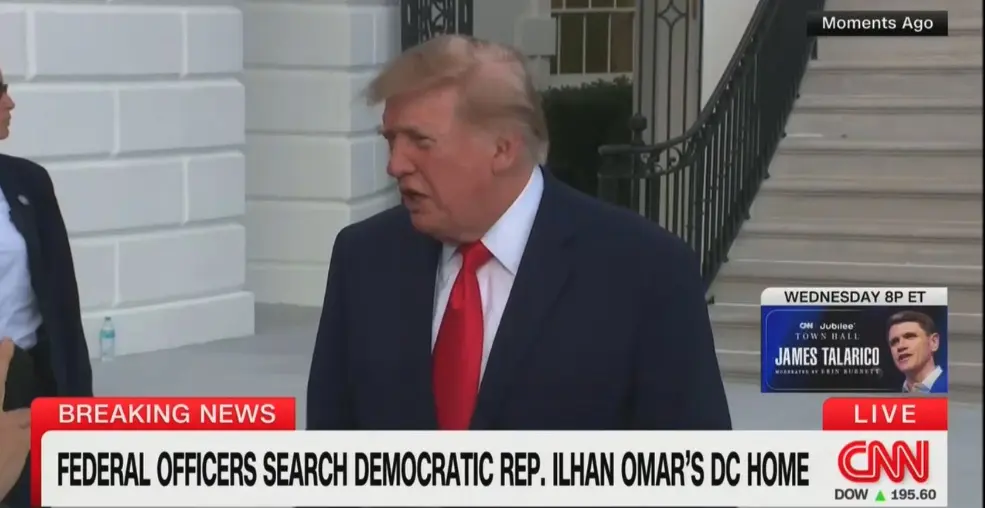
Early Monday morning, federal agents from Homeland Security Investigations conducted a search of the Washington, D.C., residence of Representative Ilhan Omar, a development that has significantly intensified the ongoing friction between the executive branch and prominent members of the congressional opposition. The raid, which reportedly began in the dawn hours, is part of a broader investigation into allegations surrounding the congresswoman’s late father, Nur Omar Mohamed. Specifically, investigators are examining whether Mohamed provided misleading information or committed fraud on legal documents during the 1990s when he sought and eventually obtained legal status and citizenship in the United States.
While the Department of Justice has remained largely silent on the specific evidence precipitating the search warrant, the timing and nature of the raid have sparked a firestorm of political debate. Representative Omar, a Democrat representing Minnesota’s 5th District and a frequent target of presidential criticism, immediately characterized the action as a politically motivated abuse of federal resources. In a statement released via social media, Omar accused President Donald Trump of attempting to "weaponize federal law enforcement" against his political rivals, asserting that she would not be intimidated or silenced by what she termed "rogue" tactics.
Details of the Federal Investigation and Search Warrant
The search of the congresswoman’s home was executed by agents attached to Homeland Security Investigations (HSI), the investigative arm of the Department of Homeland Security. According to sources familiar with the matter, the probe is centered on decades-old immigration records. Nur Omar Mohamed, who passed away in 2020 due to complications from COVID-19, arrived in the United States in the 1990s after fleeing the civil war in Somalia.
The investigation seeks to determine if there were discrepancies in the biographical data provided during his asylum application or subsequent naturalization process. While federal investigations into immigration fraud are not uncommon, the decision to execute a physical search warrant on the home of a sitting member of Congress for the alleged actions of a deceased relative is a rare and highly scrutinized legal maneuver. Legal experts note that for a federal judge to sign off on such a warrant, the government would have had to demonstrate probable cause that evidence of a crime was located specifically within the D.C. residence.
Presidential Response and Rhetoric
Hours after the news of the raid broke, President Trump addressed the situation during a scheduled press briefing. When asked by reporters if he had prior knowledge of the operation or if he had directed the Department of Justice to target the congresswoman, the President denied any direct role while simultaneously launching a verbal critique of Representative Omar.
"I understand they’re looking at her very carefully," the President stated. "I’ve always found her to be totally crooked, personally. But that has nothing to do with me. I think she’s a terrible person, just a complainer."
The President continued his remarks by criticizing Omar’s background and her criticisms of the U.S. government. "She comes from a country that is a non-country. And then she comes over here and she complains about our Constitution. I think she’s a terrible person. But that’s really up to the DOJ. I have nothing to do with it."
The President’s reference to Somalia as a "non-country" reflects a recurring theme in his rhetoric regarding the failed state status of the East African nation during its long period of civil strife. However, critics argue that such language serves to de-legitimize the citizenship and service of Somali-Americans who have sought refuge in the United States.
A History of Escalating Tensions
The raid on Monday is the latest flashpoint in a long-standing conflict between the President and Representative Omar. For years, the President has frequently singled out Omar, along with other members of the progressive "Squad," as being "un-American."
Throughout the current election cycle and the preceding years, the President has repeatedly amplified unsubstantiated claims regarding Omar’s personal life, including the debunked conspiracy theory that she married her brother to circumvent immigration laws—a claim for which no credible evidence has ever been produced.
Furthermore, the President has often linked Omar to broader issues within the Somali-American community in Minnesota. This includes frequently citing federal fraud cases, such as the "Feeding Our Future" scandal, where dozens of individuals were implicated in a massive scheme to defraud pandemic-era food aid programs. While Omar has not been legally linked to those specific fraud cases, the President has used the incidents to frame the entire community and its representatives as a threat to the state’s integrity.
Just days before the raid, during a rally and in subsequent posts on Truth Social, the President urged residents of Minnesota to "fight back" against their Somali-American neighbors. "The Somalians should not be allowed to get away with what they are doing," the President posted. "They view you as weak and stupid people. Fight back Minnesota, fight back!"
Congressional and Democratic Reaction
The search of a congresswoman’s home has unified many in the Democratic caucus, who view the move as a dangerous precedent. House leadership issued statements expressing concern over the independence of the Department of Justice and the Department of Homeland Security.
"This is a transparent attempt to use the machinery of the state to harass a political opponent," said one senior Democratic aide. "To go after a member of Congress over her deceased father’s paperwork from thirty years ago, in the middle of an election cycle, is an unprecedented use of federal power."
Supporters of the congresswoman argue that the investigation is a "fishing expedition" designed to produce negative headlines rather than legitimate legal outcomes. They point to the fact that the subjects of the investigation—immigration documents from the 1990s—are typically handled through administrative reviews rather than high-profile residential raids.
Chronology of Recent Events
The timeline leading up to the Monday morning raid suggests a period of heightened federal activity and presidential focus on the state of Minnesota and its Somali-American population:
- October 8, 2026: President Trump delivers a speech in Minnesota, alleging that the state has been "robbed" by its immigrant populations and specifically citing the Somali community.
- October 10, 2026: The President posts a series of messages on Truth Social, calling for Minnesotans to "fight back" and claiming the Somali community views the local population as "weak."
- October 12, 2026 (4:30 AM): HSI agents arrive at Representative Omar’s Washington, D.C., residence with a search warrant.
- October 12, 2026 (9:00 AM): News of the raid breaks nationally, prompting immediate condemnation from Democratic leaders.
- October 12, 2026 (11:30 AM): During a press availability, President Trump denies involvement in the raid but reiterates his personal disdain for Omar, calling her "crooked."
Supporting Data on Immigration Investigations
While the raid on Representative Omar is unique due to her status as a public official, federal investigations into naturalization fraud have seen a shift in priority over the last decade. Data from U.S. Citizenship and Immigration Services (USCIS) and HSI show a fluctuating emphasis on "denaturalization" cases.
Under various administrations, task forces have been established to review historical files for evidence of fraud, willful misrepresentation, or the concealment of material facts during the naturalization process. However, the vast majority of these cases involve individuals accused of human rights violations in their home countries or those involved in organized crime. It is statistically rare for such investigations to result in the search of a primary residence for documents related to a deceased relative unless there is a belief that the living occupant is currently engaged in ongoing criminal activity related to those documents.
Implications for the Political Landscape
The legal proceedings against the Omar family are expected to have significant implications for the upcoming legislative session and the broader political climate in the United States. If the Department of Justice proceeds with charges or further investigative steps, it could lead to a protracted legal battle over the limits of executive power and the protections afforded to members of Congress.
Analysts suggest that the President’s rhetoric, combined with the visible action of federal law enforcement, is intended to mobilize his base by highlighting issues of immigration and national identity. Conversely, for the Democratic party, the event serves as a rallying cry regarding the protection of democratic norms and the prevention of the "weaponization" of the DOJ.
As of Monday afternoon, Representative Omar’s legal team has indicated they are reviewing the warrant and the conduct of the agents. They have maintained that the congresswoman has always been in full compliance with the law and that her father’s legacy is being unfairly tarnished for political gain.
The Department of Homeland Security has not yet released an official statement regarding the items seized during the search or the expected duration of the investigation. As the story develops, the focus remains on the intersection of decades-old immigration records and the current, highly charged political environment of 2026.



 Yuyun Lusiyani
 Ana Megawati
 Joko Widodo
 Eva Lovia
 Pevita Pearce