
 Jia Lissa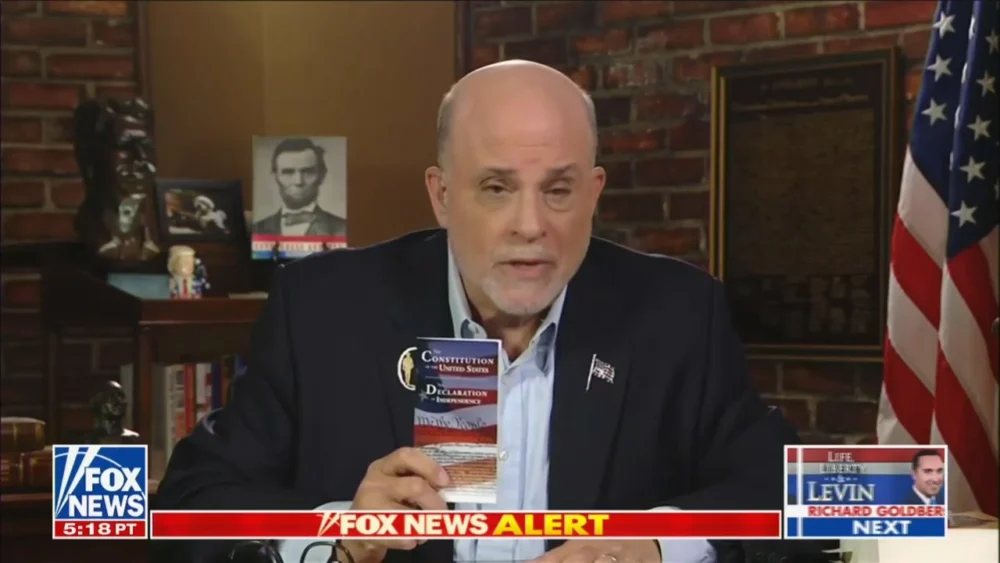
Fox News host Mark Levin has forcefully rejected reports suggesting a significant divide within the "Make America Great Again" movement regarding President Donald Trump’s military actions against Iran. During a Saturday broadcast of his program, Life, Liberty, & Levin, the conservative commentator characterized those claiming a base-level rebellion as "nut jobs" and "neofascists," insisting that the overwhelming majority of the president’s supporters remain steadfastly behind his foreign policy decisions. The comments come amidst a burgeoning rhetorical war between high-profile media figures on the right, highlighting a deepening ideological rift within the Republican ecosystem over the United States’ role in the Middle East.
Levin’s remarks were specifically aimed at a growing narrative in mainstream and independent media suggesting that Trump’s recent escalation with Tehran, dubbed "Operation Epic Fury," has alienated the isolationist wing of his constituency. Without naming specific individuals, Levin dismissed the "MAGA Split" headlines as media fabrications intended to weaken the president’s political standing. He asserted that internal polling—the source of which he did not specify—shows 92% of the MAGA base supports the administration’s actions. He further marginalized dissenters as peripheral figures with "little audiences" who do not represent the broader movement.
The Ideological Collision Within the Conservative Media
The friction within the Republican base is not merely a product of external media reporting but is reflected in the divergent views of some of the most influential pundits in conservative circles. While Levin has framed the military operation as a "peace mission" intended to liberate the Iranian people, other prominent voices have expressed deep skepticism. Tucker Carlson, a leading proponent of the "America First" non-interventionist doctrine, argued earlier in the week that the conflict was being pursued not for American interests, but because "Israel wanted it to be waged."
This sentiment was echoed by Megyn Kelly, who explicitly named Levin, Ben Shapiro, Senator Lindsey Graham, and billionaire donor Miriam Adelson as the primary drivers behind the escalation. Kelly’s critique suggested that the president’s "arm was twisted" into attacking Iran, describing the situation as "clearly Israel’s war." The public nature of this disagreement represents a rare moment of open hostility between figures who generally align on domestic policy but find themselves at odds over the geopolitical implications of military intervention.
Levin’s rebuttal on Saturday served as a defense of the interventionist wing of the party. By labeling critics as "neofascists," Levin attempted to distance the mainstream MAGA movement from the isolationist rhetoric that has gained traction on platforms like X (formerly Twitter) and alternative news outlets. He argued that the elimination of Iranian leadership was a necessary step toward regional stability, a view that contrasts sharply with the "forever war" skepticism that defined much of Trump’s 2016 campaign rhetoric.
Operation Epic Fury: Chronology and Context
The military action at the heart of this controversy, referred to as Operation Epic Fury, involved a series of high-precision strikes that reportedly resulted in the death of Iranian Supreme Leader Ali Khamenei and several other high-ranking officials within the Iranian Supreme Council. The operation was launched following a period of escalating tensions and intelligence reports suggesting an "imminent threat" to American assets in the region.
The timeline of the escalation began several weeks prior with a series of proxy attacks on U.S. installations, which the White House attributed directly to Tehran’s orders. Following a breakdown in back-channel negotiations, President Trump authorized the strikes, a move that his administration defended as a preemptive measure to prevent a wider conflict.
- Initial Escalation: Intelligence reports indicated that Iranian-backed forces were preparing for a large-scale offensive against U.S. diplomatic and military personnel.
- The Strike: U.S. forces executed Operation Epic Fury, targeting the heart of the Iranian leadership structure.
- The Fallout: While the administration celebrated the mission’s tactical success, it immediately sparked a domestic debate over executive overreach and the potential for a protracted ground war.
- The Media Response: Levin and other hawks praised the move as a masterstroke of "peace through strength," while Carlson and Kelly warned of the consequences of entanglement in Middle Eastern sectarian strife.
Statistical Analysis of Public and Partisan Sentiment
Despite Levin’s claim of 92% support within the MAGA movement, broader polling data suggests a more complex and polarized landscape. An NBC News poll conducted shortly after the strikes found that 77% of self-identified Republicans supported Operation Epic Fury. While this indicates a strong majority, it falls short of the near-unanimous consensus suggested by Levin. Conversely, the same poll showed that 89% of Democrats opposed the military action, illustrating the deep partisan chasm that continues to define American foreign policy.
Further data from a PBS News/Marist poll released on Friday provided a more comprehensive look at the national mood. That survey found that 56% of all Americans oppose U.S. military action in Iran. Within the Republican subgroup of the PBS/Marist poll, 84% expressed support for the strikes that killed Ali Khamenei, while 86% of Democrats remained in opposition. The data suggests that while the Republican base is largely unified, there is a significant minority—roughly 15% to 23%—that remains skeptical or outright opposed, a group that may align with the isolationist views espoused by Carlson and Kelly.
The discrepancy between Levin’s "92%" figure and the 77-84% range found in traditional polling highlights the difficulty of quantifying the "MAGA" base as a distinct entity from the broader Republican Party. It also underscores the tactical use of polling data by media figures to bolster their respective narratives.
Official White House Responses and the "Forced Hand" Narrative
President Trump has personally addressed the allegations that foreign interests or domestic hawks dictated his military strategy. During a press encounter with ABC’s Rachel Scott, the president was asked directly if Israel had "forced his hand" into authorizing the attack. Trump dismissed the notion as "ridiculous," suggesting instead that the dynamic was the opposite.
"No, I might’ve forced their hand," Trump told Scott. He explained his rationale by stating that negotiations with the Iranian leadership had reached a dead end and that his administration believed an Iranian attack was inevitable. "It was my opinion that they were going to attack first… They were going to attack if we didn’t do it. I felt strongly about that."
This "preemptive strike" justification has been the cornerstone of the administration’s public relations effort. By framing the operation as a defensive necessity rather than an optional war of choice, the White House has attempted to bridge the gap between its "America First" promises and the reality of high-stakes military intervention. However, this explanation has done little to satisfy critics who argue that the intelligence justifying the "imminent threat" has not been sufficiently shared with Congress or the public.
Broader Implications for the MAGA Movement and U.S. Foreign Policy
The internal strife highlighted by Mark Levin’s comments points to a broader identity crisis within the modern conservative movement. Since 2016, the Republican Party has undergone a transformation from the neoconservative interventionism of the George W. Bush era to a more populist, skeptical approach to foreign entanglements. The conflict with Iran serves as a litmus test for whether the "America First" movement can coexist with traditional hawkishness toward "rogue states."
If Levin’s assessment is correct and the dissenters are merely a handful of "nut jobs," then the president maintains a clear mandate from his base to continue an aggressive posture in the Middle East. However, if the skepticism voiced by Carlson and Kelly resonates with a larger-than-admitted portion of the electorate, the administration could face a fractured coalition heading into future election cycles.
The strategic implications are equally significant. A decapitated Iranian leadership creates a power vacuum that could lead to either the "liberation" Levin envisions or a chaotic descent into civil war and regional instability. The administration’s ability to manage the aftermath of Operation Epic Fury will likely determine whether the MAGA base remains unified or if the "split" Levin so vehemently denies becomes a political reality.
For now, the war of words on the airwaves continues. Levin’s insistence on total unity reflects a desire to project strength and resolve, but the underlying tensions suggest that the debate over the U.S. role in the world is far from settled within the Republican ranks. As the dust settles on the strikes in Tehran, the focus remains on whether the "peace mission" described by proponents will deliver the promised stability or if it will ignite the very "forever war" that the MAGA movement originally pledged to avoid.


 Yuyun Lusiyani
 Joko Widodo
 Eva Lovia
 Pevita Pearce